"If institutions fail to do their job, we see the shadow economy flourishing," - says Anna Derevianko

Boris Bodnar
Boris Bodnar Journalist
"If institutions fail to do their job, we see the shadow economy flourishing," - says Anna Derevianko
Anna Derevianko Photo: EBA
Anna Derevianko stated that over 40% of Ukraine’s economy operates in the shadow economy. And due to a relaxation of controls, grey-market schemes have even spread to the healthcare sector. Yet it is precisely the formalisation of the economy that would make it possible to avoid tax increases.

The EBA’s Executive Director made this point in an interview with RBC Ukraine.

“There are no separate statistics within the EBA, but we tend to agree with what the government and analysts are saying. The size of the shadow sector is certainly no smaller than the official figure. We say this based on our gut feeling and what we hear from businesses – it varies across sectors, but the figures are more or less accurate,” noted Anna Derevianko.

According to her, the main reason for the growth of the shadow economy is the result of the ineffective work of fiscal and law enforcement agencies.

“If institutions do not do their job properly, we see a shadow economy that thrives. Then it makes more sense not to pay taxes than to pay them, because it is easier to bribe your way out of it. The formal business sector, which is in the open, becomes an easier target for inspections than the shadow economy.
When state institutions make the right choices in terms of statehood and upholding the law, there will be less tax evasion,” the EVA director is convinced.

She emphasised that the transition from the shadow economy would be faster and more effective if state bodies and law enforcement agencies encouraged the move from the shadow to the formal sector: preventively making it impossible to choose the shadow economy, and, on the other hand, prevented people from illegally exploiting loopholes in the law.

Anna Derevianko also noted that in most cases the issue lies not with the legal provisions themselves, but with their enforcement. As long as enforcement remains at a low level, the share of the shadow economy will continue to grow, as is currently the case.

“It certainly hasn’t shrunk. Companies feel that it certainly hasn’t shrunk. This can be explained by various reasons. In 2022, there was a shock – everyone was adapting to the new conditions. Under such conditions, there was certainly less oversight. When there is less oversight, there is more scope for the shadow economy to develop. When the state prioritises combating the shadow economy in a particular sector and law enforcement agencies target the shadow economy, legitimate businesses feel the impact. “The figures have certainly not gone down,” says the representative of the European Business Association.

It should be recalled that Danylo Getmantsev, Chairman of the Verkhovna Rada Committee on Finance, Tax and Customs Policy, stated that parliamentarians are dissatisfied with the slowdown in the de-shadowing of the economy, and that instead of delivering tangible results, the Economic Security Bureau is “feeding” the public with presentations and manipulating figures in its reports.

Follow us on Telegram

Share tittle
Economy
Reports are emerging from Crimea of food shortages and restrictions on sales in shops
Economy

Reports are emerging from Crimea of food shortages and restrictions on sales in shops

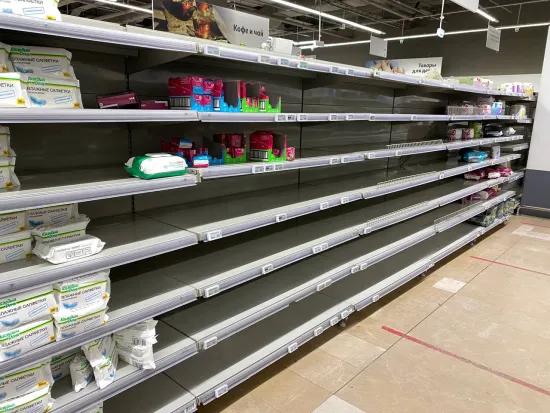
In the temporarily occupied Crimea, local residents are increasingly reporting that essential goods are disappearing from shop shelves. A number of retail chains have already introduced restrictions on the sale of certain items to a single customer.

09.06.2026
The government has allocated 2.3 billion hryvnias to prepare schools and universities for winter
Economy

The government has allocated 2.3 billion hryvnias to prepare schools and universities for winter

The Cabinet of Ministers has allocated 2.3 billion hryvnias to support schools, colleges and universities ahead of the 2026/2027 heating season. The funds will be used for backup power supplies, energy independence, utilities, shelter and the restoration of damaged buildings.

09.06.2026
Yemeni Houthis have announced a blockade of the Red Sea — targeting Israel
Economy

Yemeni Houthis have announced a blockade of the Red Sea — targeting Israel

The Iranian-backed Yemeni group Ansar Allah, known as the Houthis, has announced a blockade of shipping in the Red Sea for Israeli vessels.

08.06.2026
Ukraine has received the seventh tranche of €2.8 billion under the Ukraine Facility programme
Economy

Ukraine has received the seventh tranche of €2.8 billion under the Ukraine Facility programme

On 8 June, Ukraine received the seventh tranche of funding from the European Union, totalling €2.8 billion, as part of the Ukraine Facility programme.

08.06.2026
The National Anti-Corruption Bureau of Ukraine (NABU) has concluded its internal investigation into possible breaches of the law in the ‘Clean City’ case, which was overseen by Oleksandr Tsyvinskyi
Economy

The National Anti-Corruption Bureau of Ukraine (NABU) has concluded its internal investigation into possible breaches of the law in the ‘Clean City’ case, which was overseen by Oleksandr Tsyvinskyi

The National Anti-Corruption Bureau of Ukraine (NABU) has concluded an internal investigation into possible breaches of the law by Ruslan Magamedrasulov, head of the bureau’s detective unit. He had previously been accused of receiving funds in exchange for helping to avoid prosecution for Volodymyr Solonchak, who featured in Komarnytskyi’s recordings in the “Clean City” case. At the time, the investigation was overseen by the current director of the Economic Security Bureau of Ukraine, Oleksandr Tsyvinskyi.

08.06.2026