The State Duma has authorised Putin to deploy the army abroad to protect Russian citizens

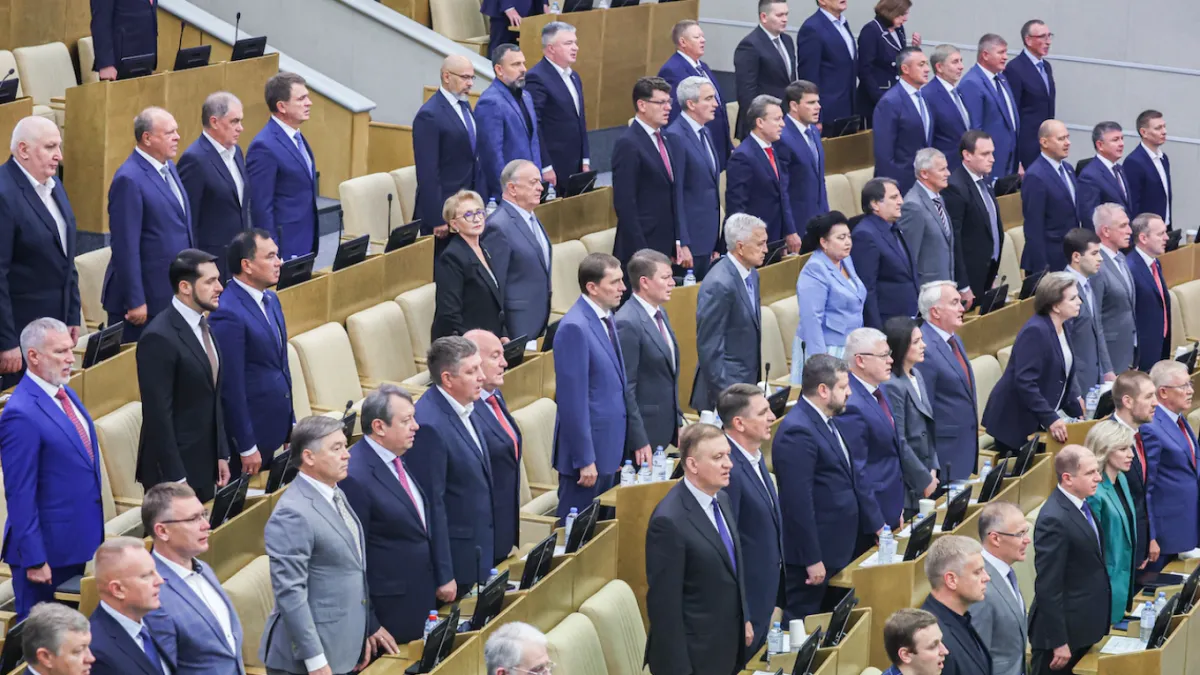
On Wednesday, the Russian State Duma passed a law in its second and third readings that significantly expands the president’s powers regarding the use of the armed forces abroad, reports The Moscow Times.
The bill amends the federal laws “On Citizenship” and “On Defence”. From now on, Vladimir Putin will be able to deploy the army to “protect Russian citizens” in cases of “their arrest, detention, criminal or other prosecution” outside Russia.
This refers to cases where Russian citizens are arrested on the basis of decisions by courts “endowed with powers without the participation of the Russian Federation”, as well as by international judicial bodies that Moscow does not recognise.
The law was passed unanimously. 384 MPs voted in favour of the bill; there were no votes against or abstentions.
The explanatory note states that the law is aimed at “strengthening the protection of Russian citizens from unlawful actions by unfriendly foreign states”.
The current version of the federal law “On Security” already allows the Russian president to send troops abroad if other states or international bodies adopt decisions that “contradict the interests of the Russian Federation” or “the foundations of public order” in Russia.
The explanatory note to the bill states that it was drafted “with the aim of protecting the rights of Russian citizens” in cases of arrest, detention and prosecution in the context of the enforcement of decisions by courts of foreign states and international judicial bodies whose jurisdiction Russia does not recognise. Among the examples cited are court decisions in The Hague.
In March 2023, the International Criminal Court issued an arrest warrant for Vladimir Putin on charges of the forced deportation of children from Ukraine. A warrant was also issued for the Children’s Rights Commissioner, Maria Lvova-Belova.
The Russian authorities adopted the decision to expand powers regarding the use of the army abroad following a series of warnings from leading NATO countries about the Kremlin’s preparations for a possible conflict with European states.
In the summer, the head of the German intelligence service, the BND, warned of the risk of Russian provocation in the Baltic states following the scenario of the annexation of Crimea. In February, Danish intelligence stated that Russia was capable of launching a large-scale war in Europe within five years.
In March 2026, US intelligence warned that Vladimir Putin might resort to a “deliberate escalation” of the war in Ukraine, potentially leading to a direct confrontation with NATO, including the threat of nuclear weapons.
According to Dutch intelligence agency MIVD, the Kremlin may need around a year to build up sufficient forces for a “regional conflict” with NATO. The MIVD believes that the aim of a possible Russian attack may not be the military defeat of the Alliance, but “political division through limited territorial gains”. The intelligence agency also does not rule out the use of nuclear blackmail.
Experts at the Institute for the Study of War wrote in October that the “zero phase” of preparations for such a war in Russia had already begun. Among the signs they cited were the reorganisation of military districts on Russia’s western border, the establishment of military bases near the border with Finland, sabotage, interference with electronic warfare systems, GPS jamming, arson and aerial provocations.