France is launching the DANAE programme for armed maritime drones

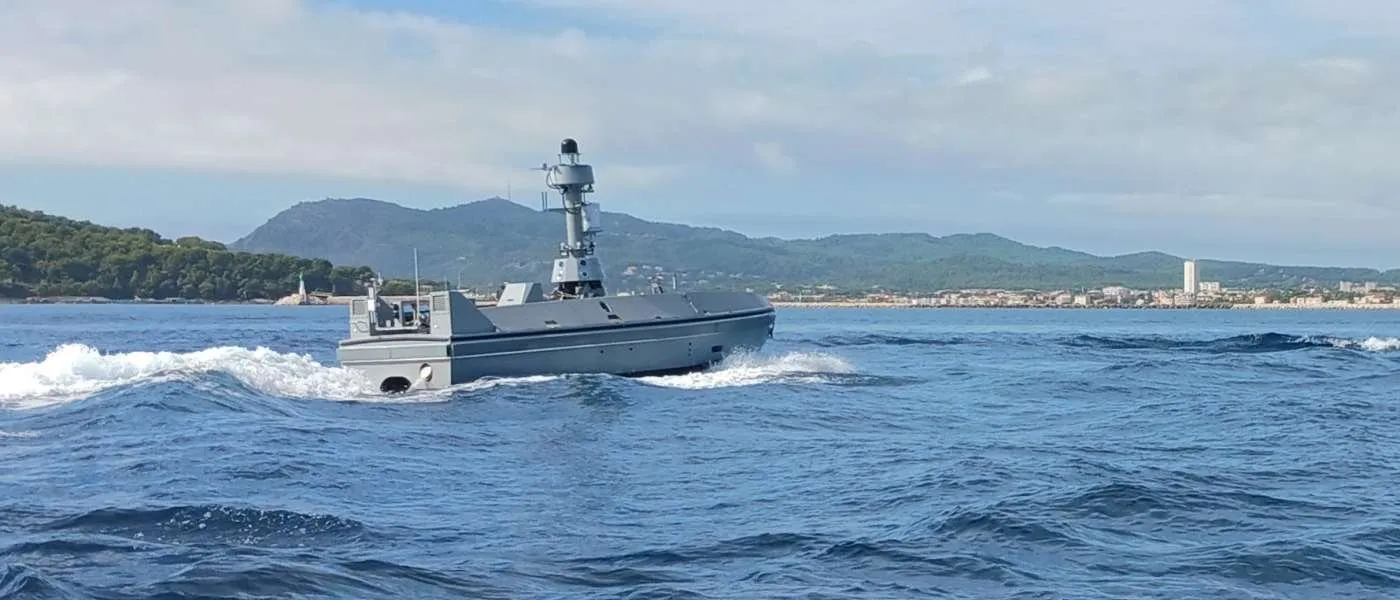
This is according to BFMTV.
France is launching the DANAE programme – the production and deployment of armed surface drones – in response to the growing role of drones in modern conflicts. The aim is to develop its own unmanned maritime systems for the navy.
The text notes that the name DANAE is a kind of pun. In Ukrainian, it can be interpreted as “Danae” – the name of Perseus’s mother. At the same time, according to BFMTV reporters, the acronym itself stands for the full name of the project – “Maritime Autonomous Surface Unmanned Vessel with the capability to carry weapons on board”.
To implement the programme, the French Defence Procurement Agency (AID) decided to depart from traditional military procurement practices. The Ministry of Defence of the French Republic explained that the country possesses a manufacturing sector capable of producing unmanned aerial vehicles within a geostrategic context which, in the French assessment, leaves no room for falling behind. The agency’s director, General Patrick Offort, stated that France needs to learn how to produce such equipment quickly.
What is known about the DANAE programme
Following the launch of the project competition in 2025, seven solutions are currently at the testing stage. Participating in the selection process are major defence companies, small and medium-sized enterprises, start-ups and manufacturers specialising specifically in maritime drones. Among the participants mentioned in the text are Thales, Naval Group subsidiary Sirehna, Keys4sea, SeaOwl Group, Marine Tech, SEAir, and Exail, which the article refers to as a “world champion”.
The AID has introduced a new partnership format that allows for the evaluation of ready-made solutions and the commitment to procurement following the completion of the trial period. According to Jean-François Thomas, the agency’s DANAE project manager, the three best options will be selected for the prototype development phase. This phase will last between 12 and 18 months, after which the winner is expected to receive a contract to supply the French Navy with the relevant drones. A final decision is expected by the end of 2027.
The article specifically notes that Thomas is working alongside a French Navy programme officer to ensure the final decision meets the fleet’s actual needs. The aim is not to produce a theoretical design, but operational equipment for which the need has already been clearly identified.
Why does France need these drones?
According to experts at Army Recognition, the key feature of DANAE is its dual mission focus. The primary objective is the security of ports and bases, particularly in France’s overseas territories, where infrastructure is scattered and increasingly vulnerable to hostile groups and states. The second mission is the operational deployment of unmanned vessels as escort systems for frigates, patrol vessels and, possibly, the aircraft carrier “Charles de Gaulle”.
Armed variants are also being considered, though the first generation of unmanned vessels may focus primarily on reconnaissance and deterrence. To this end, the plan is to use non-lethal payloads – in particular, remote surveillance systems and active sonar for detecting underwater threats.
The programme forms part of France’s broader military spending plan under the Military Programming Law for 2024–2030. The text states that the LPM allocates €5 billion for unmanned and remotely piloted systems.
The urgency of the DANAE launch is also linked to the new model of the DGA – France’s Directorate General for Armaments. During a visit to the Naval Technical Centre in Toulon earlier this year, Minister for the Armed Forces Catherine Vautrin stated that warfare is changing and requires constant adaptation and acceleration, and therefore France must provide operational capabilities even before achieving ‘theoretical perfection’.
Alain Servet, editor-in-chief of the defence magazine AR, believes that naval warfare is entering a new era dominated by speed, intensity and stealth. The article also quotes the Chief of Staff of the French Navy, Admiral Nicolas Vauzour, who stated that unmanned systems will play an increasingly central role in operations.
If successful, DANAE will provide the French Navy with its own unmanned surface vehicles, adapted to the country’s global missions. The text also notes that this could strengthen France’s position as a pioneer in autonomous maritime defence at a time when NATO allies are facing similar threats in increasingly contested waters.
It is worth recalling that the Ukrainian company Fire Point, which manufactures the Flamingo cruise missile and long-range drones, has announced negotiations with European partners regarding the creation of a new air defence system. The company claims that it aims to reduce the cost of intercepting a ballistic missile to less than $1 million and to shoot down such a target for the first time by the end of 2027.