Trump and Xi Jinping to hold talks in Beijing
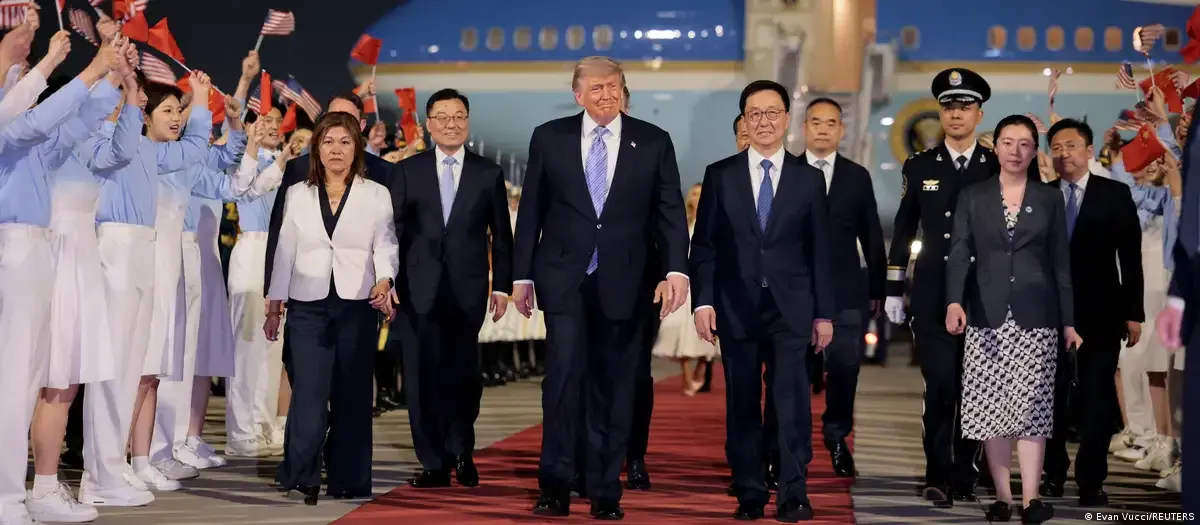
US President Donald Trump has arrived in Beijing on a state visit for talks with Chinese President Xi Jinping. The visit, originally scheduled for April, was postponed by a month and will take place from 13 to 15 May.
A report by Deutsche Welle notes that global issues, particularly economic growth and climate change, cannot currently be resolved without the involvement of the US and China. The United States remains the world’s largest economy, with China in second place. At the same time, China is the largest emitter of greenhouse gases, with the US in second place.
Beijing and Washington are convinced that the talks must not end in failure. It is expected that any agreements reached between the parties could have global significance.
Both leaders are keen to demonstrate to their citizens the results of the negotiations, which will portray them as ‘strong leaders’.
Trump needs foreign policy results
Zhu Yin, a political scientist at the Pangoal think tank and former professor at Peking University’s School of International Relations, stated that Donald Trump needs positive news on the foreign policy front ahead of the US mid-term congressional elections in November.
According to him, Trump’s approval ratings are at an all-time low, and his plan to use the situation surrounding Iran as leverage in negotiations with China has not worked.
The expert believes that Trump will now try to reach at least a partial agreement in the trade dispute that arose following the imposition of US tariffs on Chinese imports.
Ahead of the talks in Beijing, US and Chinese representatives plan to hold meetings in Seoul on 12–13 May to narrow their differences.
Taiwan remains a “red line” for China
Taiwan will remain one of the main topics of the summit. Beijing considers the island an integral part of China and emphasises that the People’s Republic of China is the sole legitimate government of China.
In the 1972 Shanghai Communiqué, the US recognised the “One China” principle. At the same time, the 1979 Taiwan Relations Act allows Washington to provide Taiwan with defensive weapons and to counter coercive pressure on the island.
Following Donald Trump’s return to the White House, Taiwan ordered $11.1 billion worth of weapons from the US in 2025. On 8 May, Taiwan’s parliament also passed a law permitting large-scale purchases of military equipment, predominantly of American manufacture. By 2033, the total value could reach $25 billion.
Beijing believes that Trump has considerable leeway within the framework of current US legislation, so the Chinese side will try to secure statements from him regarding Taiwan that are more favourable to the PRC.
China, Iran and Russia’s war against Ukraine
The situation surrounding Iran and Russia’s war against Ukraine may receive particular attention during the talks.
Peter Tsui, head of the Hong Kong Centre for Globalisation, stated that the US needs China’s support in a war against Iran. He also described China as a key player in diplomatic efforts to end Russia’s war against Ukraine.
Following Donald Trump’s visit to Beijing, Russian President Vladimir Putin is expected to arrive by the end of May.
In early May, Iranian Foreign Minister Abbas Araghchi visited Beijing and met with Chinese Foreign Minister Wang Yi. The Chinese side stated that a war by the US and Israel against Iran would cause significant harm to the region and the world.
Beijing also supported Iran’s right to the peaceful use of nuclear energy.
Furthermore, Wang Yi expressed the hope that all parties would ensure safe navigation through the Strait of Hormuz. China also holds the US partly responsible for the situation due to the temporary blockage of the passage to the Persian Gulf.
US Secretary of State Marco Rubio stated that he hopes China will send a signal to Iran that blocking the Strait of Hormuz is unacceptable.
Trade war and the possibility of a ‘big deal’
The trade conflict between the US and China will also remain at the centre of the talks.
Donald Trump has previously stated that China must increase its purchases of American goods to reduce the trade surplus.
Despite the tariffs imposed by the US, according to the US Census Bureau under the Department of Commerce, China’s trade surplus with the US stood at nearly $202 billion in 2025.
Peter Qiu stated that China is ready to buy American products but expects concessions in return, in particular the easing of restrictions on the export of American microchips for artificial intelligence technologies.
Washington had previously introduced strict export controls on the sale of advanced microchips for artificial intelligence systems.
Peter Qiu also suggested the possibility of a “major deal” that would take into account the national interests of both countries. According to him, during Vladimir Putin’s upcoming visit to Beijing, China may also discuss the terms for ending the war in Ukraine.
Follow us on Telegram