Trump has described Iran’s response to US proposals to end the war as unacceptable

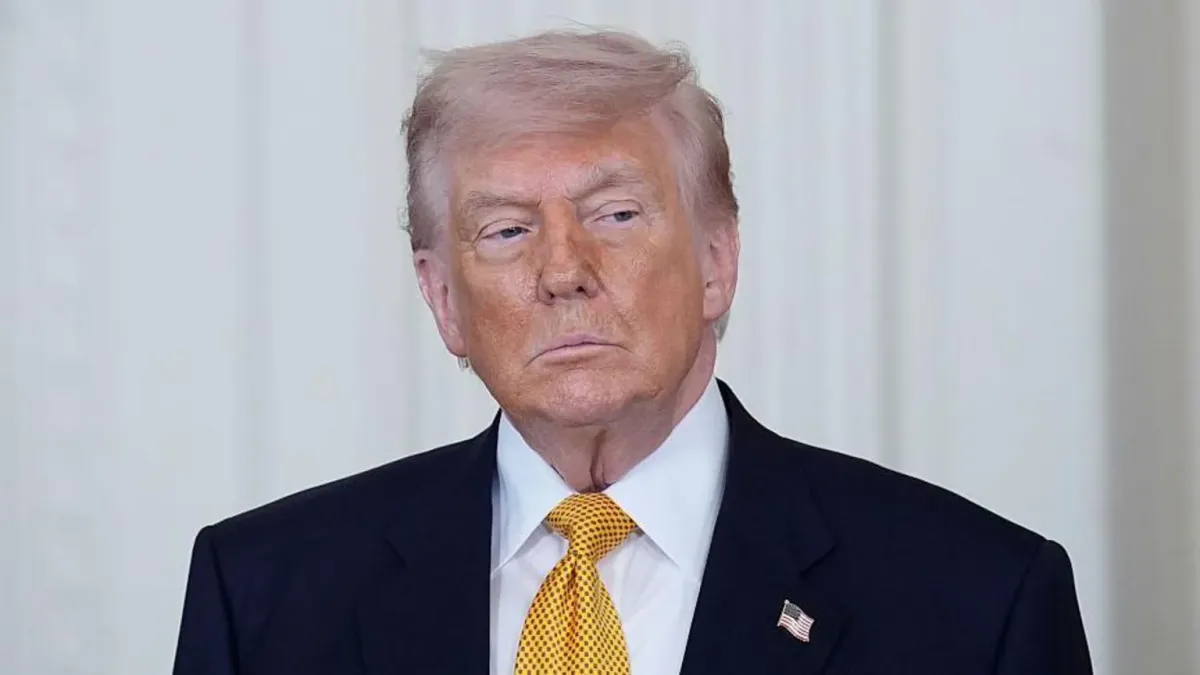
US President Donald Trump has stated that Iran’s response to American proposals to end the war is “completely unacceptable”.
The semi-official Iranian news agency Tasnim reported that Tehran had conveyed its proposals via Pakistan, which is acting as a mediator in the talks, according to the BBC.
According to the agency, Iran is demanding an immediate ceasefire on all fronts, an end to the US naval blockade of Iranian ports, and guarantees against further attacks on the country.
Despite isolated exchanges of fire, the ceasefire, which was intended to create conditions for negotiations following the start of the US and Israeli war against Iran in February, is largely being observed.
This week, Donald Trump reiterated that the war in Iran would “end quickly”.
Meanwhile, Israeli Prime Minister Benjamin Netanyahu stated that Iran’s stockpiles of enriched uranium must be “eliminated” before the war can be considered over.
“There are still uranium enrichment facilities that need to be dismantled,” Netanyahu said in an interview with the programme 60 Minutes on CBS.
Iranian state media also reported that Tehran’s proposals include a demand for compensation for war damages and an emphasis on Iran’s sovereignty over the Strait of Hormuz.
Iranian President Masoud Pezeshkian did not directly comment on the content of the proposals, but stated: “We will never bow our heads to the enemy, and when it comes to dialogue or negotiations, this does not mean capitulation or retreat.”
Donald Trump wrote on Truth Social: “I have just read the response from Iran’s so-called ‘representatives’. I don’t like it. COMPLETELY UNACCEPTABLE.”
The American publication Axios reported that the US memorandum consists of 14 points. These include the suspension of Iran’s uranium enrichment programme, the lifting of sanctions and the restoration of free navigation through the Strait of Hormuz.
The publication cited two US officials and two other sources familiar with the negotiations. According to them, many of the document’s provisions will depend on the conclusion of a final agreement.
Iran continues to block the Strait of Hormuz, which has led to a rise in global oil prices. Around 20% of the world’s oil and liquefied natural gas exports usually pass through the strait.
The US, for its part, is maintaining a naval blockade of Iranian ports in an attempt to force Tehran to agree to American terms.
Massive US and Israeli air strikes on Iran began on 28 February. A ceasefire came into effect last month.
In an interview with CBS, Benjamin Netanyahu also stated that Israel should gradually phase out US military aid.
“We receive $3.8 billion a year. I think it is time to gradually phase out military support,” he said.
Iran has also warned neighbouring states about compliance with US sanctions.
Iranian military spokesman Mohammad Akraminia stated that ships passing through the Strait of Hormuz without cooperating with Tehran would face “serious consequences”.
He also said that the US “will never be able to turn this area in the northern Indian Ocean into a real blockade using only its navy”.
The US has a significant military presence in the Persian Gulf region, including bases in Qatar, Bahrain, Kuwait, the UAE, Saudi Arabia and Oman.
On 10 May, it was reported that the Royal Navy was sending a warship to the Middle East for possible participation in an international mission to protect shipping in the Strait of Hormuz.
British Prime Minister Keir Starmer, who supports this initiative alongside French President Emmanuel Macron, stated that the mission is only possible once hostilities have ceased.
In response, Iran warned of a “decisive and immediate response” to any British or French military deployment in the strait.
Following this, Emmanuel Macron stated that France had “never considered” a naval deployment, but that the discussion had been solely about a security mission that would be “coordinated with Iran”.
Iran also carried out retaliatory strikes against US Arab allies in the region.
The UK Maritime Trade Operations Centre reported that a dry cargo ship had been struck by an “unknown projectile” approximately 43 kilometres north-east of Doha in Qatar. A small fire broke out on the vessel, but there were no casualties.
Later, the Fars news agency, citing an unnamed source, stated that the vessel “was flying the American flag and belonged to the US”.
Kuwait also reported the presence of drones in its airspace. According to the authorities, the military “responded” to the incident.
A few hours later, the UAE stated that its air defence system had intercepted two drones flying from the direction of Iran.
On 11 May, defence ministers from over 40 countries are due to hold a meeting on the British initiative to protect shipping in the Strait of Hormuz.
The meeting will be chaired by UK Defence Secretary John Healey and his French counterpart, Catherine Vautrin. It is expected that coalition members will present plans for controlling maritime traffic once hostilities have ceased.
On 6 May, Donald Trump wrote on Truth Social that if Iran does not agree to a deal, “the bombing will begin, and it will be far more extensive and intense than before”.