Trump has warned Iran that the war will be ended by force if it refuses to accept the US terms

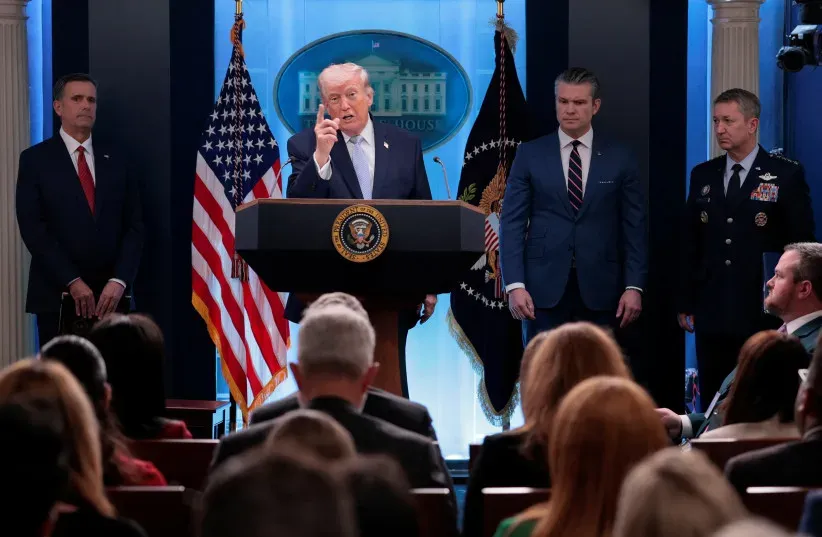
US President Donald Trump has stated that the United States will “see it through” if Iran does not agree to the American terms of a deal to end the war and resolve the issue of its nuclear programme, reports the Times of Israel.
“They will either do the right thing, or we will finish the job,” Trump said before flying to China, which maintains ties with Iran and remains a major consumer of its oil.
Trump dismissed suggestions that rising prices in the US had forced him to seek an end to the war.
“I’m not thinking about the financial situation of Americans. I’m not thinking about anyone,” he said.
“I’m thinking about one thing. We cannot allow Iran to have nuclear weapons. That’s all,” added the US president.
Ahead of his meeting with Chinese leader Xi Jinping in Beijing, Trump stated that he did not consider it necessary to involve China in resolving the conflict with Iran.
“I don’t think we need any help with Iran. We will win one way or another, peacefully or otherwise,” said Trump.
According to him, the US has the situation with Iran “under control”.
“We will either reach an agreement or they will be destroyed,” he declared.
Following reports that Pakistan had allowed Iran to station fighter jets on its territory during the war, Trump said the Pakistanis had been “wonderful” mediators.
Iranian parliamentary speaker Mohammad Bagher Ghalibaf stated that Washington must accept Tehran’s latest peace plan.
“There is no alternative but to accept the rights of the Iranian people as set out in the 14-point proposal. Any other approach will be completely fruitless, nothing but one failure after another,” Ghalibaf wrote on X.
Iran submitted its latest proposal in response to the previous US plan. Details of the American plan remain limited. According to media reports, it involved a one-page memorandum of understanding to cease hostilities and establish a framework for negotiations on Iran’s nuclear programme.
The Iranian Foreign Ministry stated that Tehran’s response called for an end to the war on all fronts, including in Lebanon, the lifting of the US naval blockade of Iranian ports, and the unfreezing of Iranian assets frozen abroad due to sanctions.
Trump called Tehran’s response “completely unacceptable” and stated that the US would achieve “total victory” over Iran. He also said that the ceasefire, which had halted hostilities for more than a month, was on the verge of collapse.
The Islamic Revolutionary Guard Corps announced that it was conducting exercises in Tehran to “strengthen its combat capability to counter any move by the American-Zionist enemy”.
Iranian Defence Ministry spokesman Reza Talai-Nik stated that if the US “does not comply with the just and final demands of the Iranian nation in the diplomatic arena, it should expect a repeat of its defeats on the battlefield”.
Trump’s reaction to Iran’s counter-proposal caused oil prices to rise and dampened expectations of a swift agreement on the resumption of commercial shipping through the Strait of Hormuz.
Iran is restricting maritime traffic in the strait and establishing a payment mechanism to collect fees from ships. The chairman of Saudi Aramco described the situation as the biggest shock to energy supplies “the world has ever seen”.
US officials have stated that it would be “unacceptable” for Tehran to maintain control over the strait, through which around a fifth of the world’s oil and natural gas supplies usually pass.
“Iran must not use this strait as a weapon to pressure or blackmail the Gulf states,” said Qatar’s Foreign Minister, Sheikh Mohammed bin Abdulrahman Al Thani.
According to the New York Times, citing US intelligence assessments, Iran still has access to 30 of the 33 missile sites along the Strait of Hormuz. This enables it to threaten ships passing through this route.
According to these assessments, the Iranian military can use mobile launchers within the sites to move missiles, and some of the sites have launch pads for firing missiles. Only three of the 33 sites near the Strait of Hormuz remain completely inaccessible.
Iran also retains around 70% of its mobile launchers across the country and 70% of its pre-war missile arsenal.