The ISW warns of the risk of Russian strikes from Belarus targeting aid routes to Ukraine

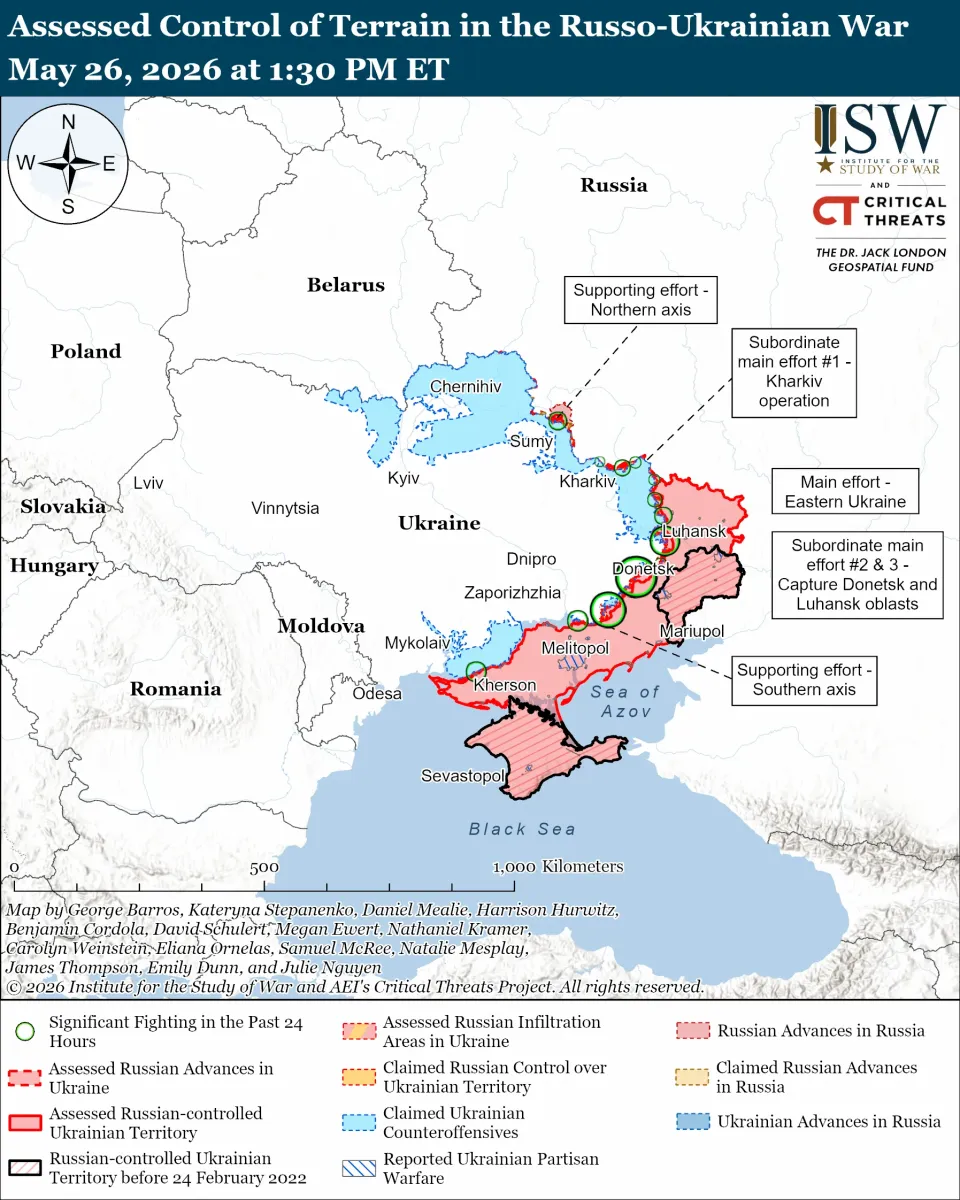
This is stated in the Institute for the Study of War’s report dated 26 May.
Analysts at the Institute for the Study of War believe that Russia and Belarus may be laying the groundwork to justify Russian drone strikes on Ukraine from Belarusian territory.
Statements by Alexander Volfovich, Secretary of the Belarusian Security Council, could serve as a pretext. On 26 May, he claimed that Belarusian forces had allegedly recorded 116 attempts by Ukrainian drones to cross the border over the past week.
Volfovich also claimed that some of these flights were allegedly directed against Belarusian border infrastructure.
The ISW notes that these statements came after warnings from Ukrainian officials about Russian pressure on Belarus to involve it in actions against Ukraine or an unnamed NATO state.
Is there a threat of a ground invasion from Belarus?
According to the ISW’s assessment, a ground invasion of Ukraine by Belarus is currently unlikely.
Analysts see no confirmed signs of a build-up of Belarusian forces near the Ukrainian border on a scale sufficient for a ground operation.
Furthermore, according to the ISW, Russia lacks the reserves necessary to support Belarusian troops in such an invasion.
Therefore, the more likely scenario is not an offensive from Belarus, but the use of its territory to launch Russian drones against Ukrainian targets.
Which routes could come under attack
The ISW warns that launching drones from Belarus could give Russia the opportunity to strike Ukrainian ground lines of communication in the western and north-western regions.
These are routes that are currently more difficult to strike from Russian territory with high precision and heavy combat payloads.
Analysts are paying particular attention to the M-06 motorway, which runs through the western regions of Ukraine, as well as the rail link between Poland and Ukraine.
These routes are of strategic importance, as they are used by Ukraine to receive aid and transport resources.
The ISW notes that launching from Belarus could allow Russia to deploy Shahed-type drones and the cheaper Molniya drones more effectively. This route enables them to be controlled remotely, increasing the accuracy of strikes and the ability to attack moving targets on supply routes.
What has happened previously
Analysts point out that Ukrainian officials reported a Russian drone operator in Belarus who, on 22 December 2025, carried out an FPV-controlled Shahed strike on a Ukrainian freight train near Korosten in the Zhytomyr region.
Korosten is located approximately 50 km south of the border with Belarus.
According to the ISW, this indicates that Russia has already used the Belarusian route to strike Ukrainian infrastructure.
Russia tones down threats against Kyiv
Separately, the ISW notes that some Russian officials have begun to back away from recent threats of systematic strikes on Kyiv.
Following the Russian Foreign Ministry’s statement on 25 May regarding possible strikes on “decision-making centres” in Kyiv, Andrei Kartapolov, chairman of the Russian State Duma’s Defence Committee, stated that Russia was allegedly not threatening to strike the Verkhovna Rada or the Office of the President.
He claimed that the “real” decision-making centres are allegedly not located in the centre of Kyiv.
The ISW believes that Russian officials may be preparing the domestic audience for the fact that the high-profile threats regarding Kyiv will not be carried out as expected in Russia.
Ukrainian drones are forcing Russia to restrict its airspace
The report also states that Ukraine’s campaign of long-range drone strikes is affecting the situation within Russia.
According to the ISW, the Russian Association of Aircraft Owners and Pilots has reported that, from 1 June, the Russian authorities will ban civil aviation flights in the Moscow airspace at altitudes between 0 and 5,100 metres.
Russian military bloggers attribute this to an intensification of Ukrainian drone strikes and problems with Russian air defence, which is not always able to distinguish its own aircraft from Ukrainian drones.
Also, on 25 May, the Russian authorities temporarily closed Kaliningrad Airport. Local media reported the first activation of the drone warning system.
Strikes on Russian oil refineries
The ISW also cites Reuters data on the consequences of the Ukrainian strike on the Syzran oil refinery on 20–21 May.
According to the agency, the plant ceased operations entirely following the strike.
The CDU-6 crude oil processing unit, which accounts for over 70% of the plant’s capacity, was damaged. Repairs could take over a month.
According to Reuters, the plant’s maximum capacity is 8.5 million metric tonnes per year, or 170,000 barrels per day.
What is happening on the front line
The ISW reports that Ukrainian forces have advanced in the Sloviansk direction and in the western part of Zaporizhzhia Oblast.
In the Zaporizhzhia region, Ukrainian troops have been conducting counter-attacks west of Orikhiv since late April 2026. Russian sources acknowledge that Ukrainian forces largely control Plavni.
Analysts also note that the Ukrainian campaign to disrupt Russian logistics in the south is hampering supplies to the occupying forces in the Kherson and Zaporizhzhia regions and in Crimea.
Russian strikes on Ukraine
On the night of 26 May, Russia launched two Iskander-M ballistic missiles and 124 Shahed, Gerbera, Italmas and Parodiya drones, including Shahed jet drones, at Ukraine.
According to the Air Force, Ukrainian air defences shot down 111 drones.
Nine drones and two ballistic missiles struck 11 locations. Debris fell in three further locations.
Russian strikes damaged agricultural, educational, energy, port and residential infrastructure in the Kharkiv, Poltava, Odesa and Zaporizhzhia regions.
Strike on UN warehouse and attack on the port of Odesa
ISW also reports a Russian strike on a UN World Food Programme warehouse in Dnipro.
According to the WFP, on 25 May, Russian forces struck the warehouse with an Iskander missile. The facility was storing humanitarian aid worth approximately $1.4 million.
This is the second Russian strike on a UN humanitarian warehouse in a week.
Separately, the ISW notes that Russian unmanned boats attacked the port of Odesa. Geolocated footage, according to analysts, shows two Russian naval drones striking the Ukrainian Navy training vessel “Druzhba”.
Follow us on Telegram