Billions for healthcare: are patients seeing the results?

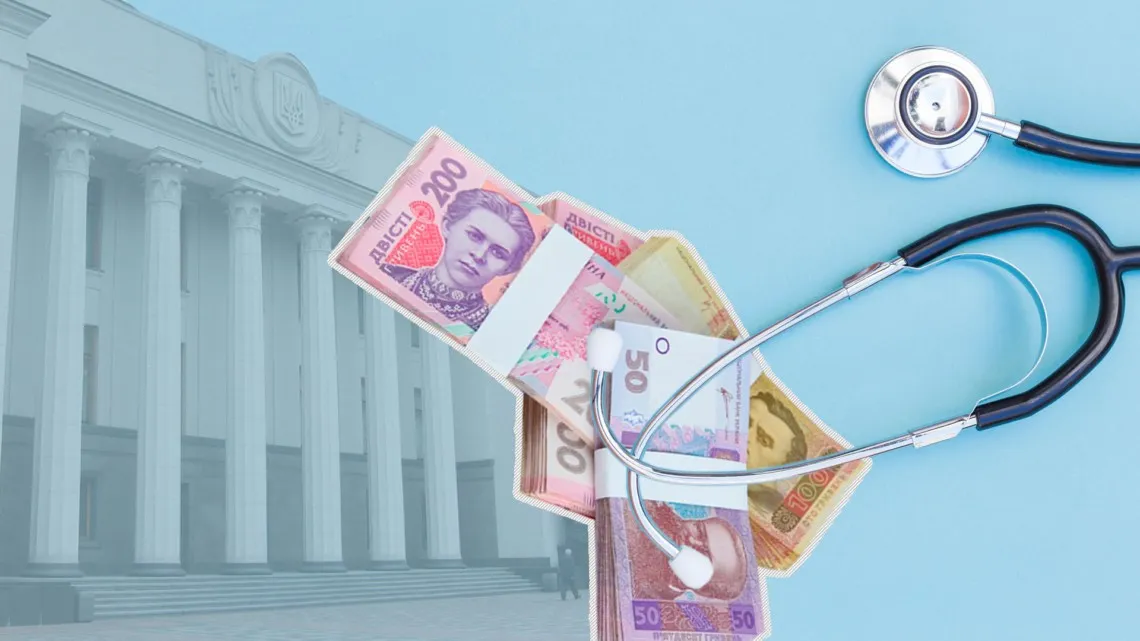
The National Health Service of Ukraine has reported that in May 2026 it paid out over 16.1 billion hryvnia under the Medical Guarantees Programme.
Of this amount, 1.2 billion hryvnias went towards emergency medical care, 2.3 billion hryvnias towards primary medical care, and over 11.7 billion hryvnias towards specialist medical care.
A further 884 million hryvnias went to the ‘Affordable Medicines’ programme.
Separately, 428 million UAH was allocated to support healthcare facilities in regions currently or previously affected by hostilities.
What lies behind the figures
At first glance, the figures look impressive. We are talking about billions of hryvnias that the state transfers to hospitals, polyclinics, emergency medical services and pharmacies.
However, alongside the financial reporting, another question arises – do patients see the real results of these expenditures?
It is not just a question of how much money the National Health Service of Ukraine (NSZU) has paid out, but also whether a person can see the right doctor in time, undergo tests, have an operation or receive a medical device without incurring additional costs.
What indicators are missing
Nina Yuzhanina – a Member of the Ukrainian Parliament for “European Solidarity” and a member of the Verkhovna Rada Committee on Finance, Tax and Customs Policy; commented on the NHIF’s report on payments under the Medical Guarantees Programme on her Telegram channel.
She pointed out that, alongside data on funding, it would be useful to see indicators of the actual accessibility of medical care.
For example, how long a patient waits for a referral to a cardiologist.
How many people are unable to book a free appointment within a reasonable timeframe.
How many operations are postponed due to a lack of necessary medical supplies.
Such indicators would allow us to assess not only the level of funding, but also how the system works for the individual.
The problem of expensive medical supplies
A separate issue is that of high-cost medical devices.
The National Health Service of Ukraine (NSZU) emphasises that stents, pacemakers, heart valves and other expensive medical devices are purchased using state budget funds and should be free of charge for patients.
However, according to Yuzhanina, patients regularly report something different: the required device is not available, they have to wait for it or buy it themselves.
That is precisely why, in her view, financial reports should be supplemented with performance indicators – such as access to doctors, waiting times, the availability of medical devices, and the real possibility of receiving guaranteed care without additional payments.
Why this is important
The Medical Guarantees Programme should function not as an accounting report, but as a mechanism for patient protection.
For a person, it is not just important that the hospital has received payment from the National Health Service of Ukraine.
The main thing is whether a patient can, when needed, receive a consultation, treatment, surgery or medication without queues, refusals or being required to pay for everything themselves.
Therefore, the issue of access to healthcare remains no less important than the sums the state transfers for medical services.
Follow us on Telegram