The Czech Republic is moving away from Russian gas in favour of LNG from the US

This is according to Forbes.
The Czech Republic is effectively replacing its former reliance on Russian pipeline gas with supplies of liquefied natural gas from the US. Over the weekend, the country strengthened its ties with the US natural gas market by reaching a preliminary agreement to secure a portion of the capacity at LNG terminals in the US.
In addition, Czech consumers will now be able to purchase gas at a price linked to the US Henry Hub market.
As reported over the weekend by the Czech Ministry of Industry and Trade following the return of its head, Karel Havlíček, from a several-day business and innovation mission to Texas, the country has provisionally agreed a long-term contract for the annual reservation of 1.4 billion cubic metres of gas at US LNG terminals.
According to Havlíček, this provisionally agreed capacity reservation, which corresponds to approximately a quarter of the Czech Republic’s annual gas consumption, is another step towards diversifying energy sources and strengthening the country’s energy security.
“Energy security rests on diversification. The pre-agreed capacity at US LNG terminals is a step that could strengthen the stability of gas supplies to the Czech Republic in the future,” said the First Deputy Prime Minister.
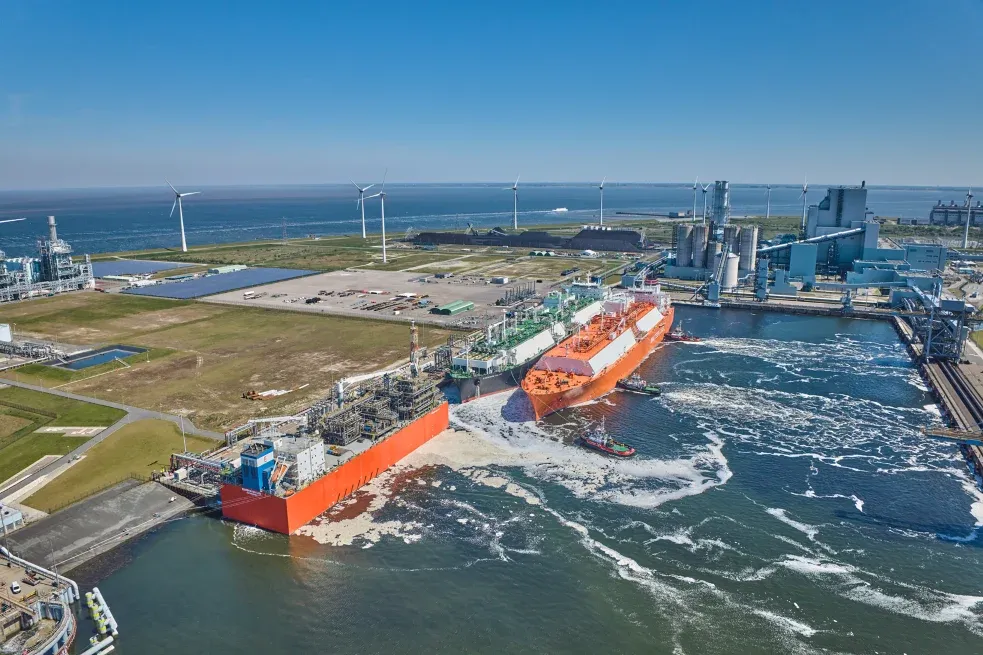
In effect, the Czech Republic – or more precisely, the ČEZ Group, which procures liquefied natural gas for the country – is thereby ensuring a direct link between the American continent and the European LNG terminals it utilises. This primarily concerns the terminal in Eemshaven, the Netherlands, where, from September 2022, a third of the annual capacity – out of a total of eight billion cubic metres of gas – has been leased for the Czech Republic.
Even before the announcement of the preliminary agreement in the US, ČEZ’s Deputy Chairman and Director of the Trade and Strategy Division, Pavel Círani, explained during the presentation of the group’s annual financial results that such a move would give the Czech Republic direct access to American natural gas. After that, it would be possible to liquefy it independently within the leased capacity and transport it to Europe.
According to him, gas is currently purchased directly from ships, and at present Europe is competing with Asia for these shipments, as a tanker may change its route due to a higher price offered. If, however, the Czech Republic were to purchase gas directly from the US, such competition could be avoided.
According to ČEZ, the LNG terminal in Eemshaven received a total of 72 vessels carrying gas for Czech consumption between the start of operations and the end of last year, delivering 6.44 billion cubic metres of gas.
This corresponds to 73.1 gigawatt-hours of gas, or 99.1 per cent of annual domestic consumption, which stood at 73.8 gigawatt-hours in 2024.
Until recently, the ČEZ Group acted solely as a gas buyer, with third parties handling its transportation and, in particular, regasification – that is, the conversion from liquid to gaseous form. However, last year the company independently delivered a vessel to the terminal for the first time, taking full responsibility for the entire route.
As ČEZ reported in a January press release, last year its specialists managed the entire navigation and logistics chain – from negotiations with a liquefaction terminal in the US to chartering a vessel, loading in the US, crossing the Atlantic Ocean and returning the vessel.
The role of American gas in Europe has risen sharply over the last few years due to sanctions against Russia. Whilst the US supplied approximately 20 billion cubic metres of liquefied natural gas to Europe in 2020, last year this volume had already quadrupled to 80 billion cubic metres.
Just five years ago, there was virtually no American natural gas in the Czech Republic, as the country was 98 per cent dependent on Russian fuel supplied via the Brotherhood or Nord Stream pipelines. The situation is now different: following the cut-off of Russian supplies, the Czech Republic is forced to rely on Norwegian, Qatari and American natural gas.
At the same time, the exact origin and volumes of gas supplied by tankers to European LNG terminals remain a commercial secret of ČEZ.
The role of American LNG in the Czech market is likely to grow, as the previously agreed annual capacity of American terminals, at 1.4 billion cubic metres, corresponds to approximately 20 per cent of the Czech Republic’s annual consumption.
Looking ahead, the Czech energy sector will require even greater volumes of gas due to the phase-out of coal, particularly in view of the future use of new gas-fired power stations.
Another sign of the deepening ties between the Czech Republic and the US gas market was a joint announcement made on Tuesday by the international LNG supplier MET and the Czech energy supplier Centropol Energy, owned by billionaire Aleš Graf.
The companies have signed a contract for natural gas supplies with pricing linked to the US Henry Hub index. This is a physical hub where more than ten major pipeline systems converge, and gas is stored, sold and redistributed across the US, and increasingly to the global market.
Thus, Czech customers will likely, for the first time, be able to hedge gas prices via this US market, where price dynamics may differ from those in Europe.
The European gas market, due to a shortage of resources – which, as Forbes notes, is currently being observed against the backdrop of the closure of the Strait of Hormuz – is increasingly facing price fluctuations. Indexation to the Henry Hub is expected to help smooth out such volatility.
“This is one of the most transparent and liquid indices in the world, where the price is formed on the basis of real supply and demand in a large and diversified market, which in the long term results in lower price fluctuations,” said Pavel Balada, head of MET Česká republika.
“In combination with the European Henry Hub index, it is a high-quality price hedging tool. We view this combination as a safeguard that helps eliminate price volatility,” added Zdeněk Martinec, Vice-Chairman of the Supervisory Board at Centropol Energy.
At the same time, Centropol Energy clarified that only after assessing the first deliveries will the company decide whether to offer this product directly to end consumers. According to Forbes, the volume of gas already contracted could cover the needs of at least tens of thousands of the company’s customers.