MPs have clashed on Telegram over customs tenders and the relaunch of the State Security Service

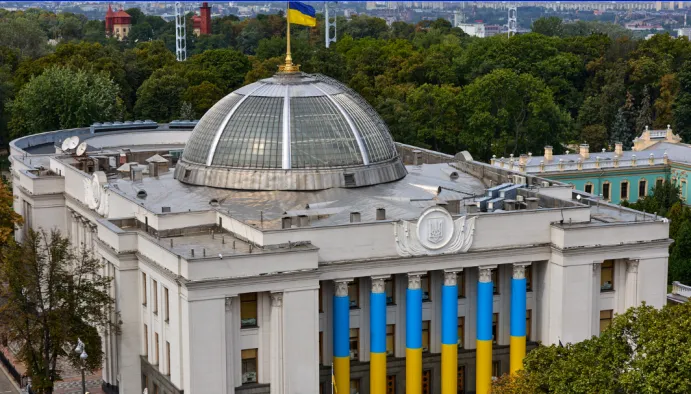
This week, a heated exchange broke out on parliamentary Telegram channels between MPs, revealing a deep divide in views on personnel reform within law enforcement agencies. The trigger was the outcome of the competition for the post of head of the State Customs Service and a wave of criticism regarding the actual state of affairs at the Economic Security Bureau following its ‘reorganisation’.
Each participant in the debate cited the same facts, yet drew diametrically opposed conclusions from them. However, this debate unexpectedly brought to light much deeper issues concerning trust in competitive procedures, political influence and unmet expectations regarding the Economic Security Bureau.
“Fair competition” or the discrediting of the procedure
On 27 March 2026, the selection committee announced the finalists for the post of Head of the State Migration Service. They were two NABU detectives: Ruslan Damentsov and Orest Mandziy. At first glance, they appeared to be impeccable candidates: an anti-corruption agency, investigative experience, and an unblemished reputation.
However, if we look back at the results of the first round of testing back in January, the conclusions become less clear-cut. Out of the list of 16 candidates who passed the threshold, Damentsov scored 107 points – the minimum required score – placing him practically at the very bottom of the ranking. Manziy achieved a slightly better result – 115 points – but he too was only in the middle of the table. Meanwhile, the winners of the first round, Daniil Menshikov (130 points), Vladislav Suvorov and Ilya Nizhnikov (124 points each) did not make it to the final.
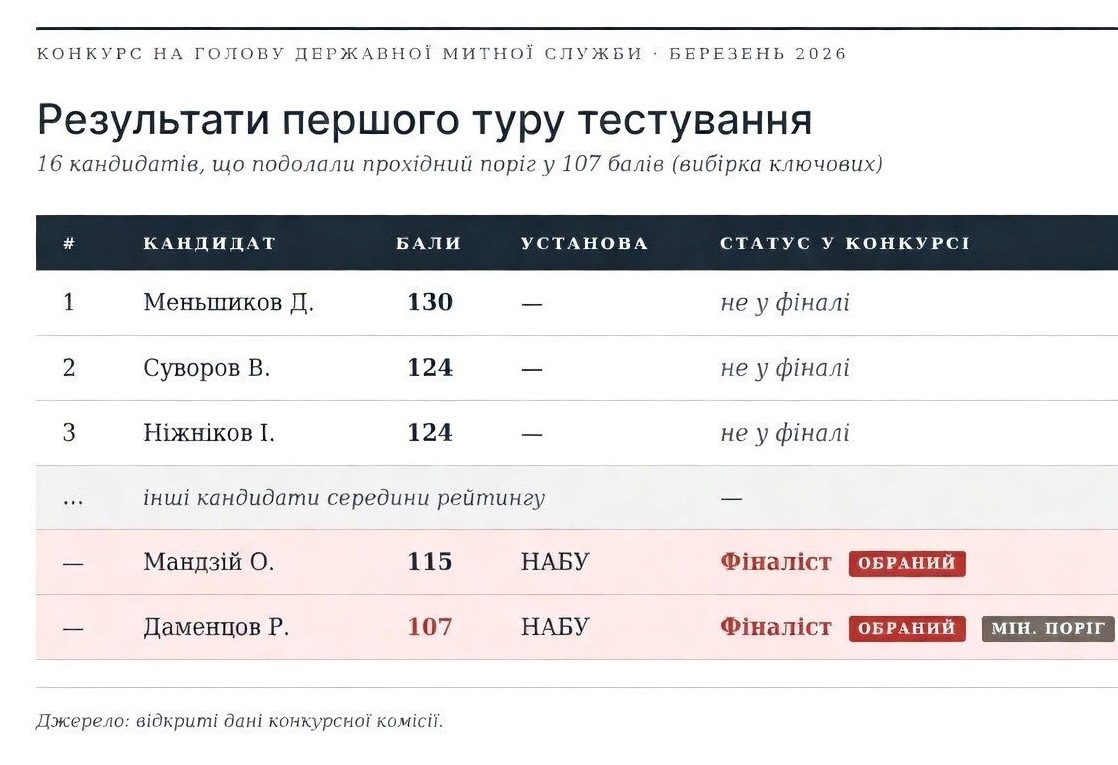
Formally, this is not a breach: the competition involved a multi-stage selection process, and the commission was able to consider a wider range of criteria: results of practical tasks, interviews, and integrity checks. However, the very fact that two of the candidates with the lowest scores in the initial testing reached the final raises questions.
After the competition results were announced, Yaroslav Zheleznyak was the first to declare the victory of the two candidates from NABU.
“The winners of the competition are Damentsov and Mandziy. Both are from NABU,” he wrote.
In his view, the procedure was legitimate, and the result was the outcome of the work of independent institutions: “When there is an independent body, independent and professional candidates emerge from it.”
In contrast, MP Danylo Getmantsev questioned the very quality of the competition, stating that “the best candidates were not chosen”. This is precisely what triggered the public conflict.
The real reason: not customs, but the ESBU
In this debate, Zheleznyak’s rhetoric quickly moved beyond the scope of customs. In his posts, he effectively draws a parallel with other competitions, primarily at the ESBU: “It discredits the idea of competitions when: your commission for the head of the ESBU selects the head of the tax police.”
In other words, in his view, the problem lies not in a specific competition, but in double standards: “our own” competitions are acceptable even with dubious results, whilst “others’” are immediately declared invalid.
The MP noted the transparency of the competition for the head of the customs service in several interviews, but did not comment on the validity of the final result. After all, this is the reformers’ main fear: competitions become not a tool for selecting the best, but a procedure for legitimising the ‘sufficiently acceptable’.
In his posts, Yaroslav Zheleznyak directly accused the authorities of systematically influencing personnel processes and added his own assessment: “You have broken, distorted, ruined… things have got worse since you took over.”
In response, Danylo Getmantsev effectively appealed to the quality of the outcome, rather than the procedure.
The ESBU paradox: a body that was lobbied for and yet does not work
For years, Yaroslav Zheleznyak was one of the main advocates for the creation and overhaul of the ESBU. He himself often emphasised that he and his team had fought for this body for three years.
However, today his rhetoric appears contradictory: on the one hand, he criticises competitions influenced by politics; on the other, he avoids directly assessing the ESBU’s low effectiveness under its new leadership.
This is the key point: political accountability for an institution becomes blurred when its results fail to meet expectations.
To divert attention from the Bureau’s poor results, Yaroslav Zheleznyak decided to highlight the failures of his predecessors. In particular, he published statistics on cases closed by the ‘old guard’ on the eve of the new ESBU leadership taking office.
In response, the Chair of the Verkhovna Rada’s Finance Committee, Danylo Getmantsev, posed more uncomfortable questions – this time to the new team.
“It is unclear why the issue of selling cases instead of reopening them in September 2025 is being raised with such outrage in April 2026? Crimes within the ‘Markeopt’ and ‘Yabko’ networks, along with around 20 other cases already referred to the new ESBU by the Committee, remain unresolved. The regional leadership of the ESBU remains unchanged,” he wrote.
The MP also asked his colleague what is currently preventing the new, effective leadership from showing at least some results?
“Perhaps their approach is to shoot thieves? In that case, clearly, this strategy needs to be communicated more actively in numerous interviews and presentations by the updated leadership of the ESBU,” added Danylo Getmantsev.
Zheleznyak’s response to Getmantsev’s accusations is notable not only for its content, but also for what is missing from it.
The MP from “Holos” merely acknowledged that under the new ESBU leadership “there is room for improvement”, but immediately added: “I haven’t heard any complaints from the business community demanding money for a long time. But all your other agencies are demanding it. And I don’t see any initiatives to overhaul them.”
This is a typical rhetorical device: shifting the blame onto others. It is interesting that the MP, who for years was one of the main proponents of the very idea of overhauling the Bureau, now readily highlights the problems of the previous leadership, but sidesteps the question of the agency’s actual effectiveness under the new leadership.
MP Maksym Buzhanskyy added an ironic but apt touch to this discussion.
“The head of the Odessa ESBU, Muntean, resigned immediately as soon as the new law was passed, he was so scared of the performance review… Oh, wait, no, he didn’t resign, he was sacked straight away as soon as the new law came into force... Damn, no, he wasn’t sacked; he’s been working perfectly well since August, nothing bad has happened, everything’s fine with him, almost better than it was,” he wrote.
Zheleznyak gave a brief but eloquent reply: “Don’t worry. If he doesn’t make the cut, in keeping with the good old tradition, we’ll send him over to the State Bureau of Investigation. That’s where such people thrive in every sense.”
Witty – but not particularly reassuring for those who were hoping for a genuine purge of the Economic Security Bureau’s ranks.
The struggle for control and questions of loyalty
To understand why the current debate is so heated, it is worth recalling the background.
At the time, Yaroslav Zheleznyak described the mechanism of the first competition for the head of the Economic Security Bureau as follows: “The competition was purely for show, with all the commission members being hand-picked... The head of the tax police, Melnik, took it upon himself, at Yermak’s behest, to harass Klitschko with cases. Pointless and futile, but it gave Yermak the opportunity to appoint Kuleba as the overseer of the stalls. So, as a token of gratitude, they gave the order at the ‘competition’ for everyone to vote for Melnik.”
On the one hand, Yaroslav Zheleznyak describes how openly controlled appointments looked during Yermak’s era, where the competition was merely a legalisation of a decision already made in advance. On the other hand, he tacitly contrasts those past events with current competitions as something qualitatively different.
This is precisely where the key question of loyalty lies: not personal loyalty to a specific individual, but systemic loyalty to the logic of selection, where the winner is determined by convenience or integrity, rather than competence.
Yermak chose ‘his own’ openly and crudely. The current competitions are more subtle: the procedure is followed, the commission is independent, and the minutes are public. But if the finalists are the two with the lowest scores on practical tasks, whilst candidates with better results are left out, the question of who is “convenient” and why does not go away.
Yaroslav Zheleznyak has for years positioned himself as the chief advocate of the idea of a ESBU reset and was one of the first to welcome the transparency of the customs competition. This is not lobbying in the dirty sense, but rather a bet on a specific reformist model, on whose success his own political reputation depends. That is precisely why he reacts so painfully to criticism from Getmantsev: to admit that the new ESBU is not delivering results, and that the reform-oriented competition is producing winners with minimal scores, would mean calling his own long-standing position into question. Moreover, the struggle for control over law enforcement agencies has not ended; it has simply taken on a new, more subtle form.
A crisis of confidence in the competitions, dashed expectations and political influence – what the MPs were actually arguing about
The discussion between Zheleznyak, Getmantsev and Buzhansky laid bare a systemic problem: in Ukraine, they have learnt how to organise competitions – with commissions, international experts, public broadcasts and minutes. But it proved far more difficult to guarantee that the winner of such a competition would, above all, be the best specialist, rather than simply a convenient candidate.
The results of the customs competition demonstrate that even an open and transparent procedure can yield a result where the ‘lowest score’ and the ‘winner’ are one and the same person. Meanwhile, the situation with the ESBU shows that ‘resetting’ an agency does not automatically mean an improvement in its performance.
The situation appears paradoxical: reforms that were intended to ensure a new level of quality in the management of state institutions are increasingly raising questions as to whether the procedure has become more important than the result. And until an answer is found, such conflicts in parliament will only multiply.