The new Civil Code: what is changing and why it has caused such a stir

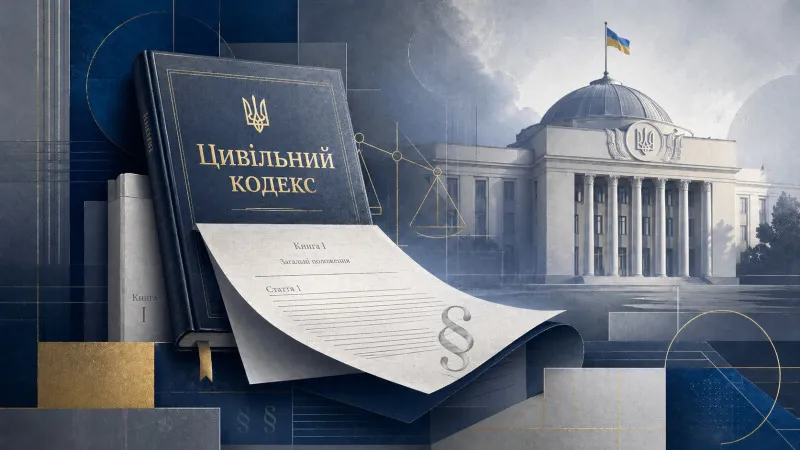
The Verkhovna Rada of Ukraine has passed Bill No. 15150—a new version of the Civil Code—at its first reading. 254 MPs voted in favour, with only two against.
The document is already being hailed as one of the most far-reaching reforms of private law since independence, yet it has immediately sparked serious debate in society. Why?
The current code was adopted back in 2003. Since then, it has been amended on numerous occasions, but no systematic update has taken place. This is precisely why the initiators of the bill, notably the Speaker of the Verkhovna Rada of Ukraine, Ruslan Stefanchuk, are presenting the document as an attempt at comprehensive reform — a so-called recodification, that is, a complete rethinking of private law.
Parliament also notes that the document is intended to modernise legislation, move away from Soviet-era approaches and bring it into line with European Union standards. The aim is reportedly not merely to make isolated amendments, but to bring about a fundamental shift in approach.
The new code is proposed to be structured in nine books, covering all areas of private law: from personal rights to private international law. It also provides for the consolidation of provisions from the current Civil and Family Codes.
What key changes are being proposed
Among the innovations is the expansion of sources of law: in addition to statutes, customs (including those of national minorities) and local acts of legal entities will be taken into account. The approach to liability is changing, and the protection of rights will be possible not only in the event of their violation, but also in the presence of a threat.
The document also adapts legislation to modern realities. In particular, it is proposed to allow the inheritance of digital assets (such as cryptocurrencies), to introduce the possibility of bequeathing biological material, and to grant children aged 6 and over the right to use bank cards for small purchases.
Separately, approaches to property relations are being revised, the rights of legal entities are being clarified, and the system of their organisational and legal forms is being streamlined.
What caused controversy previously
The previous version of the draft bill caused a widespread outcry due to a provision allowing marriage from the age of 14. Following criticism, it was removed. However, according to critics, this did not resolve all the issues, as the overall concept of the document remained largely the same.
The most controversial section — family law
It is this section that is causing the most controversy, as it directly affects everyone’s lives.
“It must be understood that this is a very large, comprehensive bill covering a very wide range of issues. The section I focused on in particular is the issues relating to family law,” MP Inna Sovsun said on Suspilne.
According to her, the problem lies not only in individual provisions, but in the approach to regulating family relations in general. She emphasises that even after the removal of the most controversial provisions, some of the conceptual issues remain.
The civil society organisation “Women’s March” states that the document could curtail women’s rights and contains provisions which, in their view, do not comply with Ukraine’s European integration commitments.
In particular, they stress that, in their view, the draft “retains provisions that allow: dragging out divorces through ‘reconciliation’, assessing a woman’s behaviour as ‘immoral’, restrict access to maintenance payments, curtail reproductive rights, keep women in marriages as hostages through pregnancy, and demand financial compensation from women for deciding to end a relationship after an engagement”.
Lawyer Oksana Guz writes that a man will be able to compel his ex-wife to revert to her maiden name if he considers that she behaved ‘unworthily’ during the marriage or committed an ‘immoral act’.
A significant part of the criticism, particularly from the ‘National LGBTI Consortium’, concerns the absence of provisions for the legal recognition of same-sex couples. Human rights organisations stress that this may contravene European human rights standards.
What this means at present
At the same time, it is important to understand that the bill has only been passed at first reading. This means that it is not yet final and may change significantly.
The next stage involves submitting amendments and finalising the document. It is then that it will be determined which provisions will remain in the final version.
“Right now, I think a great deal will depend on the public reaction,” said MP Inna Sovsun.