Ukraine has unveiled its new ‘Palytsia’ attack drone, equipped with Starlink and with a range of up to 90 km

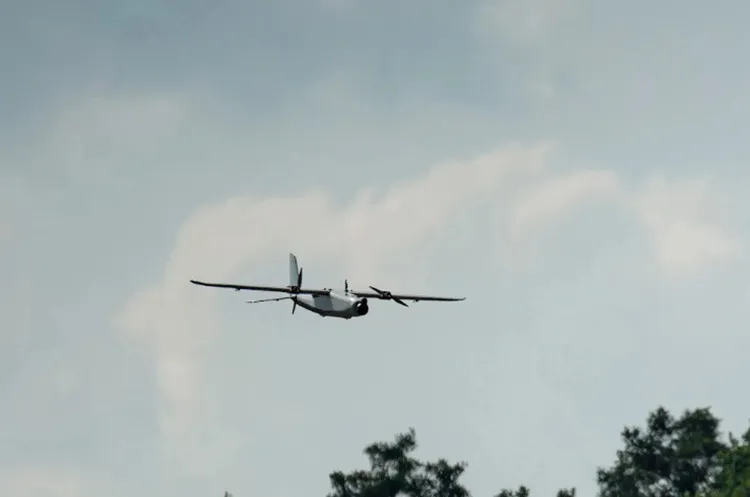
The new product is capable of operating in tandem with ‘Leleka’ reconnaissance drones, enabling the creation of a fully-fledged reconnaissance and strike system.
The drone was unveiled during the TFUA Demo Day exhibition, according to United24 Media, citing the developer.
According to DEVIRO, the ‘Palytsia’ is designed to strike targets in the enemy’s tactical rear – depots, command posts, fuel depots, military equipment and logistics routes.
The drone has an operational range of up to 90 km, can remain airborne for up to 70 minutes and carry a payload weighing up to 3 kg. Once it has locked onto a target, it is capable of autonomously completing the attack using a computer vision system.
One of the key features of the new drone is its ability to operate without GPS. It supports automatic navigation, a secure digital communication channel, MESH networking technology, and can also use Starlink for long-range control.
The range for video and telemetry transmission within line of sight is up to 100 km.
DEVIRO explains that ‘Palytsia’ was not designed as a standalone drone, but as part of an integrated system. The ‘Leleka’ reconnaissance drone locates and tracks the target, whilst ‘Palytsia’ delivers the strike.
This approach is already in use with the more expensive ‘Bulava’ strike drone, but the new system is set to be more accessible for mass production.
If a target is within 90 km and does not require a powerful warhead, the military will be able to deploy the cheaper ‘Palytsia’, reserving the ‘Bulava’ for more complex operations.
The ‘Palytsia’ is currently undergoing combat trials and has not yet been officially adopted into service. The company has stated that, once testing is complete, it plans to move to mass production, though no specific timetable has yet been given.
Recently, Ukrainian manufacturers have been developing not just individual drone models, but entire ranges of strike drones with varying ranges, costs and combat capabilities. This approach allows expensive long-range systems to be used only where they are truly needed, whilst mass-produced, cheaper systems can be deployed for day-to-day operations against Russian logistics and military facilities.
Follow us on Telegram