The failure of the Russian offensive: the occupiers have lost more territory than they have captured

Diana Shevchenko
Diana Shevchenko Journalist
The failure of the Russian offensive: the occupiers have lost more territory than they have captured
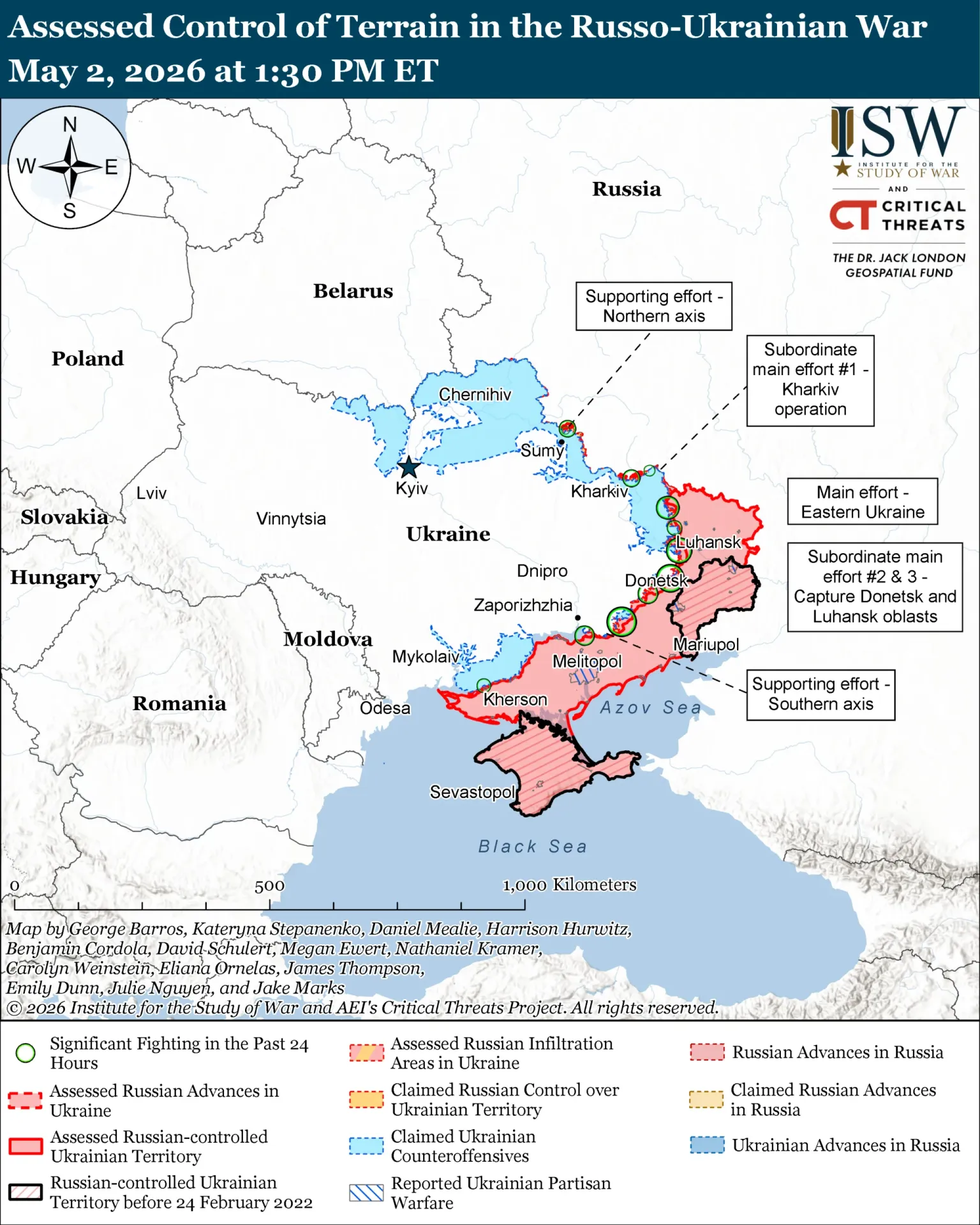
Map of combat operations, source: ISW
In April 2026, the pace of the Russian offensive slowed. According to the ISW, the occupying forces suffered a net loss of territory for the first time since the fighting in Kursk in 2024, losing control of 116 square kilometres.

This is reported by the ISW.

The pace of the occupiers’ advance has been steadily declining for over six months. Whilst at the start of 2025 the enemy was capturing an average of almost 10 square kilometres a day, this figure has now fallen to a critical 2.9 square kilometres.

Three reasons for the failure of the Russian offensive

Experts identify several key reasons why the occupiers’ ‘major offensive’ has finally faltered:

  1. Communications and command-and-control disruption. The decision to disable Starlink terminals for the Russians in February 2026, combined with restrictions on Telegram, dealt a devastating blow to logistics. Coordination between units has broken down, making large-scale attacks impossible.

  2. Exhaustion due to counter-attacks. Ukrainian forces have shifted tactics to active defence with constant medium-range strikes. Such tactics force the enemy to expend reserves on holding ground already captured, rather than on advancing.

  3. Natural factors. The winter of 2025–2026 proved to be significantly harsher and wetter than previous ones. An abnormal spring thaw effectively paralysed the occupiers’ heavy equipment, leaving the infantry without adequate support.

Infiltration tactics: the illusion of control

With no real successes to show for their efforts, the Kremlin is increasingly resorting to manipulation. Russian troops are using infiltration tactics: small groups of infantry seep into ‘grey zones’ where they cannot establish a foothold, but whose presence allows propaganda to report ‘advances’. In reality, these areas often remain under the fire control of the Ukrainian Armed Forces, and Russian infiltrators become easy targets.

Air force impasse

Despite the modernisation of aerial bombs, the enemy has faced a ‘staff shortage’. Due to a lack of engineers, who have been transferred en masse to infantry units to make up for losses, maintaining aircraft is becoming increasingly difficult. Furthermore, pilots often waste expensive munitions on secondary targets, indicating a lack of clear coordination with intelligence. The key question now is whether Russia will be able to regain momentum in the summer, when the ground dries out, or whether the current loss of territory will mark the beginning of a larger-scale retreat by the occupiers.

Follow us on Telegram
Share tittle
War
Russia has attacked more than 900 port infrastructure facilities and injured 255 workers since the start of the war — Kuleba
War

Russia has attacked more than 900 port infrastructure facilities and injured 255 workers since the start of the war — Kuleba

The Russian military has attacked at least 935 port infrastructure facilities since the start of the full-scale war. People have also been injured.

04.06.2026
The youngest was just two days old. Since the start of the full-scale invasion, Russia has killed 707 Ukrainian children
War

The youngest was just two days old. Since the start of the full-scale invasion, Russia has killed 707 Ukrainian children

Since the start of the full-scale invasion, Russia has killed 707 children in Ukraine, with a further 2,548 wounded. 4 June marks the International Day of Innocent Children Victims of Aggression.

04.06.2026
Unmanned aerial systems struck the Russian vessel 'Svitlyak' in Crimea
War

Unmanned aerial systems struck the Russian vessel 'Svitlyak' in Crimea

On the night of 4 June, the Ukrainian Armed Forces’ Unmanned aerial vehicle unit struck a Russian ‘Svitlyak’-class border patrol vessel in the temporarily occupied Crimea. Air defence systems, infrastructure facilities and the enemy’s railway equipment were also targeted.

04.06.2026
The Zaporizhzhia Thermal Power Plant, on which the safety of the Zaporizhzhia Nuclear Power Plant depends, has come under heavy shelling – IAEA
War

The Zaporizhzhia Thermal Power Plant, on which the safety of the Zaporizhzhia Nuclear Power Plant depends, has come under heavy shelling – IAEA

On Thursday, 4 June, the Zaporizhzhia Thermal Power Station came under heavy shelling. This poses a serious threat to the power supply to the occupied Zaporizhzhia Nuclear Power Plant.

04.06.2026
Will every second drone be a jet? Syrsky reveals Russia’s plans
War

Will every second drone be a jet? Syrsky reveals Russia’s plans

Russia wants to double the proportion of jet-powered attack drones in its attacks. The Ukrainian Armed Forces are already preparing for new challenges.

04.06.2026