Solar panels for flats: requirements and installation costs in 2026

In 2026, interest in solar panels in Ukraine remains high. The reasons are clear: some people want to pay less for electricity, others are looking for a backup in case of power cuts, and others simply want to be less dependent on the grid. But whilst the situation is more or less straightforward for a detached house, it is more complicated when it comes to a flat in a high-rise building.
The main issue here is not which panels to buy, but where they can be installed and how to do so without breaking the rules.
In 2026, the government did indeed simplify some of the red tape. At the end of January, the government removed some of the building permit procedures for installing solar power stations on roofs and facades. This means that in many cases, there is no longer a need to go through a separate building registration process or apply for a permit. But this does not mean you can simply go ahead and mount panels wherever you like. When it comes to the roof or façade, you still need to bear in mind that this is the residents’ shared property.
That is precisely why, for flats in high-rise buildings, only a few models are currently viable. The simplest option is a small balcony system with one or two panels. It allows you to partially cover your own electricity consumption. Another option is a shared rooftop station for the building’s needs, which is usually easier to set up through the owners’ association. The third scenario is a hybrid system with a battery, which provides a backup during power cuts, but this is the most expensive solution.
Most questions arise regarding the roof, façade and balcony. Here, it is important to understand a simple fact: the flat is private property, but the roof, façade, load-bearing structures and most of the building’s external elements belong to all the co-owners. In other words, a resident cannot consider the roof ‘theirs’ simply because they live on the top floor. Similarly, in most cases, the façade is not a private area either.
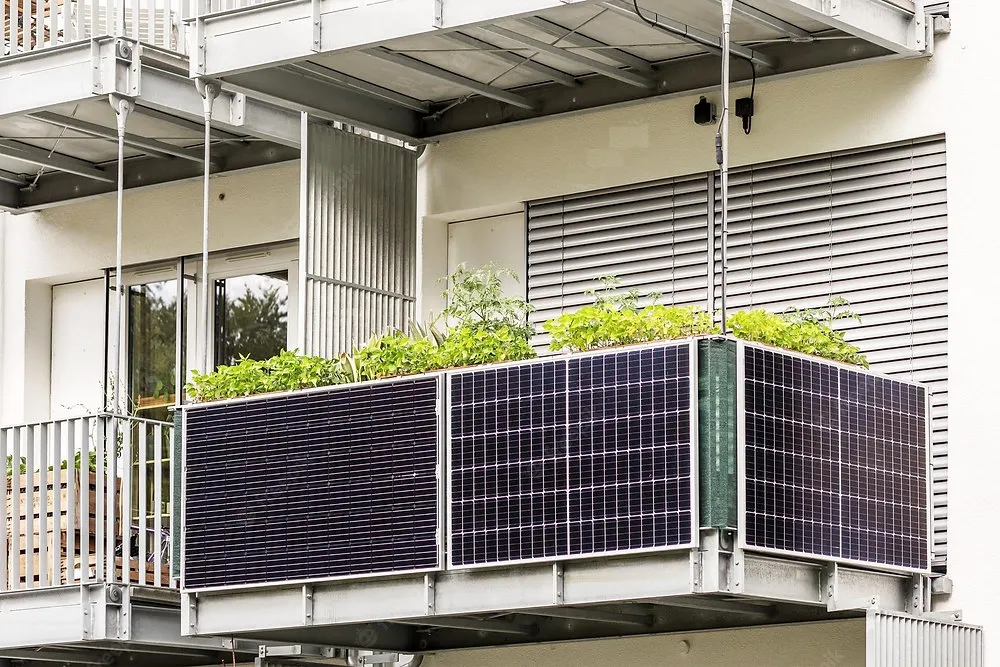
The situation with the balcony is slightly simpler, but not ideal either. The interior space of the balcony belongs to the flat, but the slab, railing or external part of the structure may be considered part of the building. Therefore, even if a person wishes to install a small panel on the balcony, it is best to agree this in advance with the owners’ association or the property manager. This is particularly important if the installation affects the building’s appearance or involves fixing to the structure.
In fact, in 2026, the most realistic option for a flat is a small balcony micro-PV system. It usually consists of one or two panels and a micro-inverter. This solution is suitable for those who want to reduce their electricity bills slightly without a complicated installation process. The advantage is that the system is small, starts up faster and does not require the same level of approvals as a rooftop project. But even here, safety must not be overlooked: incorrect connection can become a problem for both the flat and the building.
If we’re talking about a more substantial option, it works best not as a ‘personal rooftop station’ but as a building-wide project. In this case, the solar station is installed for shared use — for example, to power stairwell lighting, pumps, intercoms or, in some cases, lifts. Such solutions have a stronger legal basis, as they are easier to formalise through the Homeowners’ Association (HOA). Moreover, the legislation specifically allows HOAs to operate as active consumers, meaning they can, under certain conditions, utilise mechanisms for metering and selling surplus electricity.
For the average resident, it is important to understand one more difference. If a solar system simply generates electricity for personal consumption, this is the simplest scenario. But if the owner wishes to sell surplus electricity to the grid or offset it under special rules, then different requirements come into play — contracts, metering and market regulations. This is precisely why, for a flat, it is often more practical to start not by selling electricity, but by saving on personal consumption.
As for the cost, it all depends on the system’s configuration. The most affordable option is a balcony-mounted system of around 1 kW. In 2026, its estimated cost could start from 18,000 hryvnias and reach up to 30,000 hryvnias, depending on the panels, inverter, mountings and installation. This is the cheapest way for an apartment to ‘get into’ solar energy.
If we’re talking about a rooftop system without a battery, say a 3 kW one, the budget is already significantly higher — on average between 90,000 and 160,000 hryvnias. And if you add a battery and create a 5 kW hybrid system, the cost can exceed 200,000 hryvnias. That is why a system with a battery is a solution not so much for saving money as for providing backup power during blackouts.
Payback time also depends on the city, consumption and the type of system. On average, a small balcony-mounted system in Kyiv can pay for itself in about five years. In southern regions, where there is more sunshine, this period may be shorter. Conversely, large systems, especially those with batteries, take longer to pay for themselves. Their advantage lies not only in the financial savings but also in the fact that they provide a reserve of energy during power cuts.
Safety deserves a separate mention. This is precisely where you should never cut corners. Solar panels on a balcony, façade or roof must be properly secured to withstand the wind and not pose a risk to people. Proper electrical connection is equally important. Even if the equipment is advertised as simple and almost ready to use, in Ukrainian conditions it is better to have it connected by a specialist who will check the automation, protection and load.
There is another point that is often underestimated. The simplification of regulations in 2026 specifically concerns construction bureaucracy, but it does not override common sense. If the installation damages the building’s structure, spoils the façade or poses risks to neighbours, it will still be a problem. Therefore, before installing a system on the roof or façade, it is worth obtaining a technical report or survey confirming that the structure can withstand it.
In practice, the smartest strategy for a flat owner in 2026 is straightforward. If you want to try solar energy without major expenditure, you should look into a balcony micro-solar power system. If the aim is to meet the needs of the entire building or to provide a more stable backup power supply for shared infrastructure, it is better to launch the project through the owners’ association. And if the main objective is to have a reserve of electricity during power cuts, then a hybrid system with a battery is worth considering, even though it requires the largest investment.
In conclusion, solar panels for flats in Ukraine in 2026 are a very real possibility, but not as straightforward as the adverts suggest. It is possible to install panels, but it is important to consider exactly where they will be placed, whether the consent of co-owners is required, whether the building can support them, and whether the system will be safe. For most residents, the best approach is to start small, not rush into expensive solutions, and agree in advance on everything concerning the roof, façade and communal property.