The military oath: how it is taken and the consequences of breaching it

Contents
- The history of the military oath in Ukraine
- Who takes the military oath and when
- Text of the oath:
- Procedure for the oath-taking ceremony
- Duration of the oath
- Liability for breach of the oath
The military oath is one of the key stages in the life of a serviceman. It marks entry into the ranks of the armed forces and establishes the duty to be loyal to Ukraine, to defend its sovereignty and territorial integrity, to abide by the law and to carry out the orders of commanders.
The history of the military oath in Ukraine
The tradition of taking the oath on Ukrainian soil dates back to the times of Kievan Rus’. In modern history, the oath-taking ceremony was conducted by the Sich Riflemen Legion on 3 September 1915. At various times, it was taken by soldiers of the Army of the Ukrainian People’s Republic, the Ukrainian Insurgent Army and the Ukrainian National Army. The current text of the military oath was adopted on 6 December 1991.
Who takes the military oath and when
The oath is taken by citizens entering service in the Armed Forces of Ukraine, the National Guard, the State Border Guard Service and other military formations. These include conscripts, contract soldiers, cadets, reservists, reserve officers and mobilised citizens.
The oath is usually taken after completing basic training, which lasts from a few weeks to a month and a half. Cadets take it at the start of their studies at military educational institutions. Without taking the oath, a person is not considered a fully-fledged military serviceman.
Text of the oath:
‘I, (surname, first name and patronymic), enter military service and solemnly swear to the Ukrainian people to always be loyal and devoted to them, to defend Ukraine, to protect its sovereignty, territorial integrity and inviolability, to perform my military duty conscientiously and honestly, the orders of my commanders, to strictly observe the Constitution of Ukraine and the laws of Ukraine, and to preserve state secrets.
I swear to perform my duties in the interests of my fellow citizens.
I swear never to betray the Ukrainian people.”
The text of the oath was approved following the declaration of Ukraine’s independence. In 1999, it was amended in accordance with the Law ‘On the Statute of Internal Service of the Armed Forces of Ukraine’. In it, the serviceman undertakes to be loyal to the Ukrainian people, to defend the state, to carry out orders and to abide by the Constitution and laws.
Procedure for the oath-taking ceremony
In peacetime, the day on which the oath is taken is designated as a public holiday for the military unit. The date and venue are set by the commander in a separate order. Relatives of service personnel and other guests may be invited to the ceremony.
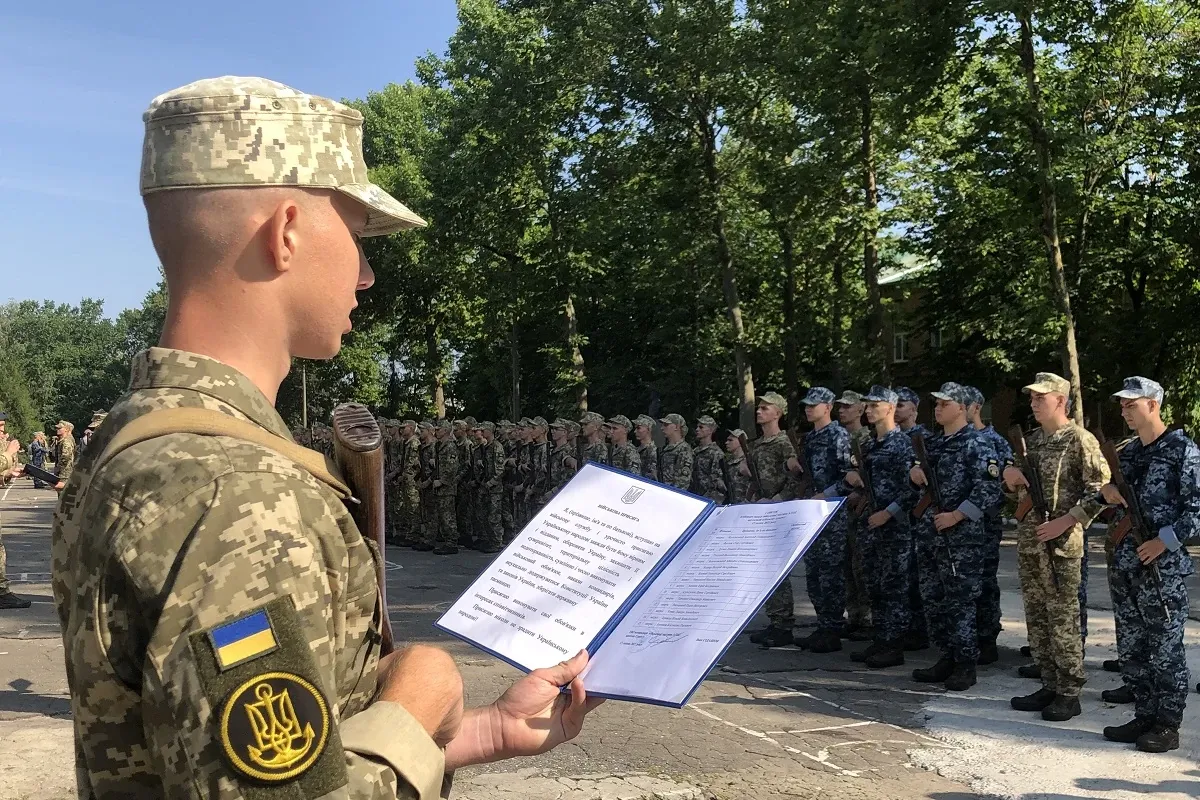
Before the ceremony begins, the soldiers line up in formation, with those taking the oath standing in the front rows. The commander delivers a speech on the significance of the oath, after which representatives of the command, officers and veterans may address the assembly.
The servicemen are then called forward in alphabetical order. With weapons in hand, they recite the text of the oath before the formation and sign the relevant document. This moment marks their official entry into the ranks of the army.
Duration of the oath
The commitments made during the swearing-in ceremony are valid indefinitely. They remain in force even after the end of active service, when the individual transfers to the reserve or acquires veteran status.
Liability for breach of the oath
Breach of the military oath may result in disciplinary action. Military personnel may be subject to a reprimand, a severe reprimand, deprivation of leave, a warning of unsatisfactory conduct, demotion in rank or position, or discharge from service on grounds of unsuitability for service.
In the case of more serious violations, criminal liability may apply. In particular, failure to carry out an order is punishable by imprisonment for a term of 5 to 8 years; unauthorised absence from duty carries a sentence of 5 to 10 years; and desertion carries a sentence of 5 to 12 years. Treason carries a sentence of 10 to 15 years’ imprisonment or life imprisonment.