In Ukraine, fines will be imposed for using the terms ‘eco’ and ‘organic’ without certification
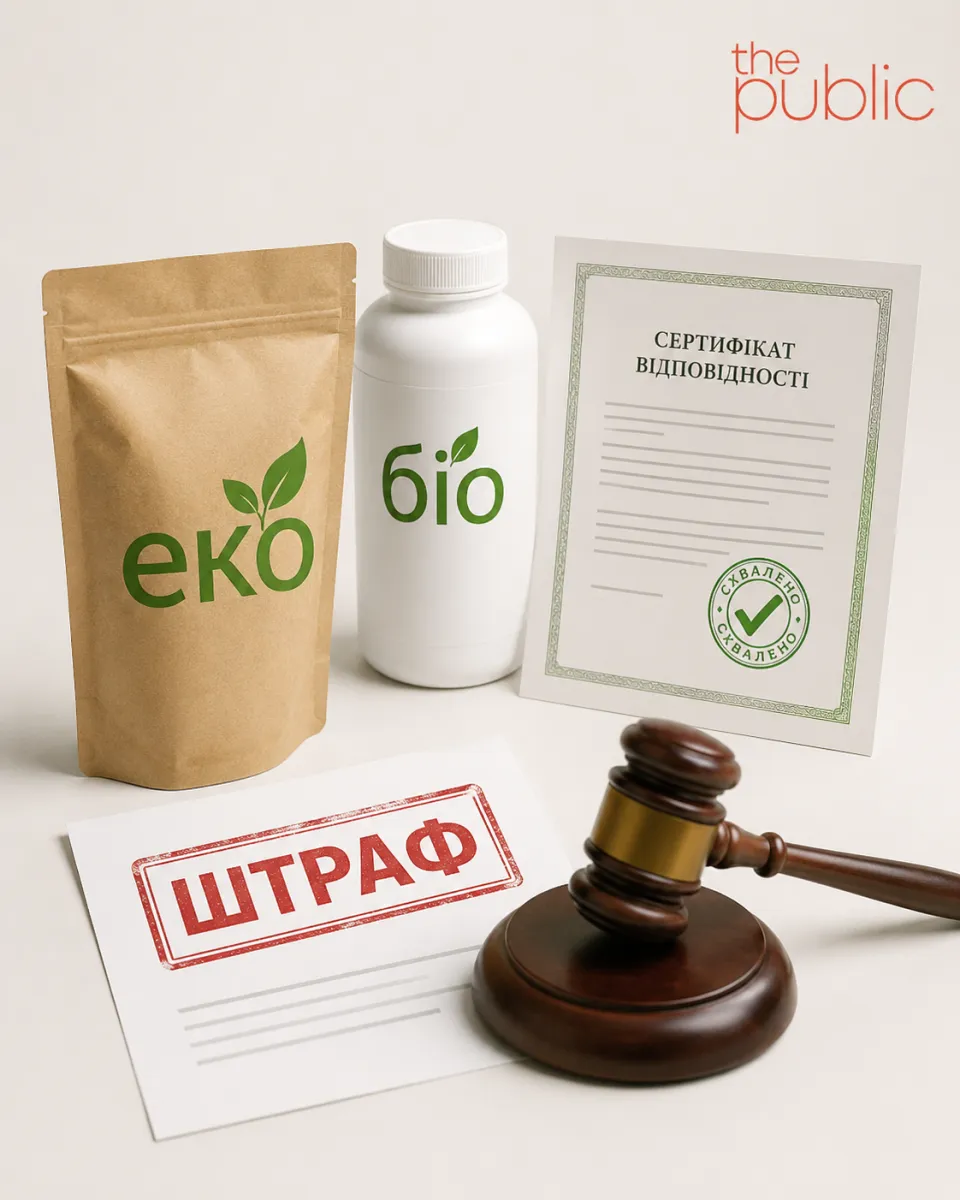
This is set out in Law No. 4921-IX on the state regulation of organic production, distribution and labelling of organic products, which has been signed by the President.
The terms ‘organic’, ‘biodynamic’, ‘biological’, ‘ecological’ and ‘organic’ may only be used for products whose organic origin is confirmed by a certificate.
The ban will also apply to cognates and derived terms, including terms with the prefixes ‘eco-’ and ‘bio-’. The language in which the label is written will be irrelevant.
The restriction will apply not only to information on packaging. The relevant terms may not be used when presenting or advertising non-organic products.
The law specifically stipulates that commercial names and trade marks containing the words ‘organic’, ‘ecological’, ‘biological’, ‘organic’, ‘eco-’ or ‘bio-’ may only be used for organic goods.
Advertising conventional products as organic will be deemed to be misleading.
What penalties does the law provide for?
Legal entities face a fine of between five and eight times the minimum wage for using the organic logo or the words ‘eco-’, ‘bio-’ and other protected designations on non-organic products.
For sole traders, the fine will range from three to five times the minimum wage.
In the event of a repeat offence within a year, the penalties will increase significantly. Companies may be fined between eight and 24 times the minimum wage, whilst sole traders may be fined between five and 16 times the minimum wage.
A similar penalty applies to the sale of goods labelled as organic without a Ukrainian or foreign certificate.
The amount of the penalty will be calculated based on the minimum wage in force on 1 January of the year in which the violation occurred. It is therefore incorrect to convert future fines into hryvnias using 2026 figures.
Which products can be labelled as organic
The production and distribution of organic products in Ukraine will be subject to certification. Certificates will be issued for 15 months, and producers and other operators will be subject to regular inspections.
A processed food product may be labelled as organic if the proportion of ingredients of agricultural origin in it exceeds 50 per cent. At the same time, at least 95 per cent of such ingredients must be organic.
A state logo will be mandatory for pre-packaged organic products manufactured in accordance with Ukrainian regulations. The packaging will also bear the registration code of the certification body in the format UA-organic-XXX.
Organic products may only be labelled with the written consent of the certification body. Such consent will be granted free of charge.
Imported organic products must be accompanied by a foreign certificate. At the same time, the use of the Ukrainian state logo on imported products will be prohibited.
What will be prohibited in organic production
Genetically modified organisms and products manufactured using them may not be used in organic production. An exception is made for veterinary medicinal products.
The law also prohibits mineral nitrogen fertilisers, growth promoters, synthetic amino acids for animal feed, ionising radiation, hydroponic methods and the cloning of animals.
Antibiotics and synthetic veterinary medicines will only be permitted for the treatment of animals in cases specified in the detailed rules on organic production.
What registers will be made available to consumers
The law provides for the creation of five state electronic registers. These will contain information on organic market operators, authorised certification bodies, organic planting material, organic livestock and aquaculture animals.
Access to the information must be available round the clock and free of charge. The registers will be published on the official website of the relevant state authority and on the open data portal.
This will enable consumers to check whether a producer is genuinely entitled to label their products as organic.
Who the new rules will not apply to
The law does not apply to perfumes and cosmetics, medicinal products, goods for personal consumption, or the activities of catering establishments.
Therefore, the new rules cannot automatically be applied, for example, to labels such as ‘eco’ or ‘bio’ on cosmetics. Different legislation applies to such goods.
Furthermore, certification will not be required for shops selling pre-packaged organic products to end consumers, provided the retailer does not produce, import or store these products separately.
When will the fines come into force?
President Volodymyr Zelenskyy signed the law on 20 July 2026. The document was published on 21 July in the newspaper *Holos Ukrainy*.
However, most of its provisions, in particular the new labelling rules and fines, will only come into force three years after publication. Consequently, the main changes are due to take effect in July 2029.
Certain technical amendments to other legislative acts will come into force earlier, but this does not mean that fines for the terms ‘eco-’ and ‘bio-’ will be introduced immediately.
Certificates issued under the current rules will remain valid until their expiry date or until they are revoked. Manufacturers have also been granted an additional period to transition to the new labelling system.
In light of this, ThePublic advises consumers not to rely solely on the terms ‘eco’, ‘bio’ or ‘organic’ on packaging. It is worth checking the manufacturer against the state register of organic market operators, and if in doubt, ask the retailer to provide a copy of a valid certificate. At the same time, it is important to remember that organic labelling confirms the method of production but does not guarantee any medicinal properties or higher nutritional value of the product.
Follow us on Telegram.