Who is Denis Shtilerman, and how did Fire Point become the leading manufacturer of long-range drones for the Ukrainian Armed Forces?

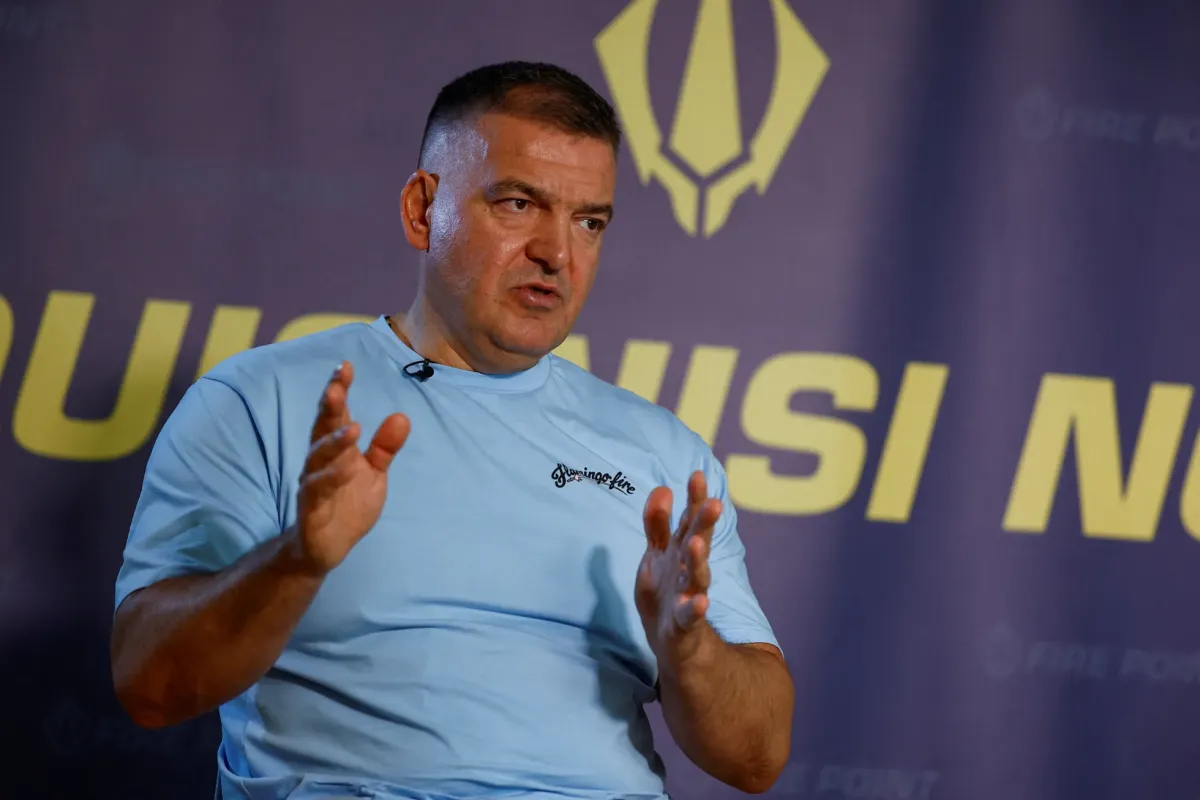
Journalist Simon Shuster wrote an article for *The Atlantic* about Denis Stilerman, Ukraine’s most high-profile arms dealer. Stilerman was educated in Moscow, held a Russian passport and even worked for the Russian Ministry of Defence.
Stilerman was born and raised in Ukraine into a family of engineers.
In 1991, he enrolled at the Moscow Institute of Physics and Technology, one of the most prestigious technical universities in the USSR, and graduated with first-class honours in theoretical physics, specialising in cosmology. After graduating, he remained in Moscow, but was involved not in science but in business, specifically the development of software and computer games, and investments in land and property.
In the 2000s, Shtilerman collaborated with the Russian Ministry of Defence. Judging by several of his interviews, he was either an employee or a contractor at a Moscow-based defence research institute, where equipment for Vladimir Putin’s ‘nuclear briefcase’ was being developed. ‘In early 2007, I was asked to devise a concept for automated troop command and control systems for the Russian Ministry of Defence. I developed it. Thank God they haven’t implemented it yet. Otherwise, everything would have unfolded according to a completely different scenario,” Stilerman told Ukrainian journalist Dmytro Gordon.
After the outbreak of the Russian-Georgian war, he severed ties with the Russian Ministry of Defence, but continued to live and run his business in Russia. Having moved from Ukraine in 1991, he held citizenship of both countries. His Russian passport was issued under the surname Danilov, which Stilerman’s father had once adopted in an attempt to conceal his Jewish origins in order to gain admission to a Soviet university. Stilerman was stripped of his Russian citizenship in 2016. Among the reasons he cited were his support for the Euromaidan, a certain ‘appeal’ from his ex-wife, and pressure from the FSB. According to him, the security services demanded $23 million from him, and after he refused to pay, they sent him to a remand centre for six months. This took place in 2018; the criminal case concerned the purchase of land from a bankrupt poultry farm. Ultimately, the case was closed without any charges being brought, reports The Atlantic, citing documents provided by Stilerman himself.
This was already his second arrest in Russia.
After his release, Stilerman moved to Ukraine in 2019, dropped the surname Danilov and, together with architect Irina Terekh, began developing a project to improve public spaces in Kyiv. In 2022, together with Terekh and his school friend Yegor Skalyga, he founded the firearms company Fire Point. According to Stilerman, he invested money earned from property deals in Russia into the company, and the start-up costs amounted to several million dollars.
Fire Point’s rise was meteoric. By the end of 2022, the company had manufactured its first long-range drone; in 2023, it began selling it to the Ukrainian army; and by 2024, it was already receiving billions of hryvnias under government contracts. Today, Fire Point produces the bulk of the long-range drones used by the Ukrainian Armed Forces to strike deep into Russia. In June 2026, at the height of the campaign of attacks on Russian oil refineries, President Volodymyr Zelenskyy publicly thanked Fire Point’s engineers for drones ‘capable of reaching targets three thousand kilometres away’.
Shtilerman describes himself as the principal owner and chief designer of Fire Point.
There is ongoing debate surrounding the company as to whether its success is based on talent or connections. Stilerman’s partner, Yegor Skalyga, was a film producer until 2022; his clients included the ‘Kvartal 95’ studio. Before entering politics, Volodymyr Zelenskyy was a co-owner of this studio, and his long-time friend Timur Mindich also held a stake in it.
In April 2026, *Ukrainska Pravda* published wiretap recordings suggesting that Mindich had sought assistance for Fire Point from Rustem Umerov, who was Ukraine’s Minister of Defence at the time. Mindich complained that the company was short of working capital and asked for payments under state contracts to be expedited. Such concern for the problems of another company raised suspicions that it was not entirely unrelated to him. Mindich denied being the owner or beneficial owner of Fire Point. Stilerman also denied this.
According to Stilerman, Mindich became interested in the company in 2024, when its drone performed best in closed-door trials organised by the Ukrainian army and the US embassy. By the end of that year, Mindich had agreed to buy a 50 per cent stake in Fire Point for $100 million, but his bid was outbid by the UAE-based defence conglomerate Edge Group, which offered over $700 million, not for half, but for a third of the company. Fire Point, according to Stilerman, ultimately rejected both offers. They remained on friendly terms with Mindich, and he did the company a great favour by using his connections to gain access to blueprints of Soviet missile technology from Ukrainian archives. These blueprints enabled Fire Point to understand the design of the Soviet S-300 surface-to-air missile system and its modern counterpart, the Russian S-400, in order to develop an interceptor missile for long-range air defence. It will form the basis of Fire Point’s air defence system, known as Freya.
“I can’t say a bad word about Mindich. He loves his mum. He’s very charming. He helped us as much as he could, asking for nothing in return,” says Stilerman.
The corruption scandal surrounding Mindich in 2025, which culminated in his flight from the country and resignations among the highest echelons of the Ukrainian government, brought both Stilerman himself and his company out of the shadows. Following this, the businessman rushed to get his ex-wife and two children, who were still in Moscow, to safety, and began making frequent media appearances to defend his company against allegations of corruption. Although Ukrainian law enforcement agencies currently have no official allegations against Fire Point, its connection with Mindich has tarnished its reputation.
‘Fire Point has the technology. They developed it themselves; well done to them, they deserve respect. But one must realise that many other companies on the market might well have been able to develop such a product too. And they would probably have done so more quickly if they’d been allocated funds as swiftly as Fire Point was,” complained the co-owner of one of Ukraine’s defence companies.
Shtilerman does not deny that political connections played a part in Fire Point’s success, but insists that the product itself was the key factor, not lobbying. He focused on low-cost long-range drones that could be launched en masse into the enemy’s rear. “They aren’t designed for long-term operation. They need to fly for 15 hours. Anything beyond that is a waste of money,” he says. The “Flamingo” cruise missile, which Fire Point unveiled in the summer of 2025, is also based on this “cheap and cheerful” concept. It was modelled on the Soviet ‘Strizh’ reconnaissance drone, and jet aircraft engines are used in its construction. Production of the ‘Flamingo’ is currently behind schedule. It was expected that by the end of 2025 the company would be producing seven missiles a day, but at present it is producing less than half that volume.
Shtilerman pins his main hopes on the FP-7.x interceptor missile for the Freya air defence system. This system is positioned as a low-cost alternative to the American Patriot and is set to form the basis of a pan-European air ‘shield’. Ukraine and nine EU countries announced their intention to create this system a few weeks ago. Against the backdrop of disagreements between Europe and the US – which have persisted since Donald Trump’s return to the White House – Stilerman is calling on the European Union to distance itself from the US and build its own defence system based on Ukraine’s experience in general and Fire Point’s in particular.
“We now have a chance, by acting together, to gain independence from America and bring down the Russian Empire. We’re not going to let this opportunity slip away just because of all the nonsense being said about me,” says Stilerman.
As a reminder, in 2025 a corruption scandal erupted in Ukraine centring on Timur Mindich, which culminated in his flight from the country and resignations at the highest levels of government.