A battle over money has broken out in the Kremlin: the Ministry of Finance versus Putin’s generals.
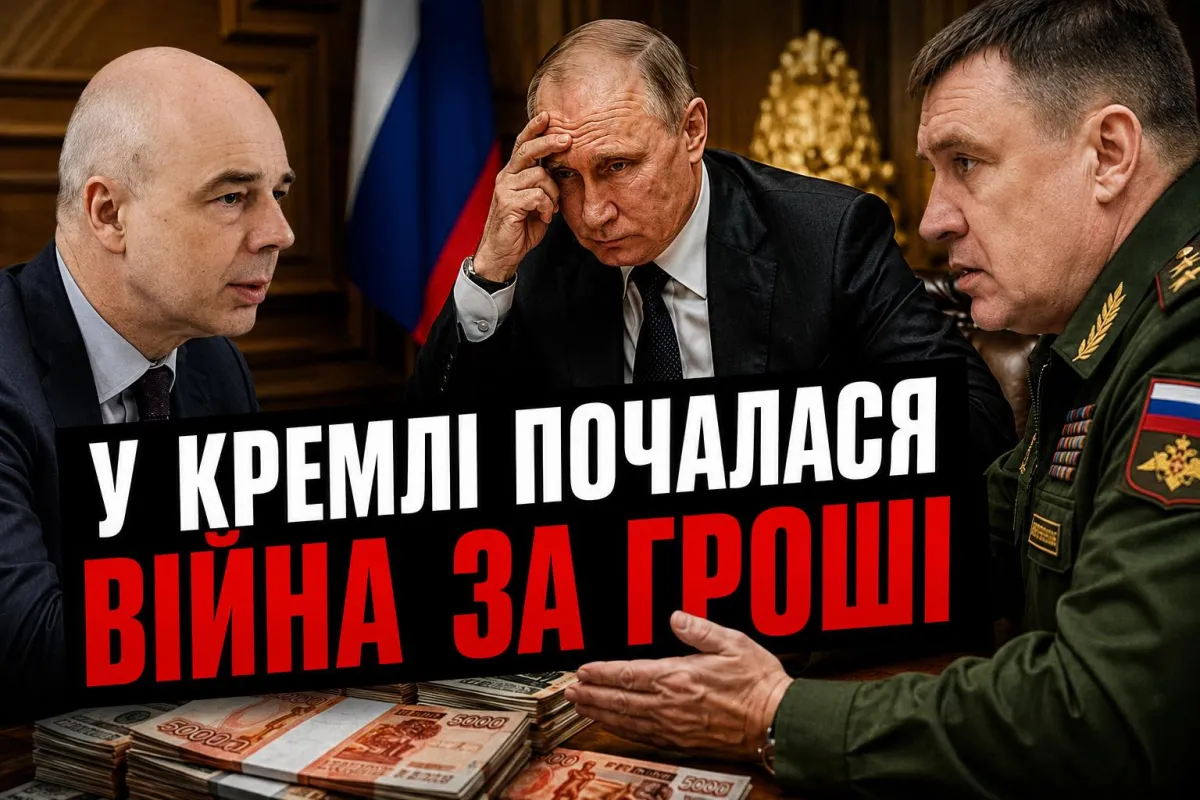
A conflict has broken out within the Russian government that, until recently, seemed impossible.
The government’s finance ministry wants to cut spending, whilst the military is demanding more money for the war. The very fact that such a dispute exists points to one thing: Russia’s economy can no longer cope with the strain.
Signs of trouble have been mounting for some time. The Kremlin has already been forced to ask large companies to make ‘voluntary contributions’ to the budget. This won’t bring in much money, but the very fact is telling. The authorities are beginning to take resources from those who have been their mainstay for decades.
The main conflict now seems straightforward. The Ministry of Finance and the Central Bank are warning of risks to the economy. The Ministry of Defence is asking for a further 3 trillion roubles to cover shortfalls in weapons and equipment. Putin is backing the military for the time being. But money is running out.
The Russian economy is already on the brink of recession. At the end of the first quarter, GDP showed a decline for the first time in three years. Even the Russian Ministry of Economy has lowered its growth forecast for this year from 1.3% to 0.4%.
It is important to understand one thing here. If official Russian statistics indicate growth of just 0.4%, the real situation is almost certainly worse. Russian officials are not inclined to dramatise problems. It is therefore quite possible that the economy will end the year in recession.
The budget situation looks even worse. In the first five months, the combined deficit of the federal and regional budgets approached 10 trillion roubles. That is approximately 140 billion dollars.
Revenues from oil and gas are also falling. According to the Russian government’s own data, they turned out to be almost 38% below target. And this is despite the fact that oil prices remain relatively high.
The reason is clear. For several years now, Ukraine has been systematically targeting Russia’s oil and gas infrastructure. Refineries, oil depots, storage facilities and logistics sites are all coming under attack. Each individual strike does not destroy the industry, but together they are gradually reducing its efficiency. That is precisely why high oil prices are no longer saving the situation as they once did.
According to Russian officials, the Ministry of Finance and the Central Bank have directly warned the Kremlin: current military spending is becoming a threat to the country’s financial stability. For the situation to start improving, two things are needed: oil prices above $100 per barrel for an extended period and a significant reduction in attacks on oil and gas infrastructure.
The problem is that neither of these conditions looks realistic at present.
Back in February, Finance Minister Anton Siluanov proposed freezing nearly 3 trillion roubles in civilian spending this year alone. In the coming years, the cuts are set to be even greater. The very fact that such proposals have been made shows just how difficult it is for the Kremlin to finance the war.
Russia has allocated 16.84 trillion roubles to defence and security this year. That is almost 40% of the entire federal budget.
Against this backdrop, the country is sinking deeper and deeper into stagflation. Put simply, prices are rising rapidly, whilst the economy is barely growing or is beginning to decline. This is one of the most dangerous scenarios for any state, as standard solutions are ineffective here.
To plug the budget gaps, the Kremlin is spending reserves and printing money. The National Welfare Fund has shrunk by around 70% since the start of the war.
Problems are also mounting in the business sector. Around 60% of large Russian companies ended last year with a drop in profits. Many are already cutting back on investment, whilst some are preparing for staff cuts.
This does not yet mean that the Russian economy will collapse tomorrow. But for the first time since the start of the full-scale war, the Kremlin’s financial bloc has begun to speak openly to Putin about what they previously preferred to keep quiet: more and more money is needed for the war, whilst the economy’s capacity is dwindling.
All articles in the "Opinion" section are published in full from their original sources. The editorial team may not share the authors’ views and accepts no responsibility for their statements.