Belarus has closed access to forests in a number of border areas
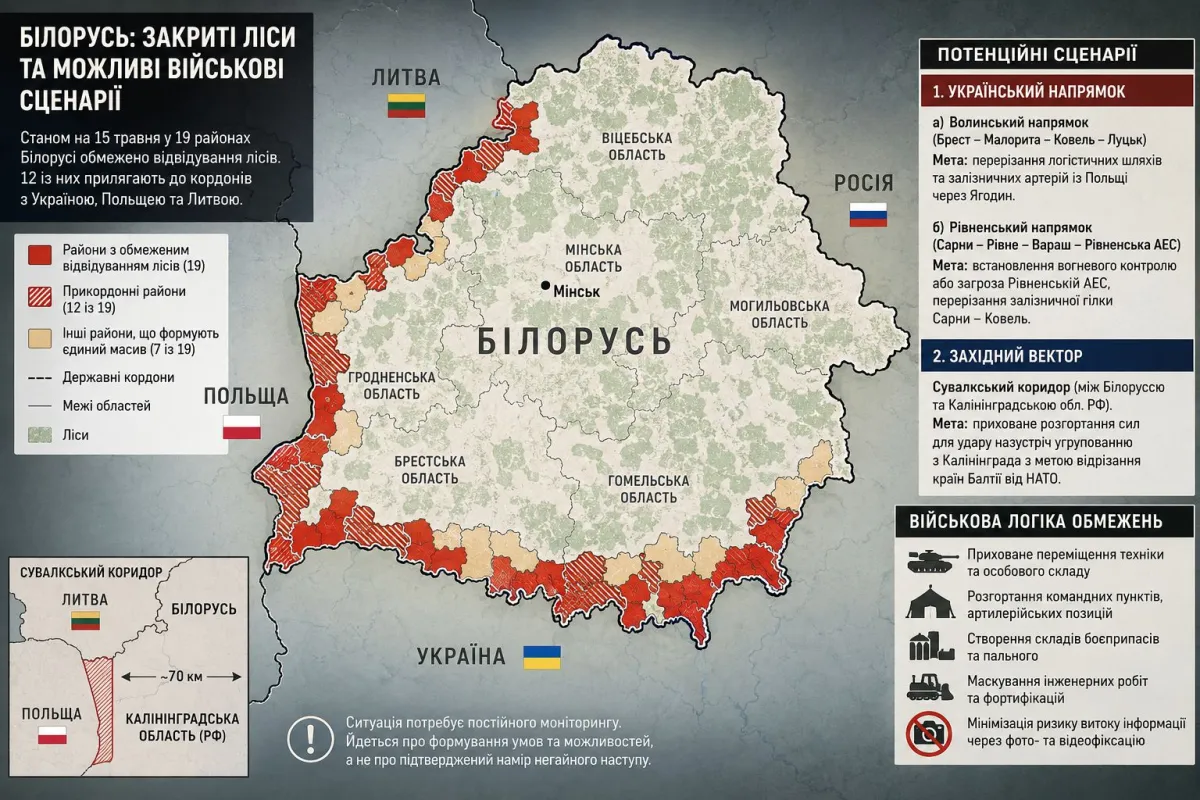
The Belarusian authorities have imposed restrictions on access to forests in 19 districts. Some of these are located near the borders with Ukraine, Poland and Lithuania.
An analysis of the geographical distribution of these restrictions is particularly noteworthy from a security perspective: 12 districts are situated directly adjacent to the state borders with Ukraine, Poland and Lithuania. The other districts form a single territorial bloc with them in the west and south-west of the country.
Formally, these are fire prevention measures and seasonal restrictions. However, the very configuration of the closed areas, their concentration specifically in the border zone, as well as the overall context of Minsk’s recent statements and actions, compel us to consider these measures within a military-political framework as well.
In modern military practice, restricting civilian access to forest and border areas is traditionally used to ensure the covert movement of troops, the deployment of field logistics, the establishment of temporary ammunition and fuel depots, and the setting up of command posts and engineering positions. Furthermore, such measures minimise the risk of information leaks caused by photographic and video recording of the movement of equipment and personnel.
It is particularly significant that these restrictions are being imposed against the backdrop of reports from Ukrainian intelligence regarding the intensification of military infrastructure within Belarus and the increased frequency of joint military activities between Minsk and Moscow.
Given the geography of the restricted areas, two main potential directions can be identified within which such actions may have military significance.
The first is the Ukrainian direction.
The southern and south-western parts of the Brest region, which borders the Volyn and Rivne regions of Ukraine, attract the most attention. This area is particularly important from a Ukrainian logistical perspective, as a significant portion of the transport and rail routes supplying Western military aid pass through Volyn.
In this context, two operational scenarios could potentially be considered.
The first involves creating a threat in the Volyn direction, particularly in the Kovel and Lutsk areas. Even without a large-scale offensive, the mere presence of the risk of an attack from Belarus forces Ukraine to maintain significant reserves on its northern border and to disperse forces that could otherwise be deployed on other sections of the front.
The second scenario relates to the Sarny–Rivne–Varash axis. Its strategic importance is determined both by the presence of critical railway infrastructure and the location of the Rivne Nuclear Power Plant. The creation of even a limited military threat to this area would have a significant military-political and psychological impact, and could also substantially affect the logistics of Ukrainian forces.
The second potential vector is the western one, linked to the so-called Suwalki Corridor.
This refers to the narrow strip between Belarus and the Kaliningrad Oblast of the Russian Federation, which connects the Baltic states with the main NATO territory. In Western military assessments, this direction has for many years been considered one of the most vulnerable in the Alliance’s security system.
The concentration of restricted areas in the western part of Belarus theoretically creates conditions for the covert deployment of forces near the Polish and Lithuanian borders. In a crisis scenario, this could be used to demonstrate force, carry out provocations, or pose a potential threat to land links between the Baltic states and the rest of NATO territory.
At the same time, another, no less likely scenario must be taken into account — a demonstrative-psychological one.
Belarus and Russia may be deliberately creating an atmosphere of constant military threat in the north without intending to move to immediate active operations. The main objective in such a case is to force Ukraine, Poland and the Baltic states to maintain significant forces along their borders, thereby dispersing reserves, air defence resources and logistical capabilities.
This is precisely why the current situation should not be interpreted as a direct sign of an imminent offensive. However, a combination of factors — geographical constraints, synchronisation with Minsk’s aggressive rhetoric, military activity by Russia and Belarus, and the strategic importance of the border regions — objectively provides grounds for heightened vigilance on the part of Ukraine and NATO countries.
At this stage, it is more a matter of creating conditions and opportunities than of a confirmed intention to use force immediately. But in the context of modern warfare, it is precisely such preparatory actions that often become part of a broader strategy of pressure, destabilisation and forcing the enemy to scatter its resources.
All articles in the "Opinion" section are published in full from their original sources. The editorial team may not share the authors’ views and accepts no responsibility for their statements.