ESBU cleaning or cosmetic facade renovation?

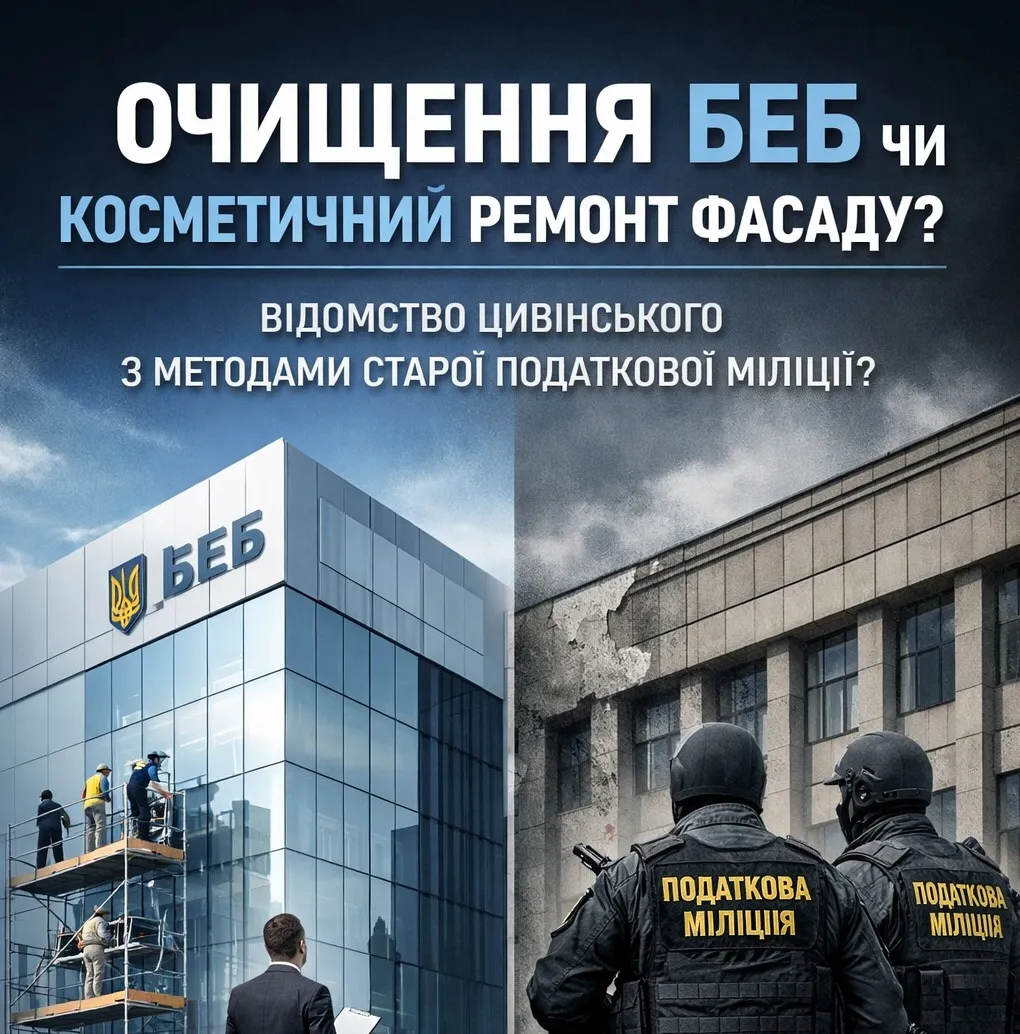
Names change, budgets are spent, but the essence remains the same: the state continues to view business as a source of revenue, and law enforcement agencies as a tool for reaping that harvest.
Enough time has passed since Oleksandr Tsivinsky was appointed director of the ESBU in August 2025 (as of April 2026 – eight months) to dispel any illusions about a ‘reset’. The time for promises is over. The time has come to audit the reality on the ground. Let us take a look at what is happening ‘in the field’: instead of building a modern analytical centre to identify systemic financial threats, we have ended up with a classic punitive structure that has learned to mask old racketeering habits under the guise of trendy European PR.
The Smiliansky syndrome: stamps instead of parcels, memoranda instead of security
The ESBU’s current strategy is painfully reminiscent of Igor Smiliansky’s management style at Ukrposhta. But whereas there, amidst high-profile presentations, brilliant tweets and the release of new patriotic stamps, parcels are being lost en masse and deliveries delayed, at the Bureau of Economic Security, under the slogans of a ‘new philosophy’, the business itself is being lost.
Oleksandr Tsivinskyi and his team have staked everything on communication. They present projects such as the ‘Economic Shield’, give interviews on prevention, sign memoranda and organise photo shoots against a backdrop of partners’ flags. But this ‘shield’ turns out to be nothing but a piece of cardboard the moment an ordinary finance director faces reality: yesterday you carried out a legal foreign economic transaction, today a shoddy ‘analytical report’ has been written about you, and tomorrow morning masked men burst into your office to seize the servers. There’s plenty of PR, but no tangible change for legitimate business — zero.
Personnel necromancy: how ‘new’ faces turn out to be well-forgotten old ones
Real reform is driven by people. And it is the BEB’s personnel policy that serves as the marker ruthlessly stripping the agency of its European integration mask. Whilst we are being told about a large-scale overhaul and performance reviews, the Bureau’s leadership is engaged in blatant personnel necromancy.
The most striking diagnosis of the system is the events of 27 February 2026. On that day, Tsivinsky personally introduced the new acting head of the Kyiv ESBU, Roman Lysakovsky. The official biography of this ‘new face’ proudly states that his career spans over two decades of service in operational and managerial roles within the very same old tax police (from 2004 to 2021). Appointing a veteran of the tax police to head a key regional office of the ESBU is like appointing a repeat-offender wolf to run security at a sheep farm, calling it ‘innovative risk management’. The personnel from the days of the infamous Perkhun haven’t gone anywhere. They’ve simply bided their time, undergone an ‘upgrade’, received new ranks and continue to sit comfortably in the very same chairs.
Conference tourism in a brand-new BMW
Whilst the ‘tried and tested staff’ are terrorising entrepreneurs on the ground, the agency’s façade requires attractive and modern trappings. This is where figures such as Kateryna Zaremba (not to be confused with the well-known researcher Kateryna Zarembo) come onto the scene.
Without any unnecessary competitive selection processes or transparent procedures, Ms Zaremba finds herself at the ESBU as head of the department responsible for international cooperation. The job description sounds as impressive as can be, but in practice it resembles high-end conference tourism. Business trips, photographs with representatives of the OECD and Europol, round-table discussions — a splendid façade of intense activity is created at the expense of the trust (and often the finances) of international partners.
Rumours of personal connections with the leadership are circulating behind the scenes. But let’s leave the tabloid gossip aside — basic arithmetic is enough to reach a verdict. Let’s open the official’s declaration for 2025. Against the backdrop of her salary and business trip reimbursements, a brand-new 2024 BMW X1 suddenly appears. The cost — over 2 million hryvnias (2,026,131 UAH, to be precise). Date of acquisition: 16 April 2025. How does this miracle align with a civil servant’s income? Very cleverly: on the very same day, 16 April, a loan for 1,418,131 UAH is taken out.
When a person responsible for the state’s economic security and representing it before Europol suddenly acquires a fleet of luxury cars under the guise of dubious loan schemes (leaving a discrepancy of over 600,000 hryvnias open to legitimate scrutiny), talk of ESBU reform’ sounds like a bad joke. This is a demonstration of success, but not of the state’s, but purely personal.
Certification as a tool of coercion
We are being sold a story of a ‘reset’ through the certification process, which began with Orders No. 35 and No. 274 in early 2026. But the design of this process is such that the internal hierarchy retains total control.
Firstly, the process is stretched out over 18 months. Throughout this time, the old guard continues to ‘run’ the business. Secondly, the methodology itself contains such vague concepts as ‘reasonable doubt’ or ‘personal relationships’. In independent hands, this would be a tool for weeding out toxic individuals without a court ruling. But when the commissions are controlled by management, these criteria become a scalpel for outsiders and a free pass for insiders. What we have is not a purge, but a tool for ensuring absolute loyalty: ‘If you meet the revenue targets, you’ll pass the assessment.’
Business reality
What is the business community feeling at this time? Indicators that cannot be faked by PR reports are screaming of deterioration. Both the European Business Association and the Business Ombudsman Council are recording a steady rise in complaints about the actions of investigators.
The main weapon of the modern ESBU is the so-called ‘analytical product’. In an ideal world, this would be in-depth research into macroeconomic patterns. In reality, the ESBU is a low-quality report, created merely to tick a box, which instantly becomes grounds for opening criminal proceedings. Typical, entirely safe business transactions — royalty payments, marketing services, legal payments to non-residents — are artificially criminalised.
The mechanics of the ESBU are sickeningly simple:
1. Write up an ‘analysis’ out of thin air.
2. Open criminal proceedings.
3. Conduct a search, paralyse operations, freeze accounts.
4. Offer a ‘compromise’ — you pay the taxes (even those that are completely disputed), we close the case.
This turns the security agency into a mere fiscal whip, where criminal proceedings are merely a tool for extorting money. Business operates by the rule: ‘prove you’re not a camel, or just pay up so they’ll leave you alone’.
An ultimatum for the ESBU
If the leadership truly wants to prove that the BEB is not a reincarnation of the tax police with a European makeover, it must stop juggling memoranda. Here is a concrete, measurable 10-point checklist. Without their implementation, all talk of reform is a lie:
1. Stop default raids. Searches must become an exclusively extreme, extraordinary measure. Today, this is a standard ‘first contact’ tool used to intimidate companies. This practice must be prohibited by law and regulation in 90% of economic cases.
2. Total inviolability of IT infrastructure. A strict ban on the seizure of servers, computers and telephones if there is even the slightest technical possibility of making a copy (forensic analysis) on site. Business must not be halted simply because it is more convenient for the investigator to take the equipment away in the boot of their car.
3. Introduction of a pre-raid review. No search should take place without internal peer review of proportionality. What exactly are we looking for? Why can’t these documents be obtained through a standard request? What risk does this action pose to the company’s lawful operational activities?
4. A public quality standard for ‘analytics’. An approved, publicly accessible quality standard for the ‘analytical product’ that serves as a trigger for criminal proceedings. Plus — the establishment of a mandatory independent audit of a sample of such reports to record the error rate.
5. Personal financial and professional accountability. An analyst or investigator whose flawed (or commissioned) analysis has led to unfounded seizures of property or the suspension of business operations must bear real accountability — up to and including dismissal and compensation for damages — rather than hiding behind the collective irresponsibility of the system.
6. Open statistics on failures. The ESBU must publish monthly figures on the number of seizures, rulings and cases overturned by the courts. If the courts are systematically rejecting the Bureau’s evidence, this is not a reflection on the courts, but on the catastrophic quality of the detectives’ own work.
7. Prioritisation rather than a tick-box system. A strict ban on opening dozens of minor cases purely ‘to meet targets and boost statistics’. KPIs should be measured solely by the number of major systemic shadow schemes dismantled, not by the number of registered documents.
8. Presumption of adequate communication. Mandatory communication with the company prior to the commencement of any aggressive procedural actions (except in cases where there is a proven risk of evidence destruction). Legitimate businesses have no need to burn documents upon request — they are already in the accounts department.
9. Transparent vetting tracking. The public must see the full picture of the purge: how many former staff with a police background failed the vetting, the exact criteria by which they were rejected, and what percentage of the management cadre from the ‘pre-Tsivinsky’ era left the agency.
10. Personnel transparency in high-profile departments. An end to the practice of appointing ‘insiders’ to lucrative European integration posts without competitive selection. The introduction of clear, measurable KPIs, open performance results and completely transparent appointment procedures. Without this, the international cooperation department will forever remain a VIP travel agency.
Author’s afterword
Institutional reform is not a new logo, visits to international forums, or social media posts about ‘building trust’. True reform only comes about when a specific detective on the ground changes his behaviour, because the system has put safeguards in place that physically prevent him from operating using the racketeering methods of the 1990s.
Until Oleksandr Tsivinsky begins to implement these ten points as part of his daily routine, the Economic Security Bureau will remain an old, rusty car with its number plates tampered with. And no matter how much you wash it, no matter how many ‘European Integration’ stickers you stick on the rear window — it will drive like the good old tax police. And, as always, it will be Ukrainian business that has to foot the bill for this feast of illusions.
Original source: the author’s Facebook page
All texts in the “Position” section are published in full from their original sources. The editorial team may not share the authors’ views and accepts no responsibility for their statements.