The truth about Donbas that nobody is talking about: is there an acceptable solution for Ukraine?
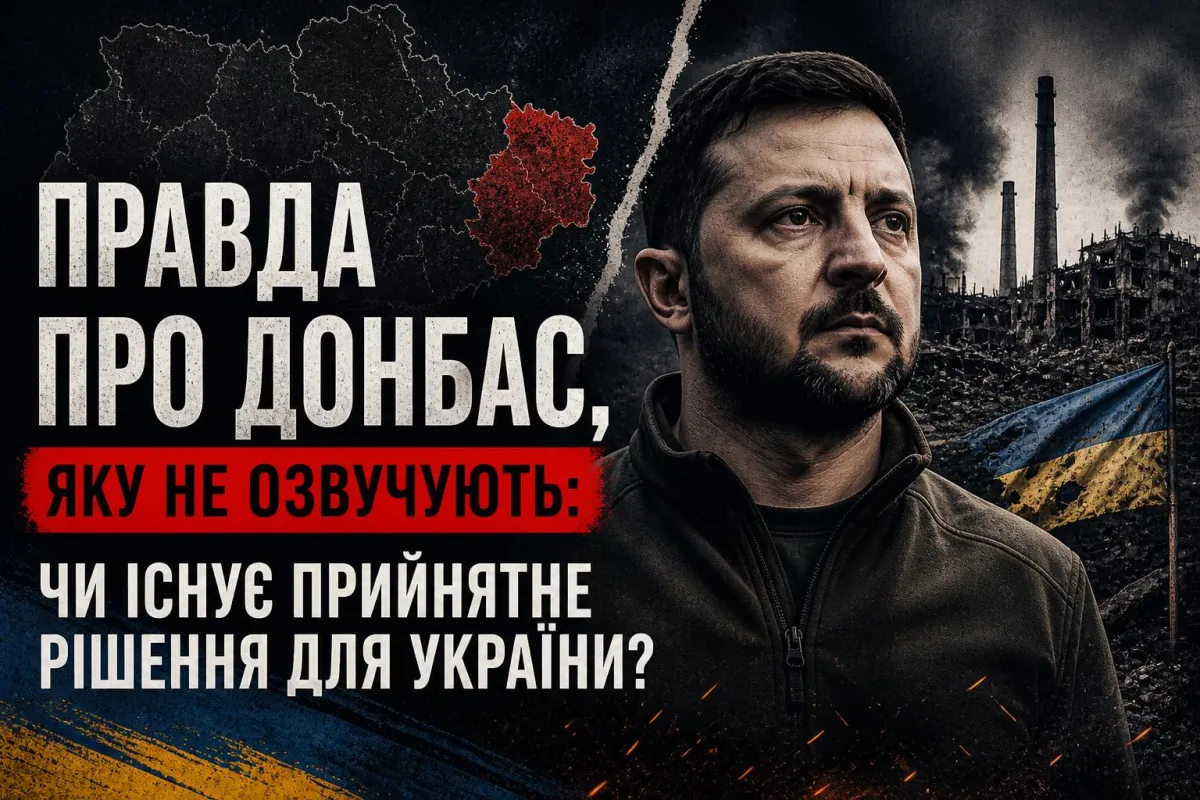
Ukraine is not considering any options for ceding territory in the Donetsk and Luhansk regions. At the same time, against the backdrop of the ongoing war and the mutual exhaustion of the parties, scenarios for a possible freeze on the conflict are being discussed with increasing frequency.
The issue of Donbas, like that of any of our other territories, represents a clear ‘red line’ for Ukraine. Kyiv does not and will not consider any option involving the transfer of territories in the Donetsk and Luhansk regions — regardless of pressure, the negotiation process or the positions of external players. At the political level, this appears to be the only viable approach. Any scenario involving the voluntary withdrawal of the Defence Forces from Ukrainian territories would mean not just a military defeat, but a political collapse. For Volodymyr Zelenskyy, this would be a decision impossible to survive politically: effectively an admission of capitulation, with predictable consequences in the form of internal destabilisation. Ukrainian society is unlikely to accept such a compromise, and this adds another dimension to the problem — even assuming that external pressure on Kyiv will increase.
But beyond the political rhetoric, the situation looks far more complex. The key question is not whether Ukraine is ready or not to accept a deal, but what options actually exist in reality. And here, one has to abandon convenient illusions.
The immediate outlook has nothing to do with a swift peace. On the contrary, everything points to both sides preparing for a new phase of intense hostilities. Ukraine is systematically building up its long-range capabilities, actively developing its drone capabilities and strengthening its technical capabilities on the battlefield. Russia, for its part, shows no willingness to make strategic concessions and is also working to strengthen its positions. This means that the coming months are not about compromises, but about an attempt to shift the balance of power ahead of possible negotiations.
Under this logic, the very emergence of a negotiation process will appear not as the result of agreements, but as a consequence of mutual exhaustion. The parties will sit down at the negotiating table when they realise that continuing the war will not yield a quick result or will require unacceptable resources. Therefore, the most likely scenario is an escalation in the summer and the start of more serious negotiations in the autumn, following attempts to change the situation on the front line.
However, even if such negotiations do begin, the Donbas issue will not have a simple solution. The option of full de-occupation in the short term appears unrealistic, even if it remains a strategic goal. A return to the logic of the Minsk agreements is also virtually out of the question: since 2022, Russia has fundamentally changed its position, integrating these territories into its own political and legal system. For Vladimir Putin, any scenario involving their return to Ukraine, even in the form of autonomy, would constitute a political defeat that he is not prepared to accept.
Ideas about creating a neutral zone or a special economic territory look attractive only in theory. In practice, they run up against the fundamental question of control: who exactly will govern these territories, which laws will apply there, and who will ensure security. Ukraine will not agree to relinquish sovereignty, Russia will not agree to lose control, and involving a third party seems almost unrealistic. None of the major players will accept the role of mediator, which runs counter to their own interests: Donald Trump is unlikely to agree to a Chinese model, Russia will not agree to a Western one, and Europe, without full US support, lacks the necessary resources for such a project.
As a result, the scenario that remains is the one that all parties like the least, but which at the same time seems the most likely. This involves effectively cementing the front line as the new reality. It will not be a legally formalised division of territories and will not imply an acknowledgement of losses, but de facto it is control over territories at the time of the agreements that will determine the boundaries of the parties’ spheres of influence. Ukraine will retain what it controls, and Russia what it is able to hold on to.
Such a scenario is not peace in the classical sense. It is, rather, a frozen conflict with a high risk of renewed escalation in the future. It does not resolve the Donbas issue, but merely postpones it, shifting it into the long term.
All articles in the "Opinion" section are published in full from their original sources. The editorial team may not share the authors’ views and accepts no responsibility for their statements.