The Ukrainian Institute for the Future has presented a scenario for industrial development up to 2035

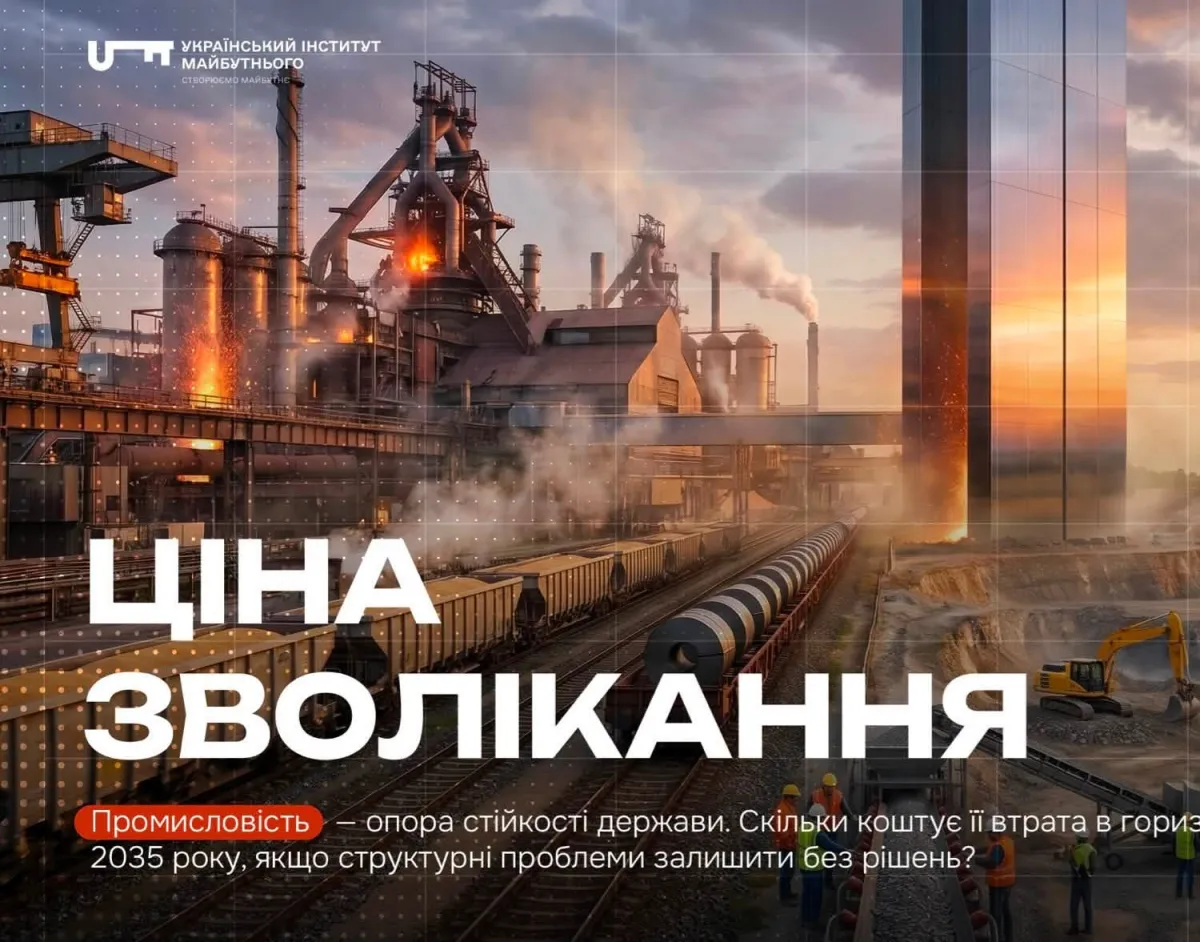
The Ukrainian Institute for the Future has presented a study in which it has modelled a business-as-usual scenario for the development of nine key industrial sectors up to 2035. The authors highlight interrelated factors which, in their view, could exacerbate the economic crisis.
Do you like bad news?
Well, neither do I.
That’s precisely why the Ukrainian Institute of the Future is engaged in scenario modelling of the future – so that we can see in good time where the tide is taking us, and have time to adjust our course.
A year ago, I wrote a post about the closure of a major city-defining enterprise.
About the chances of saving it and the cost if we don’t.
Today we presented a study on a different scale.
Nine sectors – metallurgy, chemicals, engineering, energy, logistics and others – have been consolidated into a single model of an inertial scenario up to 2035.
The conclusion is simple and unpleasant. These are four loops that feed into one another.
- Expensive energy is hitting industry
- Industry cannot decarbonise
- CBAM is rising
- There is no margin left, not even to break out of the cycle. And so it goes round and round.
Now for the figures – in brief, to illustrate the scale.
- 810,000 industrial jobs were lost between 2021 and 2024. That’s a 37 per cent drop in the industrial workforce.
Just imagine – that’s the entire population of Lviv (!)
...
Between 2013 and 2025, the metallurgy sector has already lost around 230,000 direct jobs – from 300,000 to 70,000.
A single steelworker creates up to 8 jobs in related sectors, so further contraction due to CBAM and the energy crisis threatens a further 560,000 indirect jobs (!) – these are the people who are currently holding on in Kryvyi Rih, Zaporizhzhia and Kamianske, working at the steelworks.
...
The engineering sector is losing not in terms of quantity, but in terms of quality.
By 2035, the cumulative outflow of skilled personnel is estimated at 25–45 per cent.
It takes 5–7 years to train an engineer, and even with full funding, this gap will not be closed before 2032–2035(!).
...
The energy sector was our competitive advantage before the war.
Currently, the industrial tariff in Ukraine is almost a third higher (!) than the European average – and this is not a temporary phenomenon, but a structural situation set to persist until at least 2027–2028 (!)
...
CBAM is already in force.
Exports of long steel products to the EU fell by 64 per cent in January–February this year.
One steelworks has cancelled orders for 1.25 million tonnes – half of its annual target.
...
Seven million refugees abroad represent $15–18 billion in lost GDP for Ukraine each year until they return.
Add it all up – and you get the cost by 2035: $260–300 billion.
And this isn’t down to missile strikes. It’s because problems that could be solved have been put off for years.
The good news is that there are alternative scenarios, but they depend on our willingness to change the current trend.
We will be presenting this study, which includes a policy concept for new industrialisation and the relevant calculations, in the autumn
The full study is available on the Institute’s website:
All articles in the "Opinion" section are published in full from their original sources. The editorial team may not share the authors’ views and accepts no responsibility for their statements.