The Vulture Syndrome: Why have all our neighbours suddenly turned their attention to Ukraine?
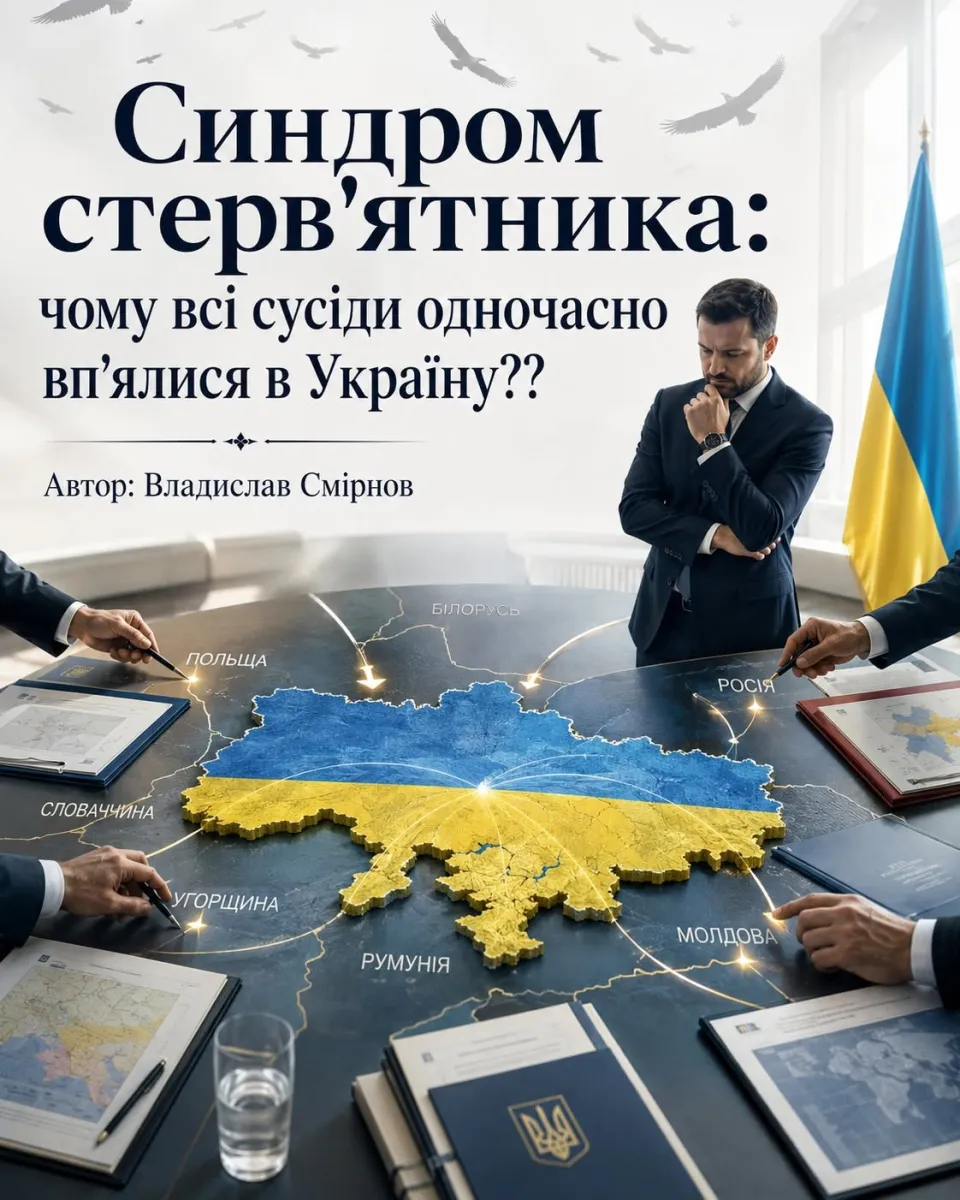
A number of Ukraine’s neighbouring countries have stepped up their focus on issues of historical memory, national minorities and bilateral relations against the backdrop of the war with Russia.
What you are feeling right now as you watch the news from Warsaw, Budapest, Bucharest or Sofia is entirely justified, healthy patriotic anger. When a country is bleeding to death in the trenches, defending the eastern flank of civilisation, whilst those it shields with its back begin to tear apart its political, historical and territorial body — it looks like a surreal nightmare. This provokes despair and a logical question: is this a conspiracy? Or is it a mere coincidence that all our neighbours have suddenly dug out their old maps and started presenting us with the bill?
We have witnessed classic geopolitical pillaging. International politics does not operate in terms of ‘gratitude’, ‘empathy’ or ‘justice’. It operates exclusively in terms of power, interest and windows of opportunity. And today it is time for us to finally bury our geopolitical naivety and figure out why our neighbours are acting as a pack and how the Ukrainian state must break their backs in this diplomatic war. We find ourselves in the eye of a perfect storm, where every neighbour has its own historical trauma, which it is trying to heal at Ukraine’s expense.
Hungary (Taran): Budapest has turned Zakarpattia into its political testing ground. The phantom pains of the Treaty of Trianon dictate their policy. They do not demand equality, they demand exclusivity: passportisation, language dictates, institutional enclaves and the 11 points of the ultimatum, which effectively remove part of Ukrainian territory from Kyiv’s educational and cultural sovereignty.
Poland (A stab in the back): Warsaw has disregarded all the 2003 reconciliation agreements. Sensing our logistical dependence, the Polish elites have launched a campaign of historical blackmail against Volhynia, compounded by economic terror (border blockades). They seek to cement Ukraine’s status as the ‘eternally guilty junior partner’, one that will pay for the right of transit through economic and moral concessions.
Romania (Silent assimilation): Bucharest acts less noisily than Orbán, but no less systematically. The concept of ‘Greater Romania’ has not gone away. They are handing out passports en masse in Bukovina and Budzhak, funding churches and schools, quietly turning Ukrainian citizens into a Romanian political resource under the guise of ‘protecting European rights’.
Slovakia (Economic parasitism): Fico’s government openly echoes Kremlin narratives, blocks military support, yet continues to profit from transit. They are playing on Moscow’s side just enough to squeeze the maximum economic concessions out of us and Brussels.
Bulgaria (The Trojan Horse in the South): A new front. Sofia is beginning to exploit the issue of Southern Bessarabia. Under the guise of ‘derussification’ of the Bulgarian minority, they are laying the groundwork for educational ultimatums. And their radicals are already openly drawing up maps where Budzhak becomes ‘Bulgarian land’.
But why have they attacked now of all times?
The neighbours did not conspire around a single table, but their actions are perfectly synchronised. This synchronisation is dictated by four ironclad factors of our temporary vulnerability:
1. The smell of blood and logistics
Weakness provokes aggression. Our neighbours understand perfectly well that Ukraine is currently in a state of existential war. Our ports are partially blocked, our airspace is closed. Warsaw, Bucharest and Bratislava are our lifelines, through which weapons, fuel and bread pass. They have cynically decided: ‘If Kyiv depends on our roads, we can twist its arm on issues of history, language and territorial structure. They have no choice; they will agree.’ This is trading our survival in exchange for their national interests.
2. The guillotine of European integration
EU accession has turned into a trap of institutional blackmail for us. EU rules give every member state the right of veto at any stage of negotiations. Our neighbours no longer need armies to chip away at our sovereignty. All they need is a single vote in Brussels. Orbán, Tusk or Fico can block an entire chapter of negotiations by demanding ‘special status’ for their minorities or forcing us to renounce our own memory. European integration has become the perfect legal tool for dismantling our internal agency.
3. The Russian conductor and hybrid warfare
It would be criminally naive not to see the shadow of Moscow behind this parade of claims. Having suffered a collapse in its attempt to capture Kyiv in three days, Russia has shifted to a strategy of balkanising Ukraine. For decades, they have poured billions into Eastern European radicals. The Hungarian ‘Jobbik’, the Romanian ‘AUR’, the Polish ‘Confederation’, the Bulgarian ‘Vazrazhdane’, the Slovak ‘Smer’ — all form a network fuelled by the Kremlin. Russia is using its neighbours as political proxies to open a second front against us — a front of internal division, historical enmity and mistrust.
4. Cheap electoral parasitism
For the political pygmies of neighbouring states, Ukraine has become the ideal victim for domestic elections. Why should the Polish prime minister tackle the complex systemic problems of his own farmers when he can block the Ukrainian border and become the ‘defender of the nation’? Why should Romanian or Bulgarian politicians develop their economies when they can play on historical resentment and win votes by shouting about ‘saving their compatriots’ in Ukraine? We have become a free PR platform for them.
What Ukraine must do IMMEDIATELY:
We must stop thinking of ourselves as victims. We can no longer be complacent. If we continue to cede ground under the guise of ‘European values’, we risk winning the war against Russia but losing our state, torn to shreds by our ‘Western friends’.
Ukraine needs a radical shift towards a Doctrine of National Interest
Tough, tit-for-tat diplomacy.
The time for silently swallowing ultimatums is over. Every demand from Budapest, Warsaw or Sofia must be met with a symmetrical, fact-backed demand from Kyiv. Demanding schools for Hungarians in Zakarpattia? Where are the state Ukrainian secondary schools in Budapest? Demanding exhumations in Volhynia? Where are the restored Ukrainian monuments on Mount Monastyr and in Hrushevychi? Are you demanding special status for the Bulgarian language in Bessarabia? Show us the Ukrainian cultural autonomies in Bulgaria. Any game must be played exclusively on the basis of reciprocity. No means no for both sides.
Institutional clean-up of the border regions.
The state must return to its border regions with an iron grip. Zakarpattia, Bessarabia and Bukovina cannot be a free-for-all for foreign funds. All financial flows intended to support minorities from neighbouring states must undergo a rigorous financial and security audit by the SBU and the Ministry of Finance. Whoever pays the teacher shapes their worldview. We must flood these regions with Ukrainian money, Ukrainian content and Ukrainian incentives. The Ukrainian state must become the sole and indispensable patron for all its citizens, regardless of their ethnic origin.
Asymmetric alliances.
We need to stop banging our heads against a brick wall when dealing with blackmailers. If Warsaw or Budapest block us, we must go over their heads. Ukrainian diplomacy must build a strong axis with Washington, London, Stockholm, Helsinki and the Baltic states. It is precisely these heavyweight states (or states that understand the real existential threat) that must put pressure on our Eastern European neighbours through NATO mechanisms and EU funds. Orbán and Fico understand only the language of power and money — and it is those who provide them with this money who must make that language heard.
The nationalisation of historical memory.
We are on our own land. We will not ask Warsaw’s permission as to whom we should consider heroes. We will not ask Sofia’s permission on how to divide up districts in the Odesa region. We must make it clear: territorial integrity, administrative structure, the official language and the national pantheon of memory are not bargaining chips for joining any alliances. Europe respects only those who respect themselves.
Conclusion
The fact that our neighbours are bearing down on us today is a test of the maturity of our statehood. We must stop being surprised by their cynicism. This is not the end of the world; it is simply the true face of geopolitics. We are not shedding blood in the east and south so that we can hand over the west and Bessarabia in the offices of European integration. The time for apologies is over. The time has come to dictate our own terms.
Ukraine today is a wounded lion, surrounded by jackals waiting for it to be exhausted in its battle with the bear. But the lion has no right to die, and no right to share its flesh. We must grow diplomatic and institutional fangs sharp enough to shatter any ultimatum, lest we be torn to pieces as souvenirs by those who smile at us today at diplomatic receptions. And for this, we need a national Ukraine-centred policy for Ukraine, a Doctrine of National Interest for Ukrainians.
All articles in the "Opinion" section are published in full from their original sources. The editorial team may not share the authors’ views and accepts no responsibility for their statements.