The war is entering a phase of resource and logistical attrition
As of 24 June, the situation on the front line remains tense. At the same time, there are increasing signs that the nature of the war is changing, with the depletion of resources, logistics and the strategic resilience of the parties playing a key role.
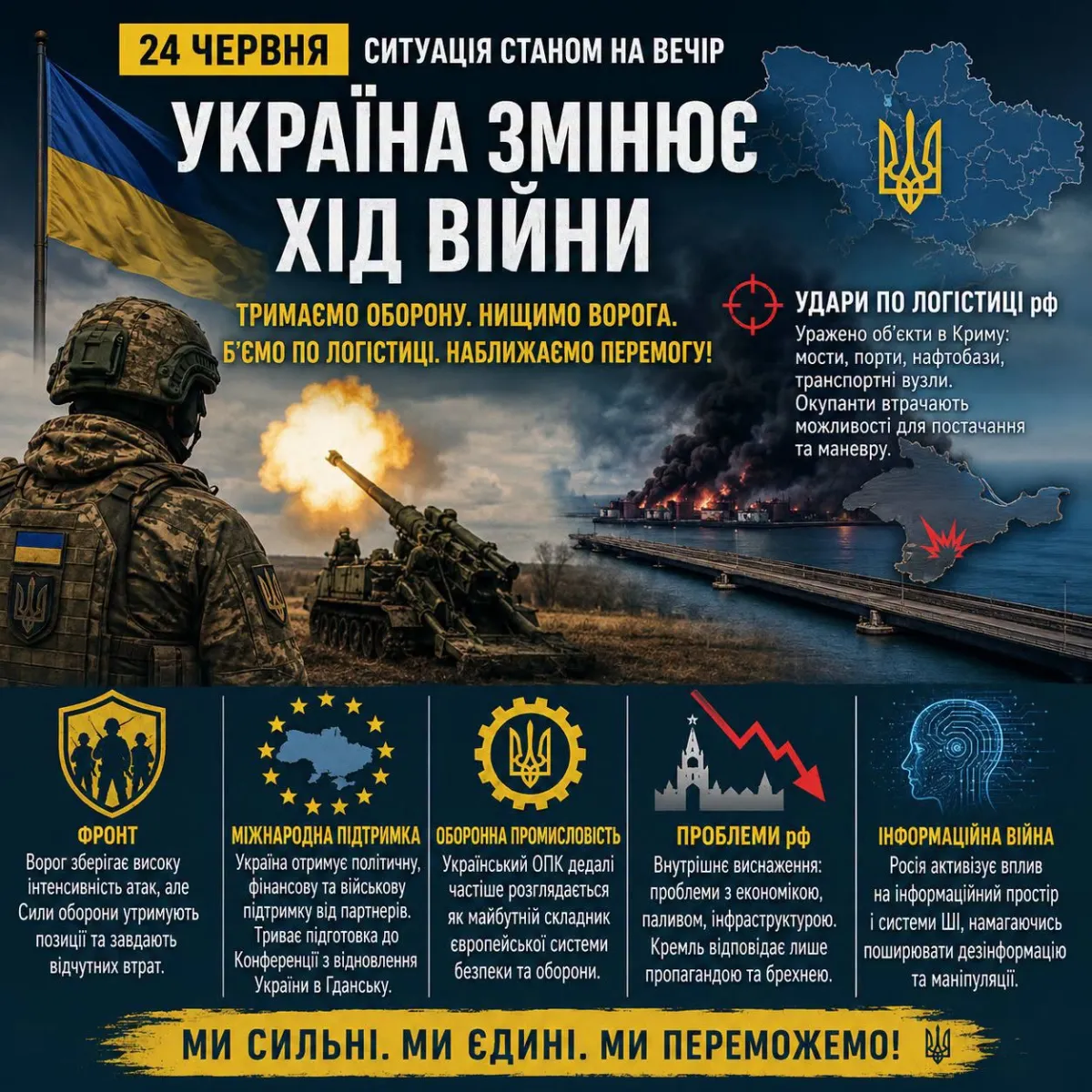
As of 24 June, the situation remains tense, but there are increasing signs that the nature of the war is gradually shifting in Ukraine’s favour.
On the front line, the Russian command continues to maintain a high intensity of offensive operations, primarily in the Pokrovsk, Kostiantynivka, Lyman and Huliaipole sectors. The number of combat engagements remains significant, indicating the enemy’s determination to achieve at least limited results during the summer campaign, whatever the cost. At the same time, the Defence Forces are holding their positions, inflicting significant losses on the enemy and gradually sapping its offensive potential.
The battle for logistics is becoming increasingly important. Following a series of Ukrainian strikes on transport, fuel and port infrastructure around the Kerch Strait, as well as on facilities supporting the occupying forces in Crimea, Russia has been forced to divert additional resources to sustaining its own military logistics. The destruction of the railway bridge across the North Crimean Canal was the latest element in a systematic campaign to disrupt the enemy’s supply chains. Crimea is increasingly losing its role as a secure rear area and is turning into a vulnerable logistical island, dependent on a limited number of supply routes.
On the international front, Ukraine continues to receive political, financial and military-technical support. Preparations are underway for the Conference on the Reconstruction of Ukraine in Gdańsk, and positive momentum in cooperation with the EU, NATO, the World Bank and other partners is being maintained. It is particularly important that the Ukrainian defence-industrial complex is increasingly viewed not merely as a recipient of aid, but as a future component of the European security and defence production system.
At the same time, signs of internal exhaustion are mounting within Russia itself. Problems with financing civilian infrastructure are mounting, difficulties in the fuel market in certain regions are deepening, and the Kremlin is increasingly attempting to compensate for real economic and logistical problems through information manipulation and propaganda.
A new dimension of information warfare deserves special attention. Russian agencies are increasingly attempting to influence not only public opinion but also artificial intelligence systems, flooding the information space with disinformation and propaganda narratives on a massive scale. This indicates that the battle for the information space is gradually shifting into the realm of next-generation digital technologies.
The main conclusion of the day is that the war is increasingly shifting towards the systematic depletion of the enemy’s resources. Whereas changes to the front line used to be the key indicator, today logistics, industrial capacity, energy, international support and the ability of states to withstand a protracted conflict are becoming increasingly important. It is precisely in these areas that Ukraine is increasingly imposing its own agenda on the enemy and forcing it to react to Ukrainian actions, rather than the other way round.
All articles in the "Opinion" section are published in full from their original sources. The editorial team may not share the authors’ views and accepts no responsibility for their statements.