The war is entering an even more technologically advanced phase against a backdrop of intense fighting
As of the morning of 1 July, the intensity of fighting on the front line remains extremely high. At the same time, the war is increasingly shifting towards a phase of technological and resource-based confrontation.
As of the morning of 1 July 2026, the main conclusion is simple: the war is entering a phase characterised by even greater use of technology and resources.
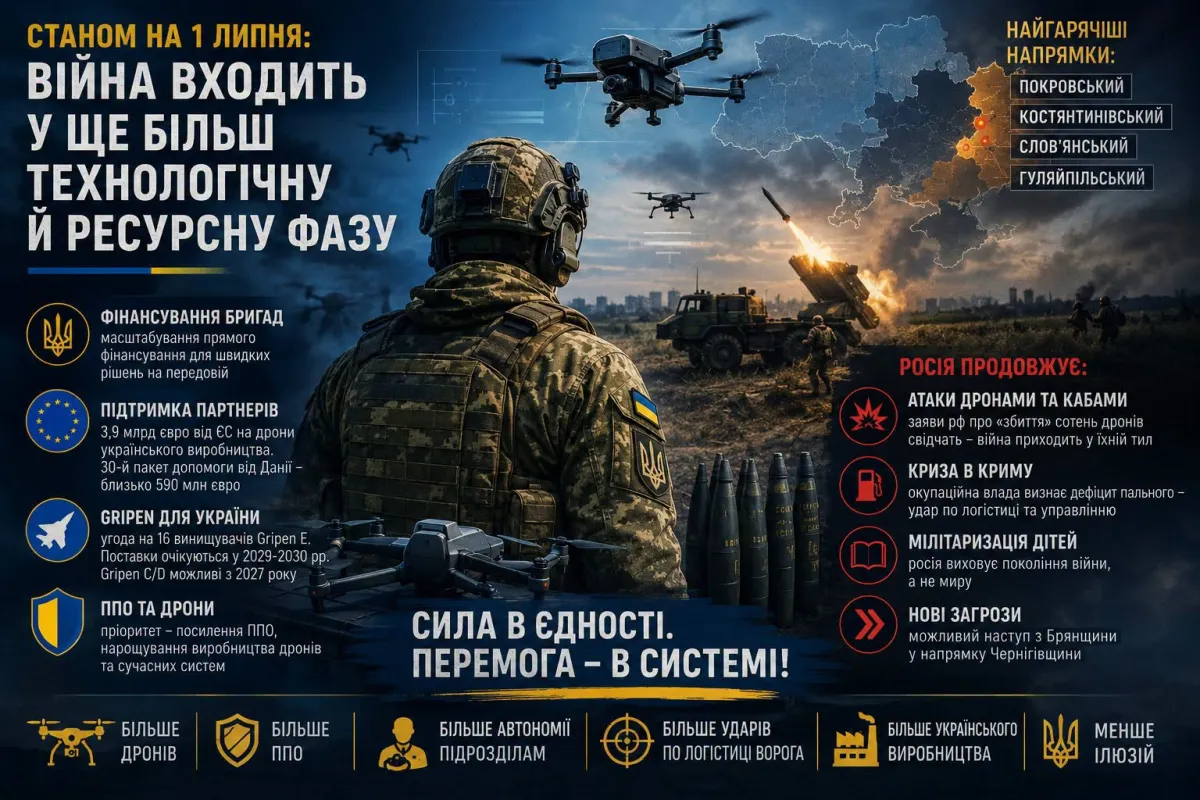
On the front line, the intensity of fighting remains extremely high. According to the latest data, over two hundred combat engagements are taking place every day. The hottest sectors remain Pokrovsk, Kostiantynivka, Sloviansk and Huliaipole. Russia continues to apply pressure with massed infantry, guided air-to-ground munitions, artillery and drones. However, this sheer force is no longer yielding rapid operational results. The war is increasingly turning into a war of attrition, in which it is not high-profile statements that are decisive, but logistics, air defence systems, drones, ammunition and the ability of units to receive the necessary resources promptly.
That is precisely why the decision to scale up direct funding for combat brigades is fundamentally correct. The war has become so dynamic that lengthy bureaucratic procedures no longer keep pace with it. It is the commanders on the front line who know best what their units need right now: electronic warfare equipment, drones, transport, communications, repair facilities, ammunition or engineering equipment. Decentralising funding is not about the convenience of commanders, but about the speed at which units can survive and the effectiveness with which the enemy can be defeated.
The second key indicator is that funds from international partners are increasingly being channelled not only towards the supply of ready-made weaponry, but also towards the development of Ukraine’s defence industry. The European Union has already transferred €3.9 billion to Ukraine from the defence component of a €90 billion loan. These funds are primarily earmarked for the procurement of Ukrainian-made drones. This is an extremely important trend: Ukraine is gradually becoming not only a recipient of military aid, but also one of the key production hubs of modern warfare.
Denmark has confirmed the allocation of its 30th military aid package, amounting to approximately 4.4 billion Danish kroner, or nearly 590 million euros. Part of these funds will also be used under the so-called ‘Danish model’, whereby funding is channelled directly towards the procurement of products from the Ukrainian defence industry. It is precisely this mechanism that should now be scaled up with Ukraine’s other partners.
A separate issue concerns the Gripen fighter jets. Ukraine and Sweden have signed an agreement for the purchase of 16 Gripen E aircraft. However, we should not be overly optimistic: deliveries of the new aircraft are expected around 2029–2030. That said, open sources are discussing the possibility of receiving Gripen C/D aircraft earlier, from 2027 onwards. In other words, this is not about quickly ‘sealing off the skies’, but about the long-term development of new combat capabilities for the Ukrainian Air Force.
There are also telling trends on the Russian side. Moscow claims to have shot down 419 Ukrainian drones over 19 regions, including the Moscow Oblast, Krasnodar Krai and Crimea. Regardless of the accuracy of these figures, the sheer scale of the reports points to one key fact: the war is penetrating ever deeper into Russia’s rear, shattering the myth of a “distant special military operation”.
Another telling sign is the situation in occupied Crimea. The occupying administration has already acknowledged that it will not be possible to resolve the fuel crisis quickly, and no significant supplies of fuel are expected in the near future. This is not merely a domestic problem for the population. Above all, it is a factor that directly affects military logistics, mobility, the command and control system, and the morale and psychological state of the occupying administration.
At the same time, Russia continues the systematic militarisation of children, particularly in the temporarily occupied territories of Ukraine. This confirms once again that the Kremlin is not preparing society for peace. On the contrary, it is purposefully shaping a generation brought up in a culture of war, transforming the education system into a component of a military-ideological machine.
Another important signal is the statement by the Commander-in-Chief of the Armed Forces of Ukraine, Oleksandr Syrskyi, regarding the plausibility of a scenario involving a new offensive by Russian troops from the Bryansk Oblast towards the Chernihiv region. This does not mean that such an offensive is inevitable. However, it highlights the need to maintain a high level of vigilance regarding the northern front, as Russia continues to seek opportunities to stretch Ukrainian forces and create new threats.
The conclusion is clear.
Ukraine continues to hold the front line, although the cost of doing so remains extremely high every day. Western partners are gradually shifting towards a more effective model of support — funding Ukrainian defence production, the development of unmanned systems, strengthening air defence, ammunition production and the creation of long-term defence capabilities.
At the same time, Russia shows no signs of being ready for genuine peace. It continues to ramp up pressure on the front line, is militarising its own society, intensifying its information operations, and is increasingly feeling the consequences of the war on its own territory.
That is precisely why the most important thing today is not to wait for a single ‘decisive’ solution. There will be no such solution. What is needed is systematic, day-to-day work: more drones, more air defence systems, greater autonomy for combat units, more strikes against the enemy’s logistics, more Ukrainian production and fewer illusions.
This war will not be won with slogans. It will be won through a systematic approach.
All articles in the "Opinion" section are published in full from their original sources. The editorial team may not share the authors’ views and accepts no responsibility for their statements.