Working with young people is a key challenge in wartime
Young people in Ukraine are growing up in a time of war and are looking for role models. That is why issues such as upbringing, responsibility and the development of values are taking on particular significance.
A friend told me a story today.
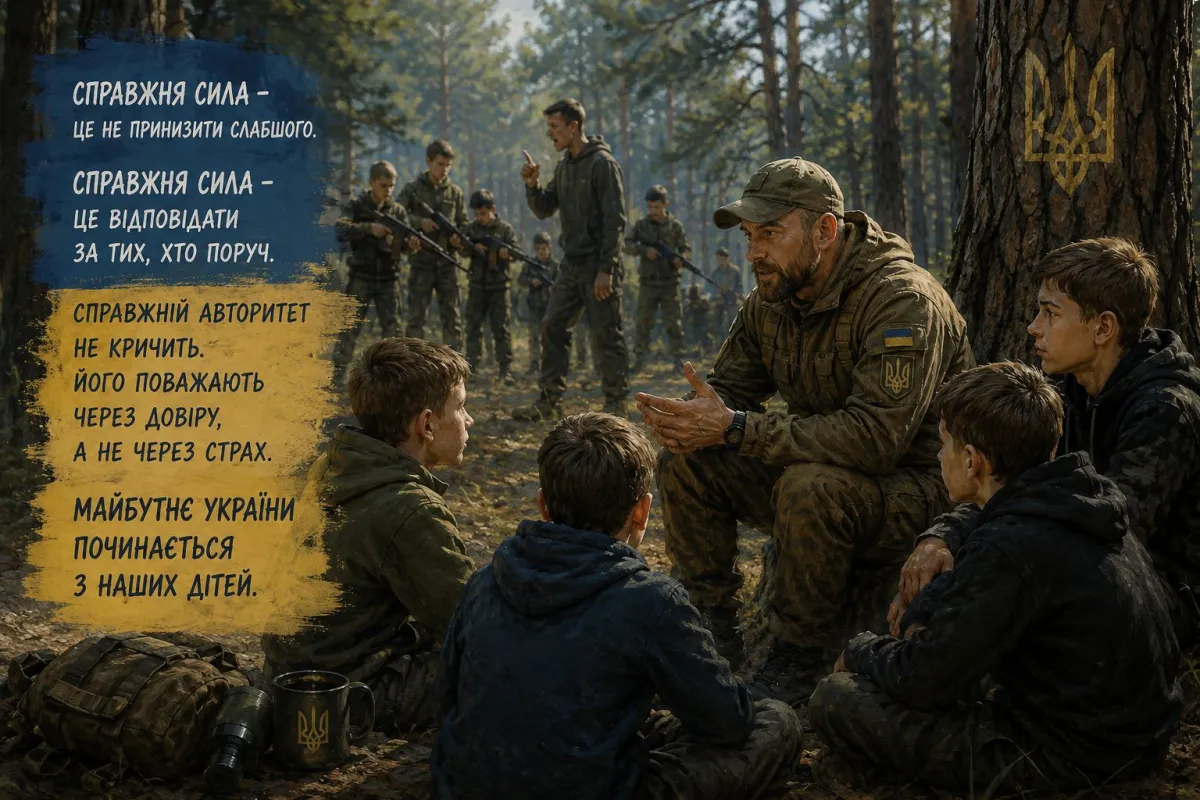
Some people were driving through a small wood in the Dnipropetrovsk region and stumbled upon a ‘training session for future partisans’. A few lads aged 15–16, armed with toy guns, were performing some exercises under the guidance of an ‘instructor’ who was perhaps a year or two older than them.
But it wasn’t the exercises that caught their attention.
The commands sounded something like this: insults, humiliation, swearing, displays of arrogance. Not training, not explanations, not responsibility, but an attempt to establish authority through fear and the humiliation of those younger than them.
And I thought: the problem here isn’t with these lads.
At fifteen, everyone wants to be strong, important, and authoritative. That’s natural. The only question is who will show young people what real strength is.
Because true strength is not the ability to humiliate the weaker.
True strength is the ability to take responsibility for those around you.
True authority doesn’t shout. It doesn’t need to prove its importance through swearing or ostentatious cruelty. It is respected not out of fear, but out of trust.
War has taught us many things. But we often fail to notice one of the most important. The best units are not held together by shouting, humiliation or hazing. They are held together by mutual respect, responsibility and the confidence that the person next to you will not betray or abandon you.
That is precisely why I am concerned today not only about the front line.
I am concerned about our teenagers.
Those boys and girls who have grown up to the sound of sirens, rocket strikes and war reports. They are now looking for role models. They are looking for people they want to be like. They are looking for an environment where they can feel needed.
And if there are no adults around who are prepared to work with them honestly and responsibly, that space will always be filled by others. Those who will build their influence on fear, aggression or cheap ‘authority’.
That is precisely why I am becoming increasingly convinced: working with young people is not an optional extra for veterans, volunteers or community organisations.
It is an investment in the country’s future.
Perhaps no less important than many other areas we’ve grown accustomed to discussing every day.
Because the Ukraine of the future is not born solely on the front line.
It is also being born in sports clubs, in SUM and Plast camps, on hiking trips, in volunteer teams, in youth groups, and simply in ordinary conversations between older and younger people.
And it is up to us what exactly we pass on to the next generation — a culture of dignity or a culture of humiliation.
Sometimes it seems to me that this is one of the most important battles Ukraine is fighting today.
Not for territory.
Not for resources.
Not for political ratings.
But for what kind of people those who will have to build and defend Ukraine tomorrow will grow up to be.
All articles in the "Opinion" section are published in full from their original sources. The editorial team may not share the authors’ views and accepts no responsibility for their statements.