A record 522 kilograms of cocaine, hidden amongst bananas, has been seized in Hungary

Hungarian law enforcement agencies have seized a record 522 kilograms of cocaine as part of an international operation; the drugs were being transported from South America to Hungary via Germany, according to Hungarytoday.
The results of the operation were announced during a press conference in Budapest. Mate Csupor, head of the anti-drug unit at the National Bureau of Investigation of the Hungarian Reserve Police, stated that the black market value of the seized cocaine is estimated at 15 billion forints, or around 42.3 million euros. According to him, this is the largest drug seizure in the country’s history.
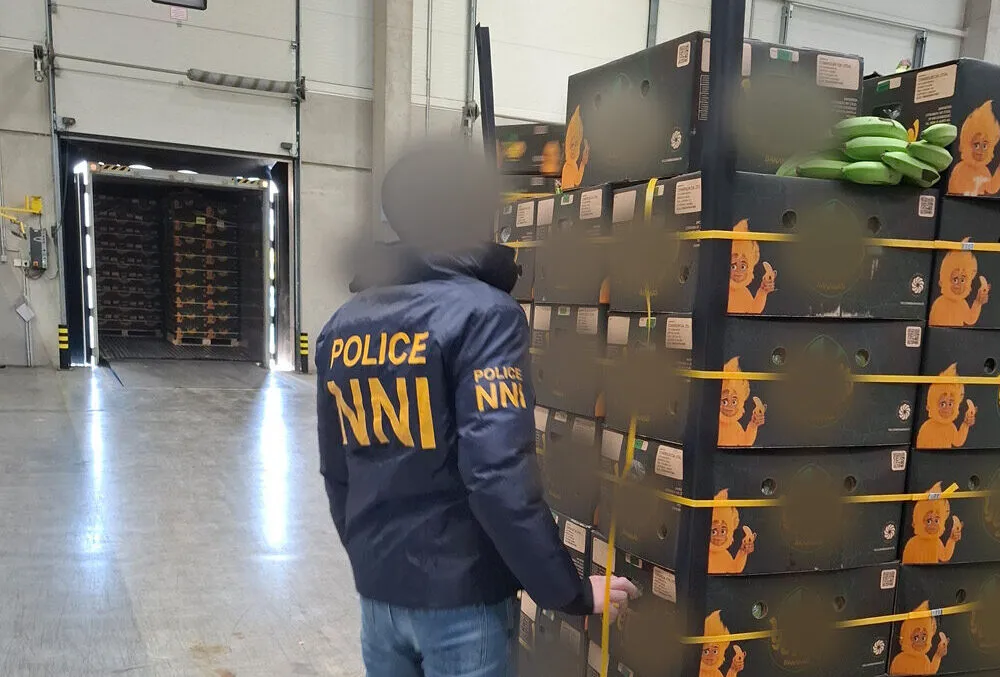
The cocaine was hidden amongst a consignment of bananas shipped from Ecuador. In November 2025, French customs officials alerted the Hungarian authorities to a container en route to Hungary that might contain concealed narcotics.
The containers arrived at the port of Bremen on 17 November. Subsequently, six containers were sent by rail to Hungary, whilst a further fourteen were transported by lorry to Romania.
To investigate the case, the Hungarian National Bureau of Investigation set up a joint international task force involving law enforcement agencies from Germany, the Czech Republic, Slovakia and the Hungarian National Tax and Customs Administration.
Preliminary X-ray checks had not revealed any suspicious items. However, after inspecting around 7,000 crates of bananas at the free port of Csepel in Budapest, investigators found 438 packets of cocaine wrapped in plastic film.
The investigation continued thereafter. A joint task force comprising the National Police Directorate, the National Tax and Customs Administration and the National Bureau of Investigation uncovered another consignment of drugs in the spring.
In a container returning from the city of Arad in Romania, law enforcement officers seized a further 72 kilograms of cocaine. The black market value of this consignment is estimated at approximately 2 billion forints or 5.6 million euros.
According to Mate Chupor, an international investigation is underway to identify and apprehend those involved. He noted that the case is linked to South American criminal groups, making the investigation particularly complex.
Law enforcement officials also reported that in recent years, international cocaine smuggling via container shipping has effectively doubled. Shipments from Ecuador and Colombia are increasingly arriving not only via the ports of Rotterdam and Antwerp, but also through the southern and central regions of Europe.
József Kalecz, Deputy Head of the Law Enforcement Department at Hungary’s National Tax and Customs Administration, stated that to detect smuggling, the agency has modernised its technical control equipment, established an X-ray Image Analysis Centre, and is utilising artificial intelligence tools.
He also noted that criminals have changed their methods. Illegal shipments are increasingly accompanied by documents that, on the surface, fully comply with legal requirements.
Thomas Rapp, a representative of the German Criminal Customs Administration, emphasised that the routes of illegal shipments usually coincide with those of legitimate trade. According to him, most drugs enter Europe by sea and are then distributed via major transport hubs.
Thomas Rapp added that the Port of Hamburg alone handled around 7.8 million containers in 2024, so customs services are forced to rely on risk analysis and targeted checks to identify suspicious cargo.