A Russian air defence missile struck a storage tank at the Kapotna oil refinery during a drone attack


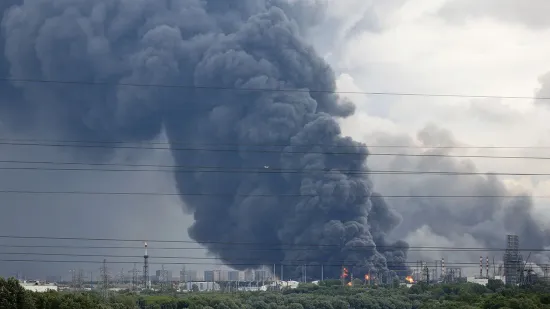
During the large-scale drone attack on Moscow on 18 June, a missile fired by one of Russia’s air defence systems, which was defending the approaches to the capital, missed the Ukrainian drone and struck a fuel tank at the Moscow Oil Refinery in Kapotnya.
The strike caused a massive explosion, which blew the dome-shaped roof of the tank into the air. The moment of impact was captured on video, which has been widely shared on social media.
The footage shows the missile flying below the drone, leaving a contrail, before striking the tank. A similar moment was also captured on video from other angles.
According to Astra, the shot was likely fired from a ‘Pantsir’ system from the north-east.
During the attack on 18 June, Russian air defence systems and crews operating man-portable air defence systems repeatedly failed to hit their targets. In a number of cases, they were unable to hit the drones even after several attempts. There were also instances where debris from downed drones fell onto buildings and exploded.
Military analyst Yan Matveev attributed this to the use of new anti-drone missiles for the ‘Pantsir’ systems.
These are the TKB 1055 ‘Gvozd’ anti-aircraft guided missiles, which are considered a compact version of munitions designed to intercept drones. According to available information, such missiles were fitted to ‘Pantsir SMD E’ systems, which had previously been deployed on high-rise buildings in Moscow.
As a result of the attack on the Kapotna oil refinery, the KUPN Euro+ combined oil processing unit, which accounts for 47 per cent of the plant’s capacity, was damaged.
According to Reuters, some secondary units, inter-workshop pipelines and auxiliary equipment were also damaged. In addition, tanks containing petroleum products were on fire on the plant’s premises.