The US Army has unveiled a new grenade that delivers a shockwave

Anna Kramarenko
Anna Kramarenko Editor-in-Chief
The US Army has unveiled a new grenade that delivers a shockwave

The US Army M111 Offensive lethal Hand Grenade, Christopher Arthur US Department of Defense
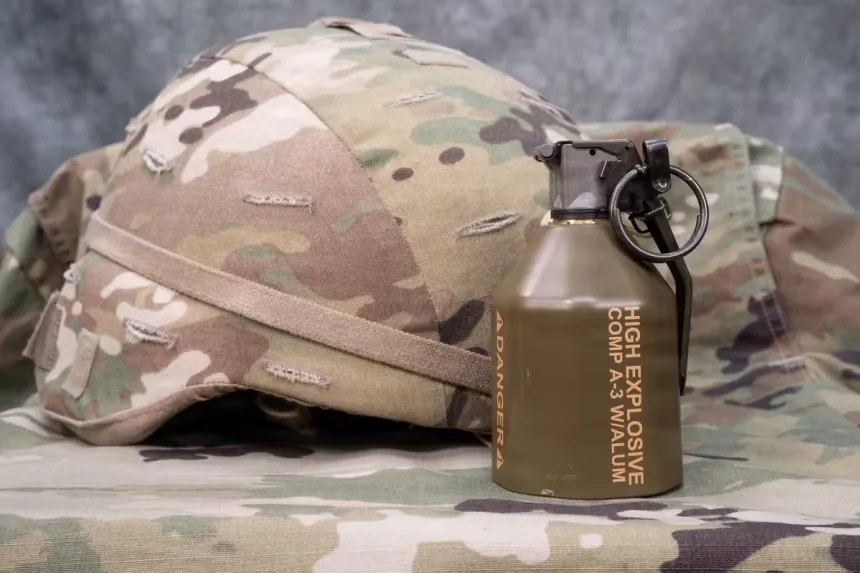
For the first time in a decade, the US Army has introduced a new lethal hand grenade. It is designed for urban combat and operates by means of a shock wave rather than shrapnel.

The US Army has unveiled the new M111 hand grenade, the first new lethal grenade since the Vietnam War. It is made of plastic and uses a shockwave to destroy targets, according to CNN.

The grenade is designed for use in urban environments, particularly during building clearance operations. According to the military, its use reduces the risk of collateral damage.

The previous grenade of this type, the MK3A2, was used in 1968 during the Vietnam War, but was withdrawn from service in the 1970s due to its asbestos content. After that, the M67 grenade remained the standard issue; upon detonation, it scatters shrapnel and can pose a danger to allies or civilians.

The new M111 grenade operates on the principle of overpressure. Upon detonation, its casing shatters and the shockwave strikes the enemy. The military notes that in enclosed spaces, this effect makes it impossible to take cover behind walls or furniture.

Colonel Vince Morris of Picatinny Arsenal stated that the grenade allows for the rapid clearance of a room and reduces risks to friendly forces. Army reference materials indicate that the shockwave can damage eardrums, lungs, eyes and internal organs, whilst more powerful explosions are capable of causing brain damage or amputations.

The development of the new grenade took into account combat experience in the Middle East. According to Morris, during the fighting in Iraq, the M67 grenade was not always suitable for clearing buildings due to the risk of hitting allies behind walls.

The M67 grenade will remain in service and will be used in open terrain where the fragmentation effect is important. Meanwhile, the M111 will be used primarily in enclosed spaces.

In addition, the US Marine Corps is procuring another grenade with a similar mechanism of action, the M21, manufactured by the Norwegian company Nammo. The military also uses thermobaric munitions, which create a shock wave and a fireball.

Share tittle
War
Syrsky took tough measures due to the poor preparation of those called up
War

Syrsky took tough measures due to the poor preparation of those called up

Following inspections carried out in May, eight military units in Ukraine have lost the right to train new recruits independently.

04.06.2026
The Kremlin is seeking a way out of the war amid military and economic difficulties
War
  • Important

The Kremlin is seeking a way out of the war amid military and economic difficulties

Russia is facing mounting pressure due to the situation on the front line, economic problems and strikes by Ukrainian drones on its territory. European officials suggest that Moscow’s increasingly aggressive rhetoric may be linked to attempts to restart the negotiation process on its own terms.

04.06.2026
Russia has attacked more than 900 port infrastructure facilities and injured 255 workers since the start of the war — Kuleba
War

Russia has attacked more than 900 port infrastructure facilities and injured 255 workers since the start of the war — Kuleba

The Russian military has attacked at least 935 port infrastructure facilities since the start of the full-scale war. People have also been injured.

04.06.2026
The youngest was just two days old. Since the start of the full-scale invasion, Russia has killed 707 Ukrainian children
War

The youngest was just two days old. Since the start of the full-scale invasion, Russia has killed 707 Ukrainian children

Since the start of the full-scale invasion, Russia has killed 707 children in Ukraine, with a further 2,548 wounded. 4 June marks the International Day of Innocent Children Victims of Aggression.

04.06.2026
Unmanned aerial systems struck the Russian vessel 'Svitlyak' in Crimea
War

Unmanned aerial systems struck the Russian vessel 'Svitlyak' in Crimea

On the night of 4 June, the Ukrainian Armed Forces’ Unmanned aerial vehicle unit struck a Russian ‘Svitlyak’-class border patrol vessel in the temporarily occupied Crimea. Air defence systems, infrastructure facilities and the enemy’s railway equipment were also targeted.

04.06.2026