Financial crisis in the courts: congress finds work of State Judicial Administration unsatisfactory

This was reported by SUD.UA.
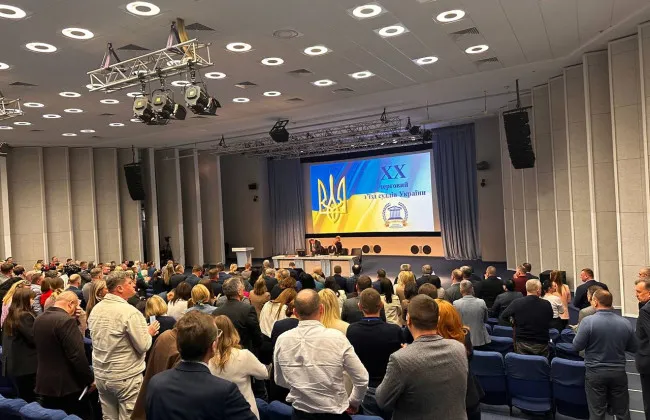
On 12 March 2026, at the 20th regular congress of Ukrainian judges in Kyiv, delegates adopted a series of decisions concerning the financial crisis in the courts, the work of judicial administration bodies and the activities of the State Judicial Administration.
The congress officially recognised that the current state of financial and material and technical support for the courts poses a threat to the functioning of the judiciary as a separate branch of government and hinders the right to a fair trial.
The delegates also noted the underfunding of expenditures for the remuneration of judges and court staff.
In this regard, the congress decided to appeal to the Verkhovna Rada with a demand to stop using the underestimated subsistence minimum of 2,102 hryvnias to calculate official salaries.
Separately, the delegates demand the restoration of the statutory ratio of official salaries: 50 subsistence minimums for local court judges, 60 subsistence minimums for appeal court judges, and 75 subsistence minimums for Supreme Court judges.
In addition, the congress supported the Supreme Court's position on appealing the provisions of the state budgets for 2022-2025 in the Constitutional Court.
The delegates also initiated a new submission regarding the budget for 2026.
A separate set of decisions concerned personnel issues and the reform of the State Judicial Administration.
During the discussion, delegates considered a proposal to express no confidence in the head of the State Judicial Administration, Maksym Pampura.
This initiative sparked a debate among the participants of the congress.
Some delegates insisted that the decision to express no confidence must be clearly justified, and that the points providing for the liquidation of the institution or the dismissal of an official must contain specific grounds and a list of comments.
During the discussion, a proposal was also made to supplement such a point with detailed sub-points containing specific claims.
In the absence of properly formulated grounds, the participants proposed to refer the matter to the competent authorities responsible for appointing the relevant official.
One of the speakers at the meeting noted that the resolution of administrative and economic issues requires separate resources and, possibly, an expansion of court staff.
Participants were urged to make personnel decisions in a balanced and reasoned manner.
During the discussion, a proposal was also made to ask the High Council of Justice to consider the issue of responsibility and the possible dismissal of certain officials.
At the same time, some participants cautioned against hasty steps.
In particular, it was argued that the work of certain officials may be imperfect, but it is carried out in extremely difficult conditions of full-scale war and limited funding, and therefore drastic personnel decisions without detailed analysis may be premature.
At the end of the discussion, the delegates called for each issue to be considered step by step, in detail and taking into account the situation in different regions and the real conditions of the courts' work.
The chair of the congress proposed to exclude from the decision the points regarding the expression of no confidence in the head of the SJA and the liquidation of the SJA itself.
As a result, during the vote, the delegates supported the decision to recognise the work of the State Judicial Administration as unsatisfactory.
It was also proposed to introduce a mechanism for annual reporting by members of the High Council of Justice to the Congress of Judges and to create a legal mechanism for their dismissal.
At the same time, proposals to express no confidence in the head of the SJA, Maksym Pampura, as well as to consider his dismissal and the possible liquidation of the SJA as an institution, were excluded from the text of the decision.
A separate block of decisions concerned social protection and the work of court staff.
The delegates demanded that adjustment coefficients be established for local court staff and that decent wages be provided for the patronage service.
The congress also supported changes to the "eOselya" programme to provide judges and court staff with access to preferential mortgage lending.
To this end, it was decided to appeal to the Cabinet of Ministers to amend Resolution No. 856 of 2 February 2022 on providing citizens with affordable mortgage loans.
In particular, this involves extending the relevant opportunities to court staff.
In addition, the congress plans to once again call on the government to lift restrictions on female judges travelling abroad.
The delegates also deemed draft law No. 14387 on a fair remuneration system in Ukraine to be unacceptable.
According to the participants of the congress, its provisions could weaken the constitutional guarantees of judicial independence, in particular by limiting judges' remuneration and lifetime financial support.
In this regard, a proposal was made to withdraw this draft law as it may contradict the Constitution of Ukraine.
The Council of Judges, in turn, will continue to develop amendments to the procedural codes aimed at simplifying procedures and ensuring reasonable time limits for the consideration of cases.
In addition, the heads of the Supreme Court and the High Council of Justice are being asked to develop mechanisms to reduce the workload of judges who take cases from courts where it is impossible to administer justice, taking into account security conditions.
Another decision was to appeal to the Minister of Defence of Ukraine with an initiative to adopt a decision to exempt court staff from mobilisation.
It is proposed to ensure such exemption at the level of 100%, similar to other law enforcement agencies.
At the same time, during the vote, the delegates rejected the proposal to recommend that the High Council of Justice invite a representative of the Council of Judges to meetings where disciplinary cases or issues of granting consent to keep judges in custody are considered.