Fraudsters are making widespread use of AI to make fake calls to Ukrainians

Anna Dovgalskaya, Deputy Chair of the Board at Globus Bank, spoke to OBOZ.UA about this.
How AI has changed fraud schemes
In the first five months of 2026, financial fraud in Ukraine, particularly involving bank accounts, became more technologically advanced and personalised.
Criminals have begun to make more active use of artificial intelligence to create fake calls, messages, counterfeit websites and fraudulent online offers.
The main change is that AI helps to scale up already known schemes: social engineering, phishing, fake calls ‘from the bank’, pseudo-collections and other types of deception.
“Artificial intelligence only exacerbates the threat. It makes messages more convincing, calls more plausible, and attacks significantly faster,” explained Anna Dovhalska.
Why attacks have become more convincing
AI allows fraudsters to personalise their attacks.
To do this, they can use publicly available data from social media, messaging apps, professional profiles or public photos.
Messages may mention a person’s place of work, their manager’s name, recent trips, or the services they use.
Because of these details, fake calls and messages look much more credible.
What the statistics show
According to the National Bank of Ukraine, the number of fraudulent payment card transactions in 2025 fell by 5% to 256,000 cases.
At the same time, the total amount of losses rose by almost a quarter, reaching 1.4 billion UAH.
The average amount per fraudulent transaction increased by 30% – to 5,536 UAH.
83% of all fraudulent transactions took place online.
90% of the losses were linked to social engineering.
The most common scams
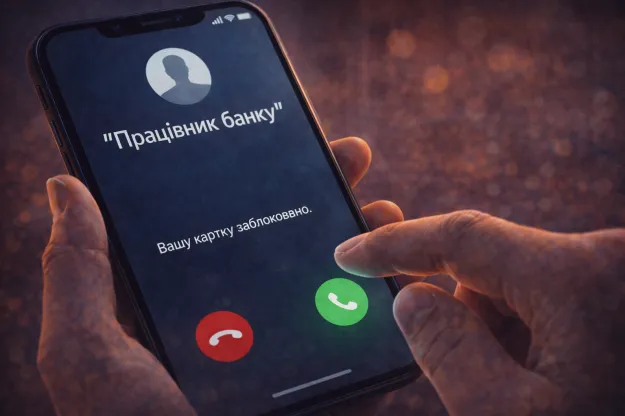
Most often, fraudsters call or write on behalf of bank employees, mobile operators or government agencies.
In such scenarios, they try to scare the victim with a ‘suspicious transaction’, account blocking or the need to ‘urgently protect their funds’.
The essence of the scam lies in psychological pressure. Under the influence of fear, victims voluntarily disclose their card details, CVV codes or passwords received via SMS.
AI phishing has become a separate problem.
Fraudsters create fake websites for banks, marketplaces, delivery services or charitable foundations that are almost indistinguishable from the real ones.
According to Dovgalska, over 80% of modern phishing emails already show signs of artificial intelligence being used.
Deepfake calls and fake voices
Anna Dovgalskaya also warned about the spread of deepfake technology.
Fraudsters can forge the voices and videos of real people using short audio clips from social media or messaging apps.
“In the simplest cases, a person is called on behalf of a relative or friend and asked to transfer money urgently. In more complex schemes, they may imitate the voice of a company director and demand immediate payment,” the banker noted.
According to experts, in some AI attacks, the click-through rate for phishing links can reach 54%.
For standard mass phishing, this figure is around 2.7%.
How to protect yourself from AI fraud
Ukrainians are advised to follow basic digital security rules.
Do not disclose your CVV code, PIN, one-time passwords from SMS messages, or online banking login details to third parties.
Do not click on suspicious links in SMS messages, instant messengers or emails.
Before entering your card details, you should carefully check the website address.
You should only use official apps from the App Store or Google Play.
If a “bank employee” demands urgent action or a money transfer, it is best to end the conversation.
Requests for money should be verified via another communication channel, even if the message comes from someone you know.
It is also worth enabling two-factor authentication for banking apps, email and messaging services.
Separately, it is advised to register your SIM card with your mobile operator to reduce the risk of your financial number being stolen.
The fraudsters’ main tool
Dovhalska emphasises that one of the main tools used by fraudsters is a sense of urgency and psychological pressure.
If someone is being threatened with account suspension, loss of money, or pressured to act “right now”, it is worth pausing and verifying the information.
Previously in Ukraine, a scheme also became active where criminals would call citizens pretending to be employees of the SBU and other law enforcement agencies.
Follow us on Telegram