How to store your charging station over the summer so that it doesn’t break down by autumn

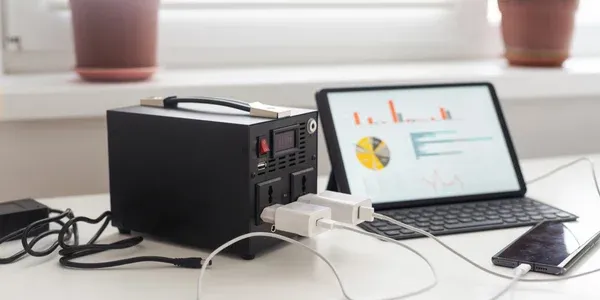
In spring and summer, charging stations often cease to be an everyday necessity.
When power cut schedules become a rarity, devices that powered the boiler, router, fridge or laptop in winter are often simply put away until the next season.
However, a charging station cannot be stored like an ordinary household item.
If left for several months without preparation, the device may fail to switch on in the autumn or lose a significant portion of its battery life.
The main rule for long-term storage concerns the charge level.
After power cuts, many people think it makes sense to keep the station 100% charged.
But this is harmful for lithium batteries.
Long-term storage at full charge keeps the battery cells under maximum stress.
This leads to irreversible battery degradation and a gradual loss of capacity.
This rule applies to both the popular EcoFlow and Bluetti power stations and lesser-known Chinese equivalents.
Storing the station fully discharged is even more dangerous.
Even when the device is not in use, the battery gradually loses energy due to self-discharge.
If you leave the station at “zero”, the battery may go into deep discharge within a few months.
In this state, the controller may lock the battery.
Recovery from a deep discharge is often only possible at a service centre and can be expensive.
The optimal charge level for long-term storage is between 50% and 60%.
This charge level is considered the best for putting the charging station into ‘hibernation’ for several months.
It is equally important to choose the right storage location.
A balcony is absolutely unsuitable for this purpose.
In summer, an enclosed balcony can overheat significantly.
Heat is harmful to lithium-ion and lithium iron phosphate batteries.
Temperatures above 30 degrees trigger chemical processes inside the battery that irreversibly reduce its lifespan.
A garage or basement is also not a safe option.
The main problem with such spaces is dampness and temperature fluctuations.
This can cause condensation to form on the circuit boards.
When the battery is first switched on, this can cause a short circuit.
The best place for a charging station is a standard cupboard in the living room or hallway.
The device should be kept away from direct sunlight, radiators and pets.
A stable room temperature is best for such gadgets.
Before storing the station, it must be switched off completely.
It is not enough simply to pull the plug out of the socket.
Many users forget to switch off the activation buttons for the AC or USB ports.
Even if nothing is connected to the station, the inverter continues to consume energy in standby mode.
In a few weeks, this can completely drain the battery.
Before putting the station away, check that the screen has gone completely dark.
If the device has a mobile app, it is advisable to switch off the Wi-Fi and Bluetooth modules.
They can also slowly drain the battery in the background.
Even when stored correctly, you shouldn’t leave the charging station untouched for six months.
The battery needs periodic ‘exercise’.
This helps prevent the chemical components inside the battery from becoming stagnant.
This procedure also helps the built-in battery management system maintain its calibration.
Once every two or three months, you should take the station out and use it a little.
You can connect a TV, a fan or a few laptops to it.
The device should be discharged to around 20%.
After that, the power bank should be recharged from the mains to the optimal 60%.
This procedure takes a few hours, but helps keep the battery in good condition for years.
When the charging station is needed again during power cuts, it should be brought back into use gradually.
You should not connect the most powerful devices to it immediately after a long period of inactivity.
First, the station must be charged from the mains to 100%.
This will help the controller correctly assess the available battery capacity.
Only then should the device be returned to full use.
As reported by ThePublic, how to adapt to summer time without stress: advice from a professor of neurology
Follow us on Telegram