Iran could damage undersea cables as a means of exerting pressure in the Strait of Hormuz

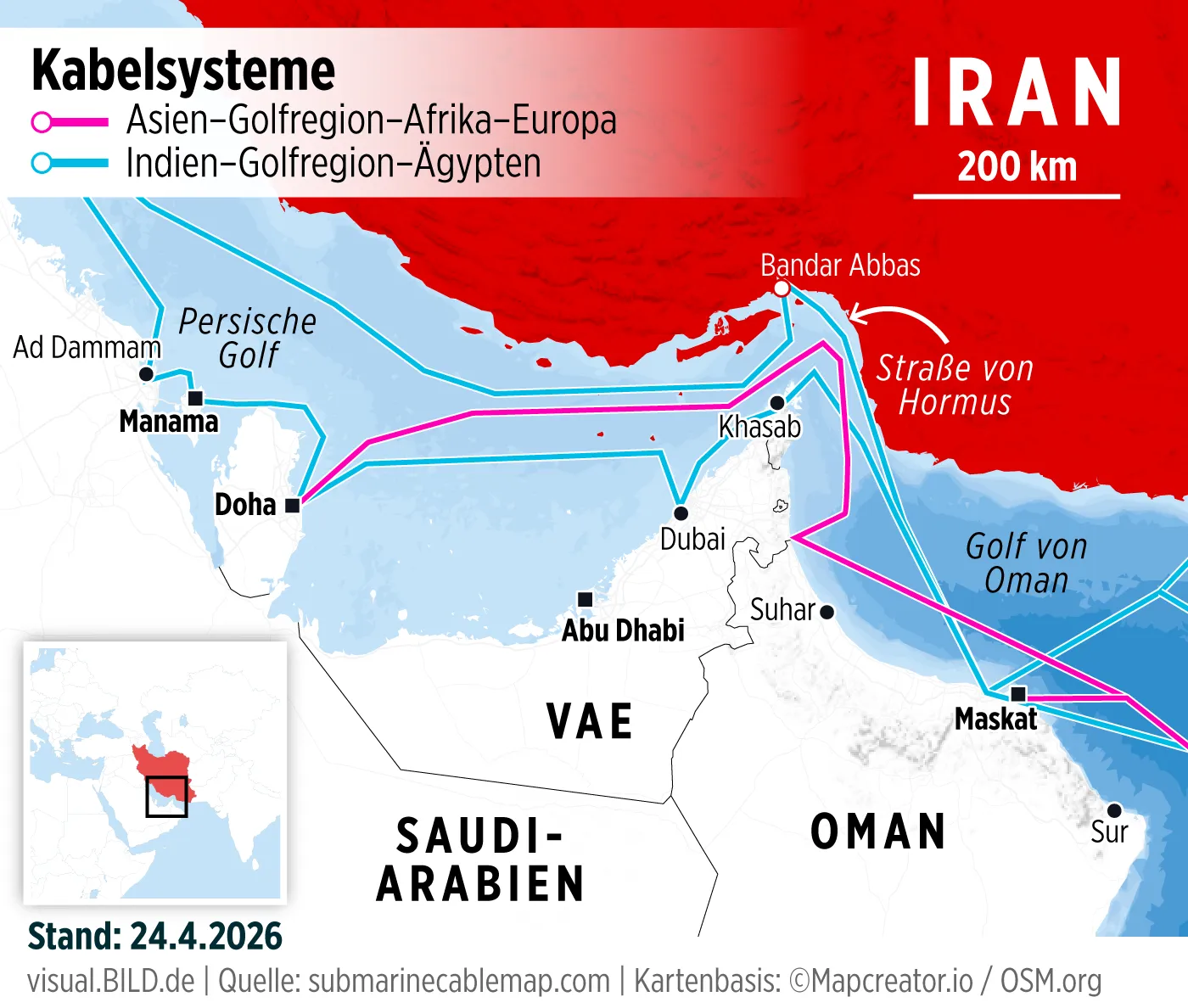
Iran may view undersea communication cables as a means of exerting pressure in the standoff in the Strait of Hormuz. The Iranian news agency Tasnim, linked to the Islamic Revolutionary Guard Corps, has published a map showing the location of the cables in the area and noted that their simultaneous damage could have serious consequences for the Gulf states, reports Bild.
Should several major cables be severed simultaneously due to natural causes, accidents or deliberate acts, this could trigger a “digital catastrophe” for the Arab states in the region.
At least seven major telecommunications cables run along the seabed of the Strait of Hormuz, carrying significant volumes of data. These include Falcon, AAE-1, TGN-Gulf and C-Me-Wi. They connect the Gulf states to data centres in the Middle East, Europe and Asia.
Due to diplomatic tensions with Tehran, these cables are laid in Omani waters rather than Iranian waters.
The agency noted that in the event of a major failure, Iran itself would also suffer, but the country is less dependent on these cables and, in their assessment, is less vulnerable. The opposition TV channel Iran International suggests that attacks on undersea cables could mark a new stage of escalation. Iranian officials have not publicly commented on these reports.
Analysts at the Stimson Center believe that Iran may view undersea cables as hostile technological infrastructure. In their assessment, cables on the seabed remain vulnerable, and the situation in the Strait of Hormuz is particularly sensitive.
Over 15 per cent of global internet traffic passes through this region. For the United Arab Emirates, Qatar, Bahrain, Kuwait, Saudi Arabia and Iraq, these cables are of critical importance.
If they are damaged, there could be serious economic consequences. This could affect millions of banking transactions, the functioning of financial markets, as well as data centres, particularly those involved in the development of artificial intelligence. Countries in Africa, Asia and Europe could also feel the impact.
Repairing damaged cables in such an area can be challenging. Repair vessels require permission from the relevant states to access the site of the incident, and the operation itself may take place in hazardous conditions.