A test purchase has confirmed that the U420 chain sells drugs disguised as souvenirs


The U420 chain of shops, which launched in Ukraine in 2025, has grown rapidly and now has around thirty shops in Kyiv and outlets in major cities such as Kharkiv, Lviv, Odesa and Dnipro. The shops are marketed as ‘cafés’ for enthusiasts of legalised cannabis and sell seemingly harmless ‘souvenirs’, including ‘hashish’ and ‘joints’.
A test purchase carried out by journalists confirmed that these ‘souvenirs’ contain dangerous psychotropic substances. Products purchased from three U420 shops were sent for laboratory analysis, which revealed the presence of a synthetic cannabinoid — a psychotropic substance that forms part of the ‘spice’ group and is banned in Ukraine.
Sellers in the U420 chain claim that their products are intended solely for collection or display, but in practice, these products are actively smoked by customers, and, according to laboratory analyses, they contain synthetic cannabinoids that cause serious mental disorders — hallucinations, panic attacks, kidney failure and other severe consequences.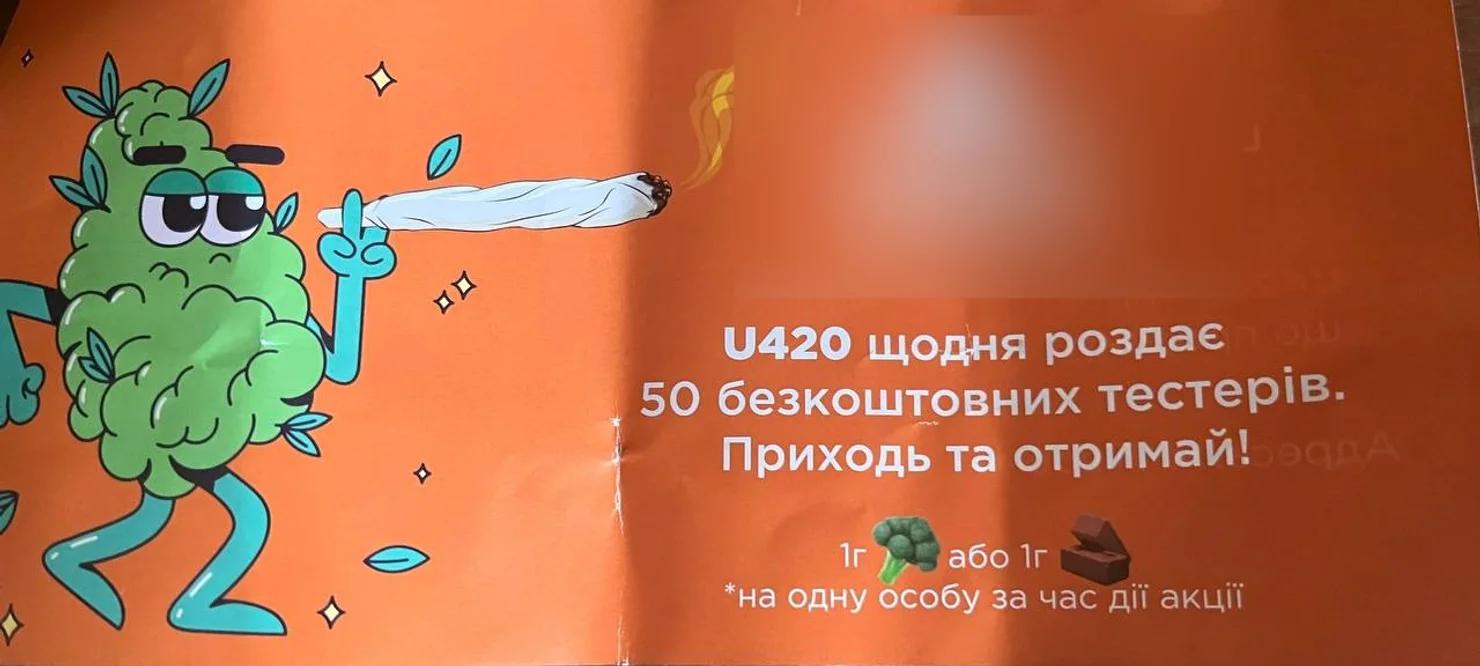
Advertising for the U420 network is actively circulating on social media, often featuring popular bloggers, which creates the impression that these products are safe and legal. Promotional campaigns also offer free samples and gifts — all aimed at attracting a young audience. Sellers actively disguise the nature of their products as collector’s items, which boosts the network’s popularity among young people.
How it works in practice: attracting minors
The network is actively expanding its operations in areas popular with young people: near student halls of residence, on high streets, near schools and other locations with high footfall. One example is the shops in Podil, located near schools and universities. Visitors to these shops are mainly young people aged between 15 and 30. At the same time, according to eyewitness accounts, some customers are minors.
Unaware of the dangers, teenagers perceive this ‘souvenir’ as a safe product, advertised as harmless to health. They have unhindered access to products containing psychotropic substances, and this is a cause for serious concern.
Parallels with the past: ‘spices’ as consumer goods
This case bears a clear resemblance to a problem that was prevalent several years ago, when a ‘trend’ for ‘spices’ began to spread in Ukraine — synthetic drugs sold under the guise of air fresheners or smoking herbs. Spices were often advertised as safe products that posed no harm to health, but in reality they caused severe mental disorders, addiction and even death from overdose.
As with ‘spice’, we are now seeing a new form of drug trafficking, where products containing dangerous psychotropic substances are sold under the guise of souvenirs or legal goods. This allows them to evade scrutiny by law enforcement agencies and creates the impression that the products are safe for consumption. And this is precisely how this business continues to thrive across Ukraine.
Law enforcement response and possible actions
This situation requires urgent intervention by law enforcement agencies. The police have already launched an investigation, but identifying such networks is quite difficult, given that they register shops under various sole traders (FOPs). Laboratory tests carried out by journalists have shown that the ‘souvenirs’ contain a synthetic cannabinoid, which is classified as a prohibited narcotic substance in Ukraine, but which may not have been banned at the time of sale due to constant changes in the product’s composition.
As for specific actions, it is only after an investigation and the detection of prohibited substances that these ‘souvenirs’ can be officially withdrawn from circulation. It is therefore important to take measures to regulate such products and establish clearer rules to combat such illegal networks.