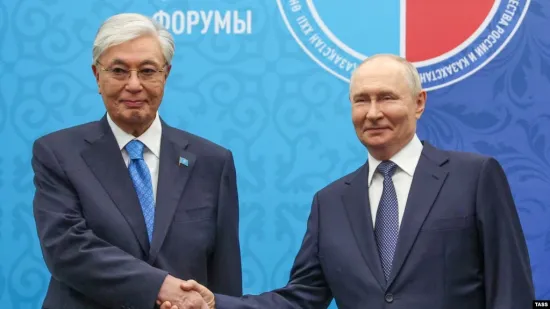
Putin has made military spending a priority for Russia until 2029

Putin announced the budget priorities on 27 July during a meeting with members of the State Duma of the eighth convocation, who had completed their five-year term.
According to him, when drawing up the budget for the next three years, the authorities must simultaneously fund defence, priority social needs, key sectors of the economy, large companies, small and medium-sized businesses, and the labour market.
Putin himself did not refer to this as funding for the war against Ukraine, instead using the phrase “strengthening the country’s defence”. However, it is precisely defence, security and classified expenditure items that account for a significant proportion of Russia’s military spending. According to economist Janis Klug, around 85 per cent of the Russian budget’s classified expenditure is linked to military needs.
During his speech, Putin also accused Western states of setting in motion a “Russophobic machine” and imposing a record number of sanctions. He claimed that external pressure would allegedly be unable to “break the Russian people”.
How much has Russia already allocated to defence?
The 2026 federal budget allocates around 12.9 trillion roubles under the ‘national defence’ heading. Together with expenditure on security and law enforcement agencies, the total amounts to almost 16.84 trillion roubles.
However, actual military spending could exceed the initial plan by a further 4–5 trillion roubles, Bloomberg reported, citing informed sources. In that case, Russia will spend around 18 trillion roubles on military needs over the course of the year.
To cover the additional costs, the Russian Ministry of Finance is considering cutting or freezing funding for civilian programmes. The authorities may raise a further 2–3 trillion roubles through new domestic borrowing.
Almost every second budget rouble went to the military
According to calculations by Janis Klug, a research fellow at the German Institute for International and Security Affairs, Russia’s military spending reached a record 5.9 trillion roubles in the first quarter of 2026.
This is 30 per cent more than in the same period of 2025. Compared with the first quarter of 2024, spending rose by approximately 69 per cent; compared with 2023, it more than doubled; and since the start of the full-scale war in 2022, it has increased 4.6-fold.
Military expenditure accounted for 46 per cent of all federal budget expenditure in the first three months of the year. This means that almost every second rouble spent by the Russian authorities went to the army, defence enterprises and war-related organisations.
According to Kluge’s estimates, since the start of the full-scale invasion, Russia has spent over 53 trillion roubles, or approximately 746.6 billion dollars, on the war against Ukraine.
This sum is equivalent to 28 years’ worth of the Russian federal budget’s expenditure on healthcare or 30 years’ worth of the budget for education. It is also roughly equal to a hundred years’ worth of the annual budgets of regions such as Krasnoyarsk Krai or Sverdlovsk Oblast.
The budget deficit has already exceeded the annual target
In the first half of 2026, Russia’s federal budget deficit reached 5.73 trillion roubles, or 2.5 per cent of GDP. The initial plan for the whole year had forecast a deficit of 3.79 trillion roubles.
The Russian government has already raised its forecast for the annual deficit to 4.83 trillion roubles due to increased expenditure. The actual figure may be even higher, although Moscow traditionally pays part of its expenditure in advance at the start of the year.
In 2025, the Russian budget received 37.28 trillion roubles in revenue – 7.5 per cent less than the authorities had originally planned. The deficit reached 5.6 trillion roubles, despite increases in corporate and personal income taxes.
Who will pay for the continuation of the war
From January 2026, Russia raised the standard rate of value-added tax from 20 per cent to 22 per cent. The authorities expect this to generate around 1 trillion roubles in additional revenue each year.
The income threshold above which small businesses are required to pay VAT is also being gradually reduced. In effect, the Kremlin is passing on part of the cost of the war to consumers and business owners through more expensive goods and an additional tax burden.
Emil Ablaev, a leading expert at the Russian Centre for Macroeconomic Analysis and Short-Term Forecasting, believes that the priority given to defence is forcing the authorities to fund other areas selectively. In his view, the scope for continuously increasing revenue through new taxes is gradually being exhausted, and the budget deficit could approach 7 trillion roubles by the end of the year.
Putin’s statement does not constitute an approved budget for 2027–2029. The Russian government must submit specific figures to the State Duma in a separate bill. The announced priority indicates that the Kremlin has no plans to cut military spending for the time being, even as the deficit, debt and tax burden grow.
As reported by ThePublic, the Kremlin has rejected Tokayev’s call to freeze the war