Kysilevsky accused the EBA of protecting imports for the army

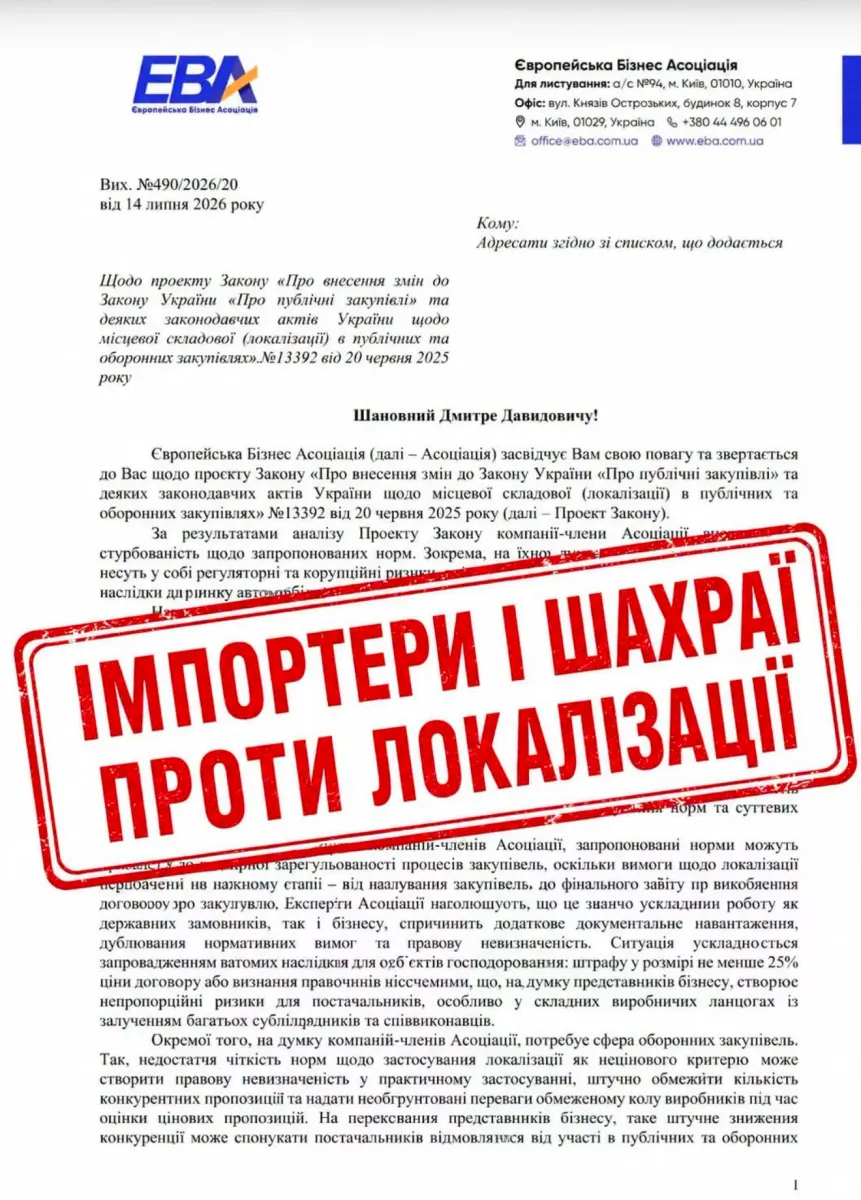
This was announced by Dmytro Kysilevskyi, Deputy Chair of the Verkhovna Rada Committee on Economic Development.
Kysilevsky received a letter from the European Business Association dated 14 July 2026. According to the MP, the organisation called for the non-introduction of localisation requirements for civilian goods procured for the Defence Forces and opposed additional controls on the origin of products in public tenders.
The letter arrived after the adoption of the new ‘On Public Procurement’ Act. The Verkhovna Rada adopted Bill No. 4888-IX on 27 May, and on 23 June it was returned with the President’s signature.
Most of the law’s provisions will come into force on 24 March 2027. By that time, the government must prepare the necessary subordinate legislation and adapt the electronic procurement system to the new rules.
Kysilevsky described the EBA’s appeal as belated, as the provisions criticised by the Association had already been included by parliament in the adopted law.
The MP did not publish the full text of the EBA’s letter. Consequently, its content is currently known only from Kysilevsky’s own account, and his assessments of the Association’s motives represent the politician’s personal view.
What is localisation?
Localisation indicates what proportion of a product’s value was generated in Ukraine. This may include Ukrainian materials, components, labour, manufacturing services and other business costs.
In 2026, for goods meeting the relevant requirements, the proportion of the Ukrainian component must be at least 30 per cent. In 2027, this figure is set to rise to 35 per cent, and from 2028 onwards – to 40 per cent.
Put simply, the state may require a supplier to prove that a bus, crane, transformer, trailer or other equipment specified by law was not simply imported from abroad, but was partly manufactured in Ukraine.
These rules are intended to channel part of the budget funds into Ukrainian factories, jobs and tax revenue. At the same time, localisation does not mean a complete ban on imports.
The requirements do not apply to the procurement of goods from countries covered by Ukraine’s international agreements on public procurement, in particular the WTO GPA Agreement. When determining exceptions, the country of origin of the products, their cost and the terms of the specific tender are taken into account.
What will change in procurement for the armed forces
The new law extends localisation requirements to certain civilian products procured for the needs of the Defence Forces. Previously, the same equipment might have been subject to localisation requirements in a standard public tender, but not in a defence procurement.
This applies, in particular, to trailers, excavators, and engineering and construction machinery. A separate list also includes mechanised humanitarian demining equipment, equipment for the disposal of explosive ordnance, body armour and combat ballistic helmets.
Ukrainian localised goods will be given a price advantage during the evaluation of tenders. This means that the state will be able to select products with a Ukrainian component, even if their nominal price is slightly higher than an importer’s offer. According to the Federation of Employers of Ukraine, this advantage will amount to 25 per cent.
Procuring authorities will be required to reject bids if the goods do not meet the specified localisation threshold or are not listed in the relevant register.
How Ukrainian origin will be verified
The law tightens scrutiny of companies claiming that their products are manufactured in Ukraine.
The State Audit Service will be able to monitor not only tender clients but also suppliers. A separate commission will consider complaints regarding the inclusion of products in the register of localised goods and possible violations.
The Cabinet of Ministers must also define the mandatory production operations for specific types of products. This should make it more difficult to carry out schemes whereby imported goods undergo minimal processing or are merely re-registered in Ukraine, and are then passed off as domestic products.
The country of origin will be deemed to be the place where the goods are actually produced, rather than the country where the selling company is registered.
A company may be added to the register of unreliable suppliers for providing false information regarding localisation or for supplying products that do not meet the declared specifications. For contractors under defence contracts, a fine of 15 per cent of the value of such goods is envisaged.
What Kysilevsky accused the EBA of
The MP claims that the European Business Association has opposed the powers to carry out additional checks on localisation and the requirement to monitor the Ukrainian content at all stages of procurement.
Kysilevsky viewed this stance as a defence of sellers of imported goods. He also stated that relaxing controls could enable companies to pass off Chinese or Turkish goods as Ukrainian.
At the same time, the MP did not name any specific EBA members whom he suspects of such violations, nor did he provide any evidence of the Association’s or its members’ involvement in fraudulent schemes. His assertion that the Association is lobbying on behalf of unscrupulous suppliers is an accusation, not an established fact.
Kysilevsky addressed Ukrainian and European companies that have production facilities in Ukraine and are members of the EBA. He called on them to explain whether they had endorsed the Association’s position on localisation.
What this means for manufacturers and importers
Companies that manufacture or partially assemble products in Ukraine will be able to gain an advantage in public and defence procurement. To do so, they will have to confirm that they meet the required level of localisation and carry out the mandatory production operations.
Importers will still be able to take part in tenders if a specific procurement is not subject to localisation requirements, if an exemption under an international agreement applies, or if the goods meet the established requirements.
The ultimate impact of the law will depend on the lists of products, the procedure for inspecting manufacturers and the Cabinet of Ministers’ subordinate legislation. The new rules do not mean that all government contracts will automatically be awarded to Ukrainian companies.
Follow us on Telegram.