Vladimir Putin’s approval ratings due to the protracted war and economic problems

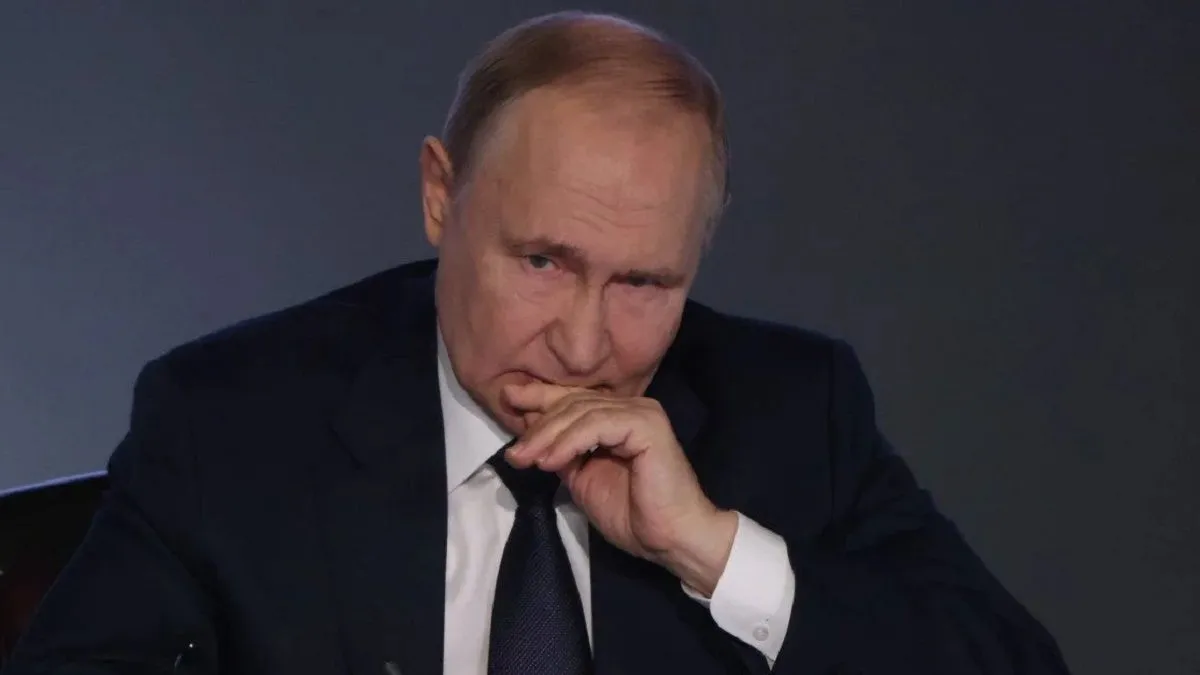
Russian President Vladimir Putin is facing growing discontent within Russian society due to the protracted war against Ukraine, economic problems and restrictions on internet access.
On 24 April, the Russian state-run sociological centre VTsIOM recorded a drop in Putin’s approval rating to 65.6 per cent. This is the lowest figure since the start of the full-scale war and 12.2 percentage points lower than at the start of the year, reports The Washington Post.
It is difficult to gauge real public sentiment in an authoritarian system, as criticism of the war is banned in Russia and opponents of the regime face persecution. At the same time, the drop in figures compared to Putin’s previous ratings indicates growing war fatigue, as the conflict enters its fifth year.
One Russian official, speaking on condition of anonymity, said the general mood could be summed up as ‘enough is enough’. According to him, many feel the war has lasted longer than the Second World War, yet Russia has still failed to fully capture even a single region.
Economic pressure is also mounting. In the first two months of the year, Russia’s economy contracted by 1.8 per cent. Sanctions and high interest rates are holding back investment, whilst overdue commercial payments reached a record $109 billion in January. The number of companies with tax debts has risen to 439,900.
At an economic forum in Moscow, business representatives and economists openly criticised the government. Vladimir Bogalev, head of a Russian tractor manufacturer, stated that those at the top of the government had ‘completely lost touch with economic reality’.
Robert Nigmatulin, an economist at the Russian Academy of Sciences, said that Russia is lagging behind China, and that inflation has significantly outpaced economic growth. According to him, since 2015, GDP has grown by approximately 1.5 per cent per year, whilst consumer prices have risen by 77 per cent.
Gennady Zyuganov, leader of the Communist Party of Russia, warned in a speech to parliament that without resolving these issues, the country could face economic collapse. He stated that this autumn Russia could face events similar to those of 1917.
High military spending and sanctions have caused a sharp rise in inflation. The Bank of Russia raised interest rates above 20 per cent, and they currently stand at 14.5 per cent. Economists are increasingly warning of the risks of recession.
Russia’s Minister of Economic Development, Maxim Reshetnikov, stated that the country’s reserves are ‘largely exhausted’. Putin himself acknowledged the economic problems this month and called on the government and the Central Bank to explain the slowdown in growth.
The Russian economy has received some relief due to rising oil prices against the backdrop of the US and Israel’s war against Iran. At the same time, economists note that a prolonged period of high prices is needed to balance Russia’s budget.
Ukrainian strikes on Russian ports and oil refineries are creating additional pressure. According to Reuters, this led Russia to cut oil production by 300–400 thousand barrels per day in April.
Internet restrictions are also fuelling discontent. A video message from influencer Viktoria Boni, who criticised online restrictions and other problems in Russia, went viral. The Kremlin subsequently stated that it was working on the issues raised.
Analysts note that problems are evident across various sectors of society. Tatyana Stanovaya, a senior research fellow at the Carnegie Russia Eurasia Centre, said that discontent is very strong, but the authorities are likely to respond with further repression.
Former Russian businessman and opposition figure Mikhail Khodorkovsky stated that the initial patriotic effect of the war has faded. According to him, the war has been going on for too long and has not brought about any tangible changes.
Some Russians also speak of a deterioration in sentiment. Tatiana, a 53-year-old manager at a logistics company, compared the current internet restrictions to a ‘digital iron curtain’. Irina, a 46-year-old sales manager, said that sales have fallen, people have less and less money, prices have risen, and utility bills and taxes have gone up.
Igor, a 19-year-old student, described the general mood as a sense of hopelessness. According to him, many people want to leave but are unable to do so.