The Pink Full Moon over Ukraine: when to view the Moon on 1 April

The exact times of the full moon and the lunar phases are confirmed by the astronomical services Time and Date and The Old Farmer’s Almanac.
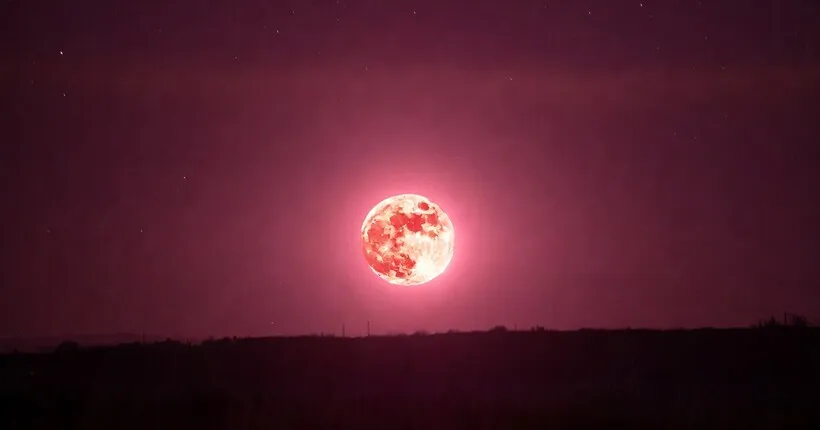
Despite the widespread association of this full moon with 1 April, the full moon phase for Kyiv will occur on the morning of 2 April at 05:11. At the same time, the most spectacular sight is traditionally observed not at the peak, but in the evening beforehand, when the Moon’s disc is just rising above the horizon and appears larger.
For Kyiv, the Moon will rise on 1 April at 19:04. At this time, it will be low on the horizon and may have a yellowish-orange hue due to light passing through dense layers of the atmosphere. For viewing, it is best to choose a spot with an unobstructed view to the east.
The name ‘Pink Moon’ does not mean that the Earth’s satellite will turn pink. It derives from the traditional name for the April full moon, associated with the spring flowering of pink phlox in North America. In the Christian tradition, this is also the Easter full moon, on which the date of Easter depends. In 2026, Western Christians will celebrate Easter on 5 April.
What astrologers say about this full moon
In astrological interpretations, the Pink Full Moon is described as one of the key events of spring. It is described as a moment when hidden emotions and inner conflicts become more apparent, and the main theme of this period is said to be honesty with oneself.
According to these descriptions, Libras, Aries, Cancers, Capricorns, Pisces and Scorpios are likely to feel the strongest influence of this full moon. For some, it is supposedly a period of re-evaluating relationships; for others, a time of inner change, emotional transformation or the need to find a balance between personal and professional life.
How best to observe the Pink Moon
No telescope is needed to observe it – the full moon is clearly visible to the naked eye. When it comes to photography, it is best to take pictures during the moonrise, when the moon appears largest, and for a sharper shot, it is worth using a tripod or a self-timer. Visibility, as always, will depend on cloud cover in the specific region.
As a reminder, on 2 August 2027, one of the most spectacular total solar eclipses of the 21st century will take place over Europe, North Africa and the Middle East. In some regions, the Moon will block out the Sun for more than six minutes, and there will be no eclipse of this duration until at least 2114.