Russia has taken the nuclear-powered cruiser Admiral Nakhimov into its final trials

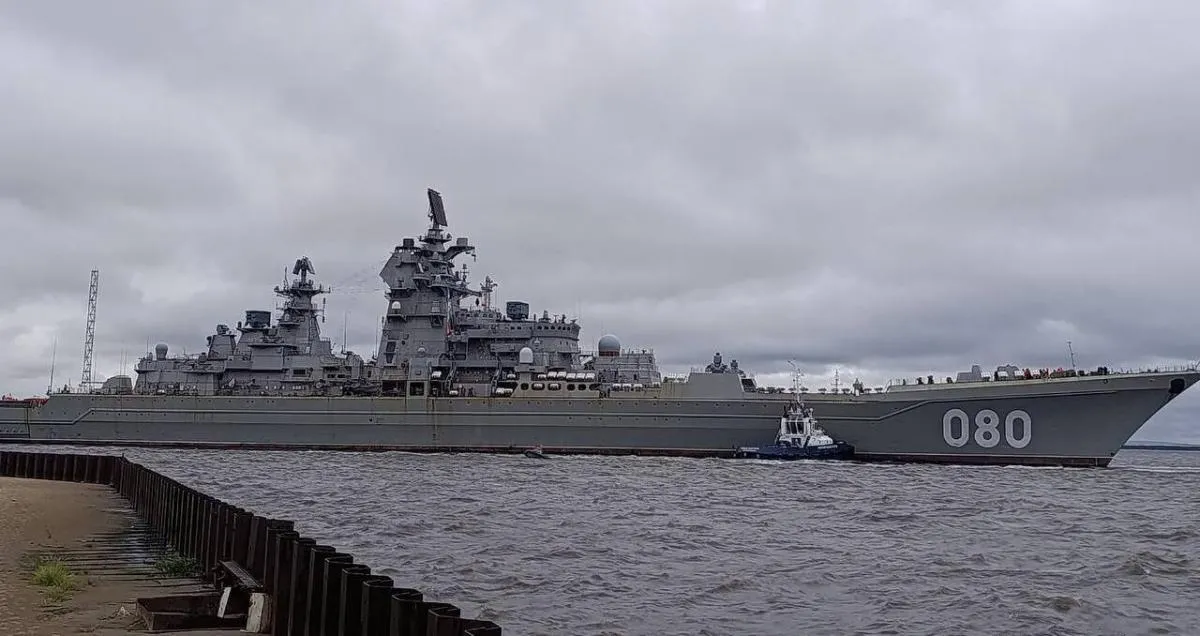
This was reported by the press service of Russia’s Northern Fleet, according to UNIAN.
The heavy nuclear-powered missile cruiser Admiral Nakhimov has begun the final stage of trials following repairs and modernisation.
The ship is part of Project 1144.2M and is one of the largest warships in the world. Its displacement exceeds 25,000 tonnes, and it is powered by a nuclear propulsion system.
The cruiser is designed to engage large surface targets, as well as to provide comprehensive air and anti-submarine defence.
What armament could the cruiser have received
According to publicly available data, during its modernisation, the Admiral Nakhimov was to be fitted with 80 standardised UKSK 3S14 launchers.
These can launch Kalibr, Onyx and Zircon missiles. Russia refers to the latter as ‘hypersonic’.
The cruiser was also due to be fitted with the Fort-M and Pantsir-M air defence systems, as well as the Paket-NK and Otvet anti-submarine systems.
A long-delayed project for the Russian Navy
The Admiral Nakhimov is an old ship, built in the late 1980s. In the late 1990s, it was sent for repairs.
Work to return the cruiser to the Russian fleet began in 2013 at the Sevmash shipyard in Severodvinsk.
The modernisation project has long since become a long-running construction project and has been accompanied by repeated revisions to the schedule.
In August 2020, the Admiral Nakhimov was moved from the dry dock to the Sevmash quay, but work continued for several more years after that.
According to the source, the physical start-up of the ship’s nuclear reactors did not take place until January 2025.
Cost and assessment of the project
According to unofficial estimates, the actual cost of modernising the Admiral Nakhimov could reach around 200 billion roubles, or over 2.7 billion dollars.
The Project 1144 cruisers were the first and last nuclear-powered surface missile ships of the Soviet Navy.
They remain the largest non-aircraft-carrying warships built since the Second World War.
At the same time, experts have mixed views on these ships. They are large and expensive, but in terms of strike capability, according to some estimates, they are inferior to the cheaper nuclear-powered missile submarines of Projects 949 “Granit” and 949A “Antey”.
A weakness of the original design was said to be its vulnerability to low-flying subsonic anti-ship missiles. This shortcoming was to be partially rectified during modernisation, but the ship still remains a large and conspicuous target for modern weapons.
Currently, only one ship of this type remains in service with the Russian Navy – the “Peter the Great”.
Follow us on Telegram