Skynex in Ukraine: Media reports suggest the German air defence system malfunctioned during the Russian attack

According to the German publication, an internal Ukrainian report describes an incident that took place on 1 April 2026 during a Russian attack on an industrial facility in western Ukraine.
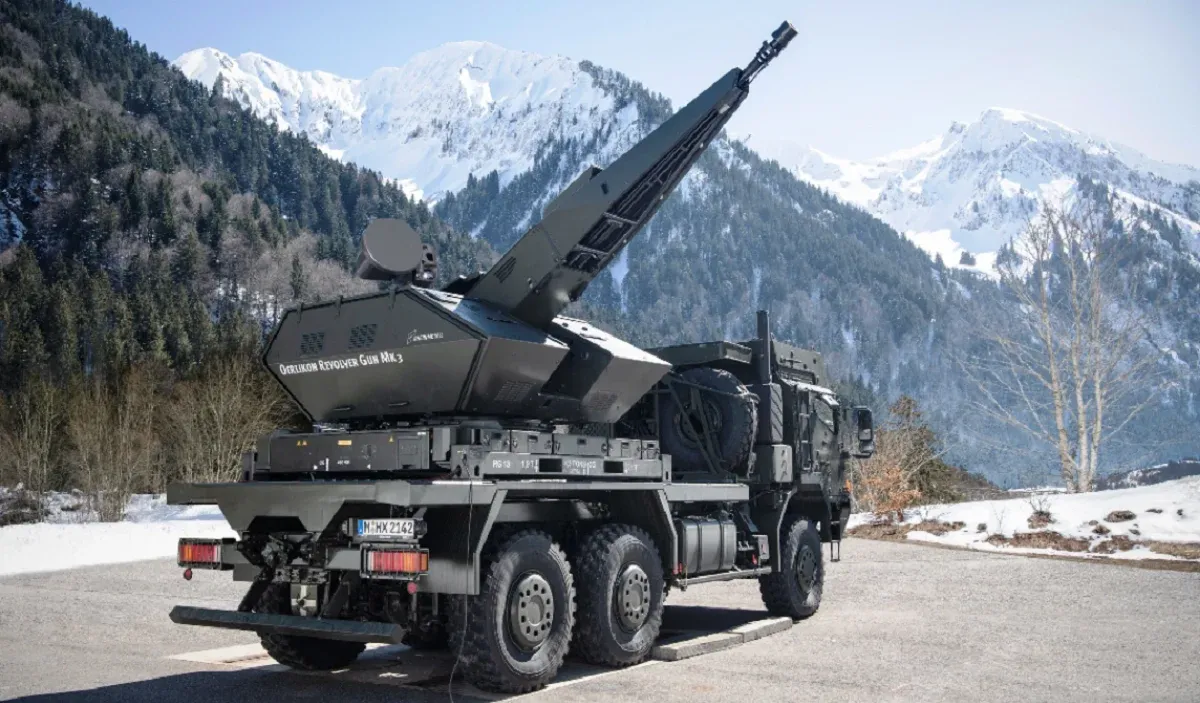
The facility was defended by two Skynex batteries. These comprised eight 35-mm gun modules, two X-TAR3D radar stations and two command posts.
The systems were deployed so that their engagement zones overlapped. The intention was to enable each air target to be engaged simultaneously by at least two guns.
How Skynex performed during the attack
According to Stern, the radars detected two Russian attack drones approximately 20 kilometres from the facility. One of the drones was flying through the guaranteed engagement zone.
Despite this, only a single shot was fired at it, which missed the target. The drone then struck a piece of the facility’s infrastructure and exploded.
The publication reports that the Ukrainian report cited a combination of technical problems and failures in target tracking as the cause of the failure.
What faults were identified
According to Stern, within a few minutes, three of the eight gun modules failed.
The report cited by the publication lists the following causes:
hydraulic faults;
malfunctions in the radar tracking system;
jamming of the loading mechanism.
As a result, Stern claims, only two guns were able to reliably track the target.
The publication describes the conclusions of the Ukrainian document as critical. It states that Skynex allegedly demonstrated ‘low technical operational readiness’, performed ‘extremely unreliably’ and ‘did not meet the manufacturer’s stated specifications’.
Rheinmetall’s response
Rheinmetall declined to comment on the specific combat incident for security reasons.
At the same time, the company stated that Skynex “has proven its exceptional effectiveness in Ukraine”. According to the manufacturer, Rheinmetall received this assessment from the Ukrainian side.
Stern also quotes an unnamed German official who urged against drawing definitive conclusions based on a single incident. He said that the number of Skynex systems currently in operation is still too small for a comprehensive assessment, and that the incident could also have been caused by operational errors.
What is known about Skynex
Skynex is a very short-range anti-aircraft artillery system developed by Rheinmetall to combat drones, cruise missiles, aircraft and other aerial targets.
The system uses 35-mm cannons and programmable ammunition designed to engage targets with a cloud of debris. This is why Skynex is regarded as a cheaper option for intercepting drones compared to the use of anti-aircraft missiles.
Following the outbreak of full-scale war, Skynex became one of the Western air defence systems that Ukraine received to protect its critical infrastructure.
Why assessments of Skynex vary
Stern’s report contrasts with previous reports of Skynex’s successful performance in Ukraine. In June 2026, according to information from the Ukrainian Air Force via the German Aid to Ukraine project, a Ukrainian unit equipped with the Skynex system destroyed 12 Russian aerial targets in a single engagement — one cruise missile and 11 Shahed-type drones.
Furthermore, the commander of a Ukrainian anti-aircraft artillery battery reported that his unit had shot down a total of two cruise missiles and around 35 Shahed drones.
Therefore, the single incident described by Stern does not provide grounds for assessing the entire system as a failure. At the same time, it may indicate problems with the technical readiness, maintenance or operation of individual batteries in real combat conditions.
Follow us on Telegram