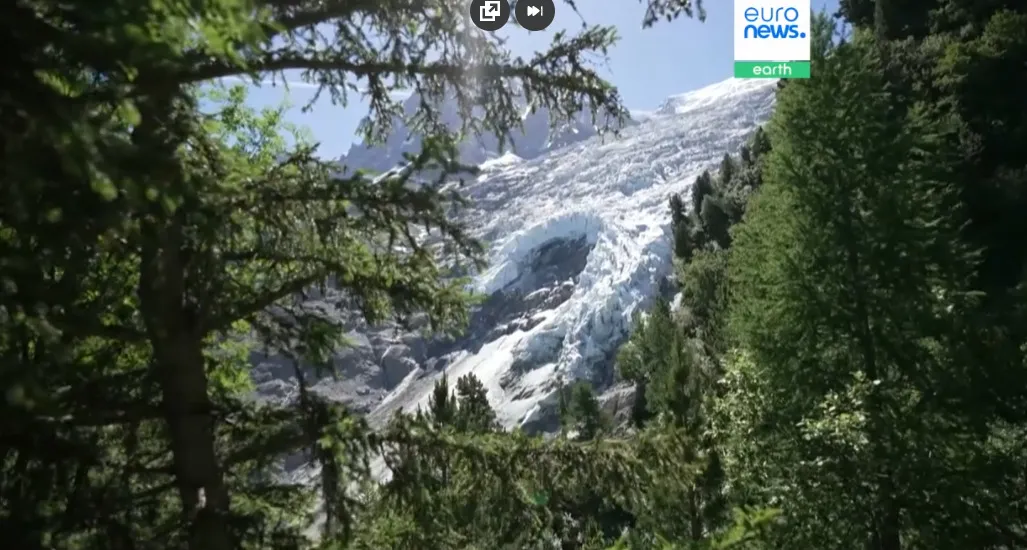
The Bosson Glacier in the Alps is melting. Due to the abnormal heat, it has shrunk dramatically in size

Boris Bodnar
Boris Bodnar Journalist
The Bosson Glacier in the Alps is melting. Due to the abnormal heat, it has shrunk dramatically in size
The Bosson Glacier in the Alps
Due to the heatwave in Europe, the French Bosson Glacier, which forms part of Mont Blanc, has started to melt much faster than usual.

This is according to Euronews.

New photographs taken from aeroplanes and drones show that the glacier is losing ice on a massive scale. Furthermore, a huge hole is still visible at the foot of the glacier, which formed back in 2025 as a result of climate change.

This glacier is considered one of the main attractions of the French Alps. In the 1980s, according to media reports, it was so large that its ice reached right down to the bottom of the valley. However, global warming has led to a sharp reduction in its size.

Scientists claim that glaciers in the Alps are now melting at a staggering rate, as the abnormal heatwave in Europe has destroyed the snow that previously shielded the Bosson from direct sunlight.

It is worth recalling that the heatwave sweeping across Europe has claimed at least 18 lives in France. Among the dead were two children who had been left in a car.

According to Reuters, the temperature in Bordeaux rose to 41.9°C, breaking last August’s record, whilst in Poitiers it reached 41.2°C — the highest reading since 1947. Paris recorded its highest June temperature on record — 38.4°C. Due to the extreme heat, schools across France were closed or had their timetables adjusted.

It was reported that the abnormal heat could lead to public health emergencies and economic losses for countries.

Follow us on Telegram

Share tittle
Science
COVID-19 vaccine technology has proven successful in the fight against cancer
Science

COVID-19 vaccine technology has proven successful in the fight against cancer

Medicines developed using mRNA technology – the same technology that enabled COVID-19 vaccines to reach the market in record time – are proving to be consistently effective in the fight against cancer.

10.06.2026
American crabs and Japanese prawns have appeared in the Black Sea: what is the reason?
Science

American crabs and Japanese prawns have appeared in the Black Sea: what is the reason?

Global warming in Ukraine is affecting biodiversity, creating conditions in which local flora and fauna are being displaced by new species from other regions.

10.06.2026
Scientists have developed a vaccine using AI for the first time: which virus will it target?
Science

Scientists have developed a vaccine using AI for the first time: which virus will it target?

Researchers at the University of Cambridge have developed a vaccine against all types of coronavirus using artificial intelligence. They are also working on developing new treatments for Ebola and influenza.

05.06.2026
In Japan, rare crested ibises, which had become extinct in the country several decades ago, have been reintroduced into the wild
Science

In Japan, rare crested ibises, which had become extinct in the country several decades ago, have been reintroduced into the wild

For the first time in several decades, eight crested ibises – a species that became extinct in Japan in the last century – have been released into the wild.

01.06.2026
A nature reserve is to be established near the Ukrainian Antarctic research station 'Akademik Vernadsky'
Science

A nature reserve is to be established near the Ukrainian Antarctic research station 'Akademik Vernadsky'

Ukraine has secured the establishment of a new specially protected area in Collins Bay, located near the Akademik Vernadsky station in Antarctica. The initiative was approved following three years of intensive international negotiations.

25.05.2026