The conflict between Poland and Ukraine over the UPA proved to be a trap for Navrotsky

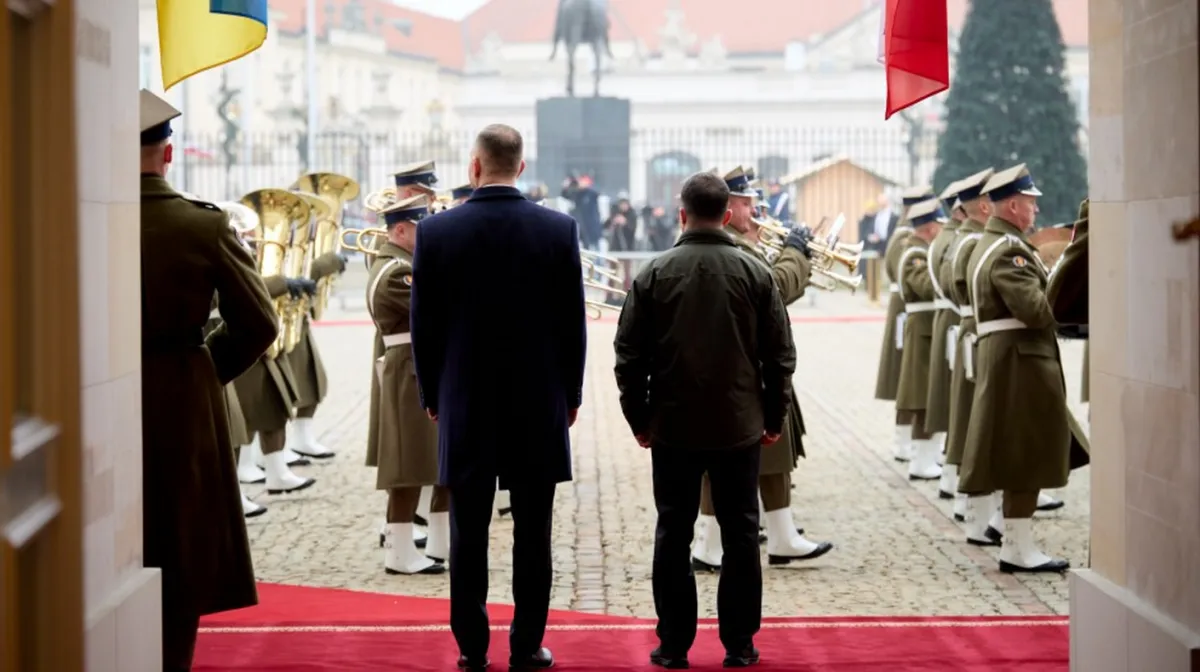
Tensions between Ukraine and Poland have been escalating for the past two weeks. However, recent events have revealed a new trend: Warsaw’s hardline stance towards Kyiv and its refusal to compromise are gradually becoming a problem for the Polish side.
On 8 June, the Chapter of the Order of the White Eagle, Poland’s highest honour, considered a request from President Karol Nawrocki to strip Ukrainian President Volodymyr Zelenskyy of this distinction.
The reason was the decision to award one of the Ukrainian Armed Forces units the honorary title ‘In the Name of the Heroes of the UPA’.
Why Zelenskyy’s decision caused a crisis
The Ukrainian president’s decision provoked a sharp reaction in Poland. It temporarily united even political opponents, and the public reaction was also almost unanimous.
Only a few cultural figures and intellectuals dared to describe the Polish response as excessive.
The situation involving Deputy Minister of Science Andrzej Sheptytsky was telling. He merely described the Ukrainian perspective on the UPA issue, without endorsing it.
However, even such a cautious departure from the general line of criticism of Ukraine proved unacceptable to the Polish right. Calls began to be heard in Poland to either dismiss Szepetycki or bring down Donald Tusk’s government.
How Navrotsky could have used the order against Tusk
Under Polish law, the decision to strip Zelenskyy of the order would only come into force after the Prime Minister’s approval. Donald Tusk does not share the right-wing’s enthusiasm for such a move, yet part of the responsibility could fall on him.
In such a situation, Tusk would face a choice: face domestic criticism or deal with the foreign policy consequences.
Under these circumstances, the stripping of Volodymyr Zelenskyy of Poland’s highest honour, or at least the initiation of this process by the president, appeared to be a matter for the coming days.
However, the chapter’s meeting on 8 June ended without any outcome. The Polish President’s Office did not publish the body’s conclusion and stated that Karol Nawrocki would “make a decision in due course”.
Polish politicians began talking about de-escalation
Also on 8 June, the first statements from Polish politicians appeared, which could be seen as a signal to ease tensions in relations with Ukraine.
Prime Minister Donald Tusk called on Volodymyr Zelenskyy and Karol Nawrocki to engage in frank talks.
“Cooperation is in the interests of both our states and peoples, whilst conflict is in Moscow’s interests. I think this is obvious to all of us,” Tusk said.
Sejm Speaker Włodzimierz Czazasty also spoke out in favour of easing tensions. He called for “wisdom” to prevent the conflict from escalating.
Former Sejm Speaker Szymon Golownia spoke even more bluntly. According to him, revoking the order from the president of a country fighting for independence would do more harm to Poland itself than to Volodymyr Zelenskyy.
At the same time, following his defeat in the 2025 presidential election, Golownia lost both his position as Speaker and the leadership of the party he had founded. He can therefore afford to say publicly what current politicians do not voice directly.
Why the conflict has become a problem for Poland
The events of 8 June showed that Poland was unprepared for such a high level of conflict with Ukraine.
It can be assumed that the high-profile statements by Navrotsky and representatives of his office were based on the calculation that the Ukrainian side would quickly make concessions and revoke the decision on the unit’s name. In that case, the Polish president could have chalked up a “victory over the Bandera followers”.
It is telling that, according to the statutes of the Order of the White Eagle, the Polish president does not require the chapter’s approval to strip someone of this honour.
On the contrary, it is the chapter itself that may initiate such a process, but the final decision rests with the head of state, regardless of the experts’ conclusion.
This further indicates that Navrotskyi’s appeal to the Chapter was primarily intended as a means of exerting pressure on Kyiv.
Following a visit to Warsaw by the head of the Office of the President of Ukraine, Kyrylo Budanov, information was leaked to the Polish media about Kyiv’s alleged readiness to revoke the decision regarding the “UPA heroes”. According to “European Truth”, this information was fake and unfounded.
Why Kyiv did not make concessions
Kyiv’s reluctance to revoke the decision is well-founded.
Such a move might temporarily resolve the current problem, but would create far more acute challenges for the future. In effect, it would legalise Warsaw’s right to edit Ukrainian history and demand that it be presented in a form most acceptable to Poland.
For Kyiv, such a scenario is unacceptable.
An additional signal was Volodymyr Zelenskyy’s decision to change the home base of his aircraft from Rzeszów in Poland to Chișinău. This demonstrates that the Ukrainian side is not bowing to pressure.
At the same time, the source of the crisis has not disappeared.
The anti-Ukrainian hysteria that has been rife in the Polish media in recent days indicates that public demand for “punishing the ungrateful Ukrainians” remains very high.
There are grounds to predict that this issue will become one of the key themes in the 2027 parliamentary elections, just as it was during the 2025 presidential elections.
What fears have emerged in Polish politics
Current statements by Polish politicians also reveal new fears regarding Ukraine. They complement old arguments, particularly those concerning the “Ukrainisation of Poland”.
Above all, Polish politicians are concerned that Kyiv’s dependence on Warsaw’s support has significantly decreased.
In 2022, Polish aid was crucial to Ukraine’s ability to fight. However, Poland has gradually been overshadowed by more substantial support from other European countries.
Consequently, the ability to threaten to restrict or withdraw this aid is also diminishing. If necessary, countries in Western and Northern Europe can compensate for the withdrawal of support from Poland.
Furthermore, the protracted crisis in relations casts doubt on the promises made by Polish politicians to secure the best conditions for Polish businesses when contracts for Ukraine’s reconstruction are awarded.
At the same time, this heightens fears that Kyiv’s foreign policy will increasingly be oriented towards Berlin rather than Warsaw.
How the conflict has affected Navrotsky
The combination of these fears with the Polish stereotype of “Ukrainian ingratitude” and long-standing phobias is fuelling the emergence of theories within right-wing circles that seem strange from a Ukrainian perspective.
In particular, there is a theory that Germany and its Chancellor Friedrich Merz are behind the current escalation. According to this theory, the Germans allegedly seek to block Ukraine’s accession to the EU, but through the hands of others.
In this situation, the conflict with Ukraine, which was supposed to bring Karol Nawrocki political dividends, has become a trap for him.
He has staked his reputation on the initiative to strip Volodymyr Zelenskyy of the Order of the White Eagle. Therefore, abandoning this idea could deal a blow to Nawrocki’s reputation.
However, carrying out this threat would also deal a blow – first and foremost to Poland. This is precisely what Polish politicians have already begun to voice publicly.
For Ukraine, the current situation, despite the tensions, could present an opportunity to improve relations with its neighbour and strategic ally.
Removing historical issues from the realm of political relations between Kyiv and Warsaw could benefit both countries. The only exception are those politicians who build their own image on criticising and blackmailing a neighbouring state that is fighting for its survival.
Follow us on Telegram