The military have developed the ‘Pegas’ all-terrain vehicle: it can traverse marshes and carry 200 kg

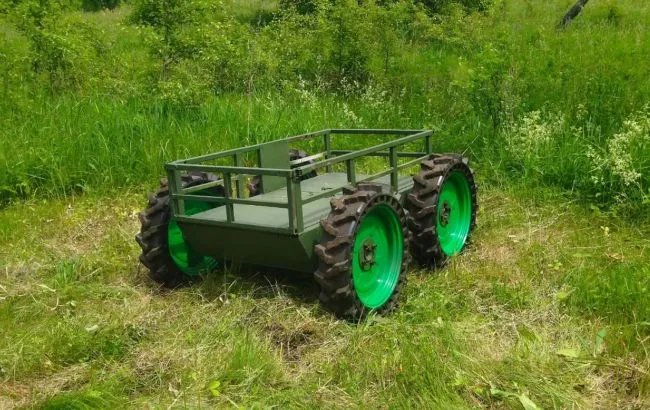
The creators of the system informed RBC-Ukraine of its development.
The need for a dedicated ground-based robot arose due to the challenging conditions at the front. Following heavy rain, certain routes are difficult to navigate even on a quad bike, whilst standard systems, due to their low ground clearance, scrape the ground with their undercarriage and become stuck.
The brigade has set up an engineering workshop where they assemble ground-based robotic systems and repeaters, as well as adapt the equipment to the military’s needs.
‘Pegas’ was not developed using off-the-shelf factory blueprints, but in accordance with the conditions of its future deployment. Engineers design the structure themselves and use readily available parts, including second-hand engines.
According to the developers, this approach means the system costs several times less than mass-produced factory platforms. The military have not disclosed the exact cost of the ‘Pegas’.
How much cargo can the ‘Pegas’ carry?
The system’s primary purpose is to deliver cargo to frontline positions without requiring military personnel to undertake dangerous logistical missions. The ‘Pegas’ can carry water, food, fuel and ammunition.
The platform’s payload capacity is up to 200 kilograms per trip. During testing, the system withstood 370 kilograms; however, this is a test figure rather than the stated payload for regular transport.
To navigate difficult terrain, engineers have increased the ground clearance and fitted airless tyres. The design can be adapted depending on the terrain and the unit’s tasks.
How the charging issue was resolved
The ‘Pegas’ runs on replaceable batteries. Once the battery is flat, the military do not need to wait several hours for the robot to recharge: they simply need to fit another battery pack.
According to the developers, the replacement takes a few minutes, after which the platform can resume its mission.
The batteries for the system were developed by engineers at PAWELL Battery in Lviv. The batteries incorporate technologies from industrial power supply systems, constant-discharge controllers and power buses designed to minimise energy loss.
The replaceable batteries are intended to reduce downtime between missions and simplify the use of the ground robot in locations where it is not possible to quickly connect it to a power source.
The developers have not yet disclosed how many ‘Pegas’ systems have been assembled or whether they plan to transfer the technology for mass production.
Follow us on Telegram.