Today, 23 May, Ukraine celebrates Heroes’ Day

The idea for Heroes’ Day originated among Ukrainian nationalists. It was first officially established by a resolution of the Second Grand Assembly of the OUN, which took place in April 1941 in Kraków.
The document stated: ‘The mandatory organisational holidays are: Unity Day on 22 January, Heroes of the Revolution Day on 23 May, and Struggle Day on 31 August’.
The date of 23 May was not chosen at random. On 3 May, Mykola Mikhnovsky, the ideologue of Ukrainian independence, died in controversial circumstances. On 23 and 25 May, Soviet agents killed the leaders of the Ukrainian liberation movement, Yevhen Konovalets and Symon Petliura.
During the Ukrainian Revolution of 1917–1921, Yevhen Konovalets was the founder and commander of the Sich Riflemen, one of the most combat-ready Ukrainian military formations of the time. After the revolution, he continued the underground struggle for Ukrainian independence, heading the Ukrainian Military Organisation and later the Organisation of Ukrainian Nationalists. Yevhen Konovalets was killed on 23 May 1938 in Rotterdam by the Soviet agent Pavel Sudoplatov.
During the Ukrainian Revolution of 1917–1921, Symon Petliura headed the Ukrainian General Military Committee, served as Secretary-General for Military Affairs, founded the Haidamaka Camp of Sloboda Ukraine, and served as Chairman of the Directory of the Ukrainian People’s Republic and Chief Ataman of the Army and Navy of the UPR. After the revolution, whilst in exile, he led the State Centre of the UNR in exile, attempting to preserve Ukrainian state institutions and the military and to unite the Ukrainian diaspora around the continuation of the struggle. Symon Petliura was assassinated on 25 May 1926 in Paris. Despite a smear campaign, for many Ukrainians his name remained a symbol of the struggle for independence.
During the Second World War and after its end, Heroes’ Day was observed by members of the Organisation of Ukrainian Nationalists and soldiers of the Ukrainian Insurgent Army. On the eve of the holiday and on 23 May, they held closed meetings during which they honoured the fallen heroes with a minute’s silence, delivered speeches, and new members of the organisation took their oaths.
Mass festive events were also organised for the general public at the graves of local heroes. People sang the Ukrainian national anthem and the OUN anthem ‘We Were Born in a Great Hour’, lit torches and stood guard of honour.
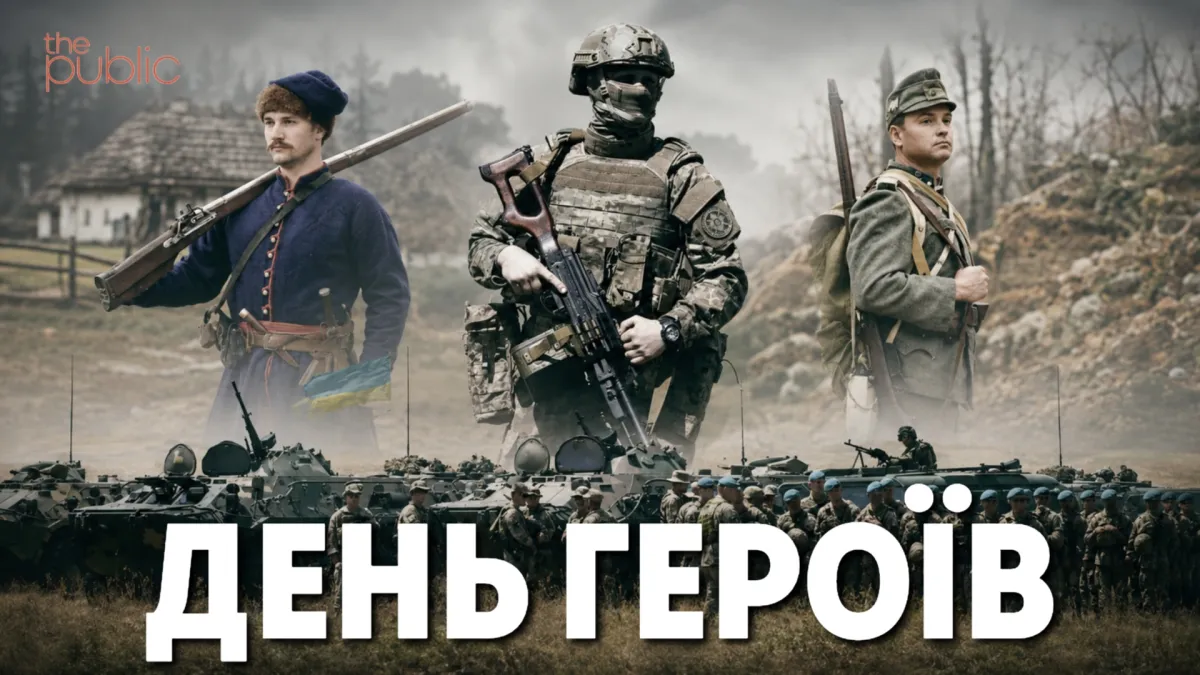
Heroes’ Day held particular significance for the Ukrainian diaspora. Representatives of the diaspora emphasised the continuity of the Ukrainian military tradition from the times of Ancient Rus’ and the Cossacks to the Ukrainian Galician Army, the Sich Riflemen, the Army of the Ukrainian People’s Republic, the OUN and the UPA.
After 1991, the holiday began to gain popularity, particularly in the western regions of Ukraine. In 2014, large-scale celebrations of Heroes’ Day took place in the Volyn, Lviv, Ivano-Frankivsk and Ternopil regions.
Currently, Heroes’ Day has no official status, yet the tradition of commemorating 23 May is growing stronger, particularly since 2014. Since then, Ukrainians have been defending their territorial integrity and the right to freely choose the country’s development path in the war against the Russian Federation, which launched a full-scale invasion following the annexation of Crimea and the occupation of part of the Donbas in 2022.