The level of counterfeiting of hryvnia banknotes has fallen by a third in Ukraine

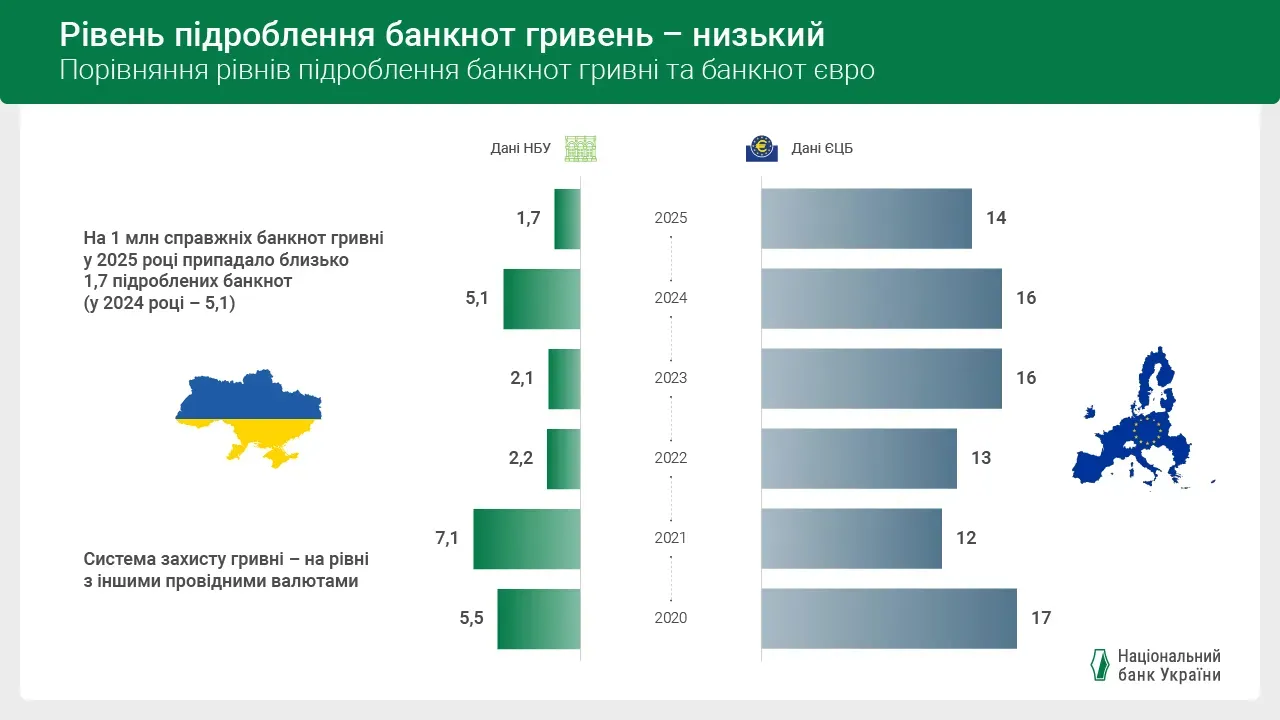
The rate of counterfeiting of national currency banknotes fell by a factor of three in 2025 compared with 2024. According to data from the monitoring of hryvnia banknotes withdrawn from circulation, there were approximately 1.7 counterfeit banknotes for every 1 million genuine banknotes in 2025.
This is the lowest figure since the start of Russia’s full-scale invasion of Ukraine. In 2024, the figure stood at around 5.1 counterfeit banknotes per 1 million genuine ones.
By way of comparison, according to the European Central Bank, the equivalent figure for the euro in European Union countries in 2025 was 14 counterfeit notes per 1 million genuine notes.
Reasons for the decline in counterfeiting of the national currency
The National Bank attributes the decline in counterfeiting to the replacement of older banknote designs, which were most frequently counterfeited, with newer and better-protected ones. This was also influenced by the work of law enforcement agencies investigating the circulation of counterfeit money.
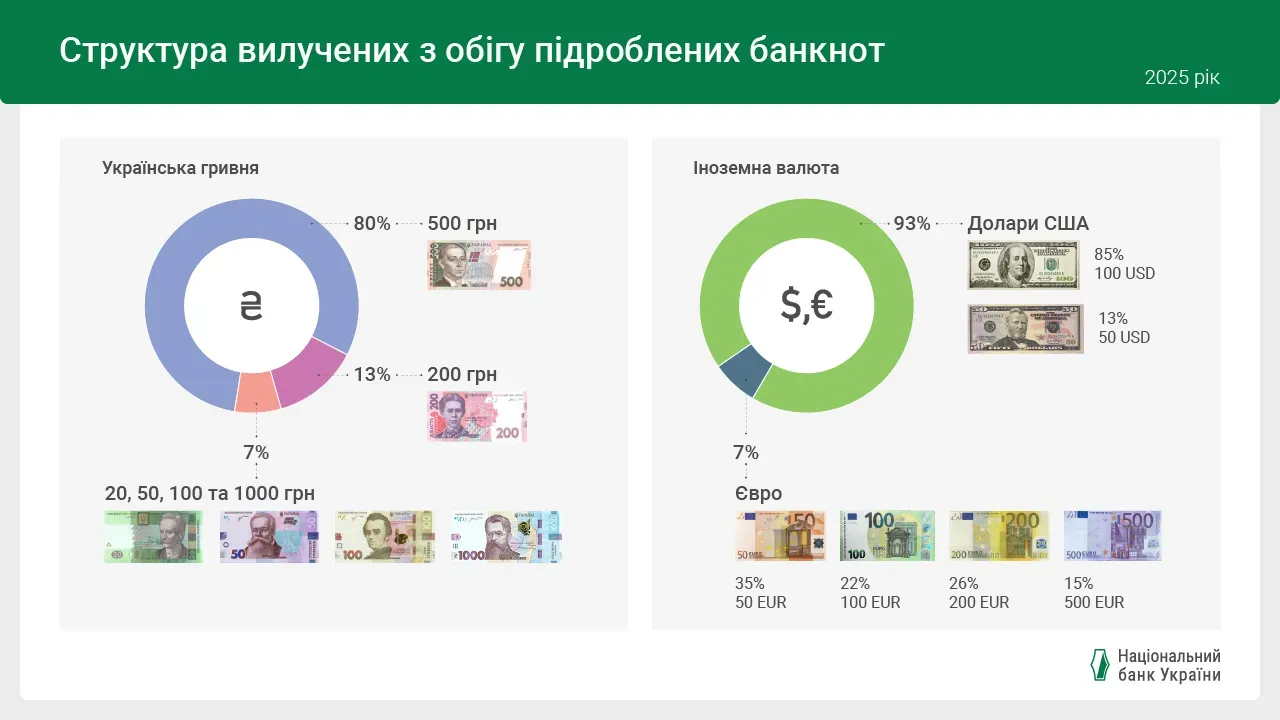
In 2025, counterfeit 500-hryvnia notes were most frequently withdrawn from circulation. They accounted for 80 per cent of the total number of counterfeits. 200-hryvnia notes accounted for 13 per cent. Counterfeit notes in denominations of 20, 50, 100 and 1,000 hryvnias together accounted for 7 per cent.
As in 2021–2024, the most counterfeited notes were the older 2003–2007 series, particularly the 2006 500-hryvnia note.
Counterfeits of the current generation of banknotes, issued in 2014–2019, accounted for only 10 per cent of the total number of counterfeits seized in Ukraine’s banking system. The number of such counterfeits per 1 million genuine banknotes in circulation was 0.2.
The National Bank notes that most counterfeits of modern banknotes were of poor quality and designed to take advantage of the inattention of the public and cashiers.
The new generation of banknotes in denominations of 100, 200, 500 and 1,000 hryvnias, introduced into circulation between 2015 and 2020, feature an updated design and enhanced security features. For high-denomination banknotes, features such as a ‘window’ security strip and the SPARK element, with background image movement and colour-shifting effects, are used.
Counterfeiting of foreign currency
The volume of counterfeit foreign currency seized in 2025 also fell by approximately a quarter compared with 2024.
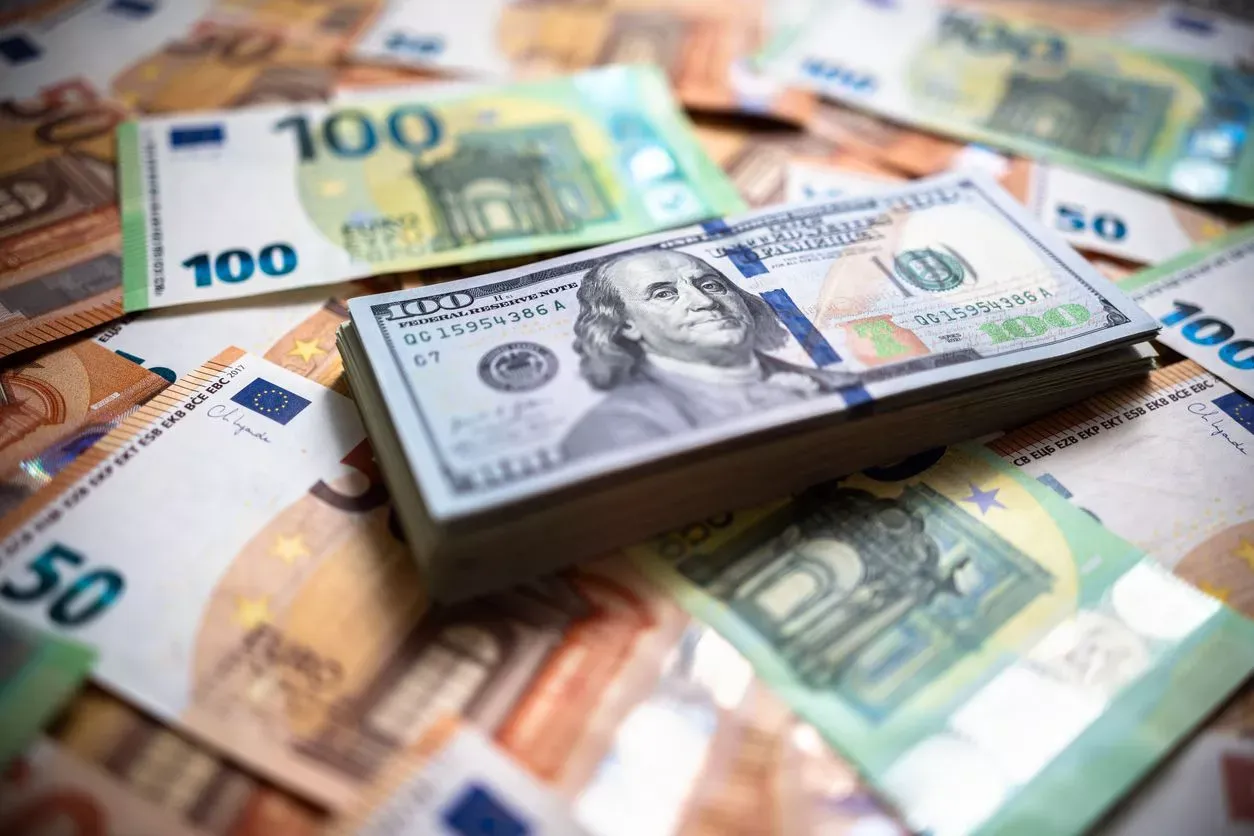
US dollars accounted for the majority of counterfeit foreign currency. They made up 93 per cent of the total number of counterfeit banknotes seized. The euro accounted for 7 per cent.
The most commonly counterfeited denominations were the US$100 note, which accounted for 85 per cent of seized counterfeit dollars, and the US$50 note, which accounted for 13 per cent. Among euro notes, the most frequently seized counterfeits were the €50, €100, €200 and €500 denominations.
The National Bank advises against carrying out currency exchange transactions ‘on the street’ or via the internet. For this purpose, one should only use licensed currency exchange points at banks or non-bank financial institutions.
If in doubt about the authenticity of hryvnia or foreign currency, citizens may contact banks. Banks forward such banknotes to the National Bank for free examination.
If hryvnia banknotes are recognised as genuine and valid for payment, customers are reimbursed the corresponding amount. Genuine foreign currency banknotes are returned to the person who submitted them for examination, regardless of the degree of wear or damage.
Counterfeit banknotes are confiscated without reimbursement of their value. The National Bank reports such cases to law enforcement agencies.