Easter baking: the best recipes for Easter cake and icing

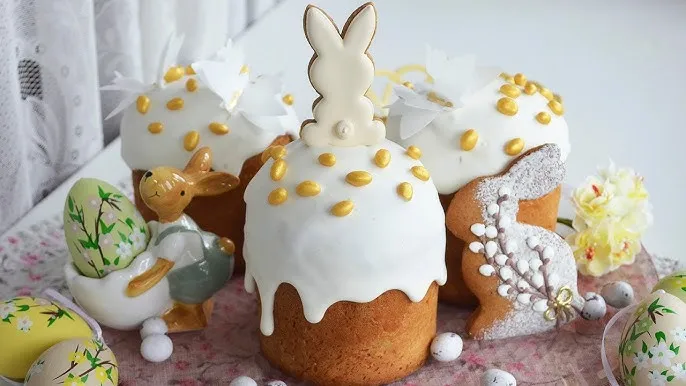
Easter is the most important holiday for Orthodox Christians. And one of its symbols and the highlight of the Easter table is the paska.
There are countless ways to make this traditional Easter cake. And this festive baked treat has many names: ‘babi’, ‘kalachi’ and ‘zoloti babi’. Some bake paska with yeast, adding raisins, poppy seeds and candied fruit; others make it yeast-free, or as a krafin-paska. One housewife has a proper oven at home, whilst another has got used to using a bread machine. In short, everyone has their own recipes for making traditional Easter paska; the main thing is that these experiments with the dough turn out well.
Quick Easter cake
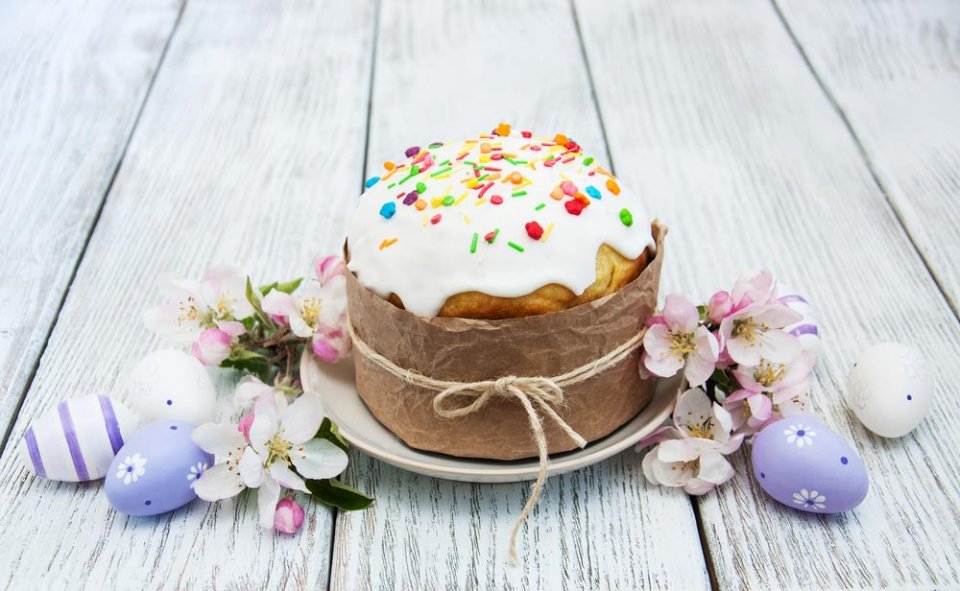
Not everyone who decides to bake their own Easter cake enjoys standing at the hob for hours and spending half a day making this pastry. So let’s start with the simplest recipe.
Ingredients:
- 4 cups of flour,
- 100g butter,
- 50g yeast,
- 3 eggs,
- 1 cup of sugar,
- 1 cup of milk, salt.
Step-by-step method:
Dissolve the yeast in warm milk, add the eggs, melted butter, sugar, a pinch of salt and the flour, then mix well. Spoon the dough into greased tins, filling them halfway, and leave in a warm place for 3–4 hours. Once the dough has risen, place it in the oven and bake until done.
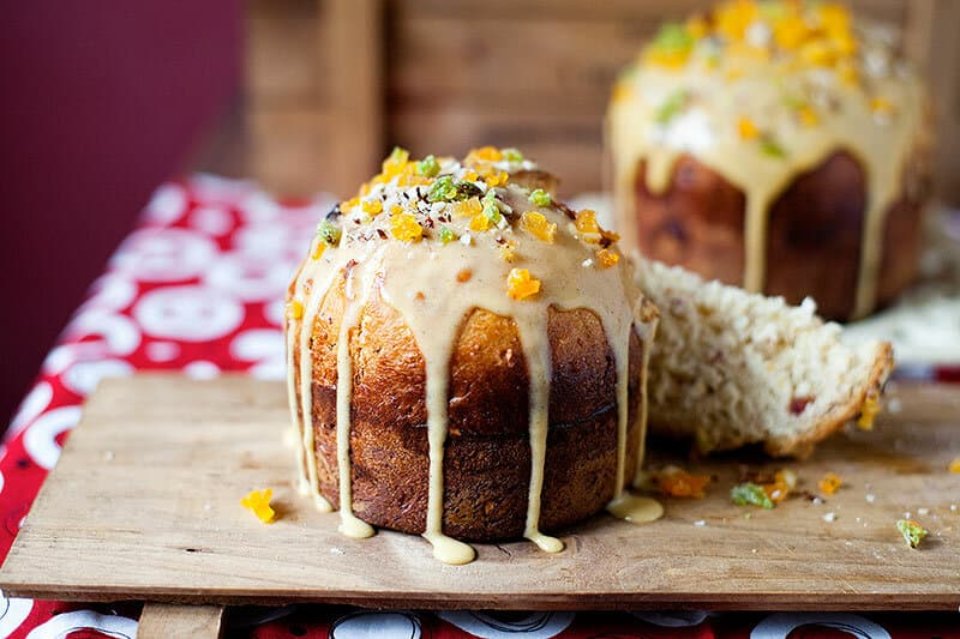
Yevhen Klopotenko’s classic Easter cake recipe
Ingredients
- 750–800 g wheat flour
- 220 ml warm milk (2.5%)
- 25 g fresh yeast
- 1 egg + 1 egg yolk
- 2 tablespoons of 20% sour cream
- 225 g sugar + 1 tablespoon for the starter
- 10 g vanilla sugar
- 1 orange (optional)
- 100g soft butter (82.5%)
- 2 tablespoons of sunflower oil
- 25 ml cognac/whisky/rum (optional)
- 100g raisins/candied fruit
- 200g icing sugar
- a pinch of salt
Step-by-step method:
Start by making the starter dough. Heat the milk in a saucepan and crumble the yeast into it. Stir well until dissolved. Add the sugar and stir again until the sugar has dissolved. Cover with a tea towel or cling film and leave in a warm place for 20 minutes.
The starter should double in size. Add one whole egg and one egg yolk to it. Add the sugar, vanilla sugar and a pinch of salt. Add the softened butter at room temperature and the sour cream.
Mix everything well with a whisk. If desired, grate the orange zest using a fine grater and add it to the mixture with the starter.
Add the flour and mix the dough with a spatula until smooth. You can add a strong spirit if you like.
Knead the soft dough for about 10 minutes. It should not stick to your hands. Shape it into a ball and place it in a large, deep bowl greased with sunflower oil. Cover with a tea towel and leave in a warm place for an hour to rise.
The dough should increase in volume by 2–3 times. Knead the dough and shape it into a ball again. Leave it to rise for another 40 minutes to ensure a light and airy Easter cake. Knead the raisins into the dough.
Preheat the oven to 180°C on the fan setting. Fill paper or metal tins with the dough, but only to two-thirds of their capacity. Leave the tins in a warm place, covered with a tea towel, so that the dough rises to the edges of the tin.
Bake the Easter cakes in the oven for 20–35 minutes.
Lisa Glinska’s Paska-Krafin
If you’ve grown tired of classic Easter cake recipes, krafins are here to the rescue. They are a hybrid of a flaky croissant and a muffin. They are baked from yeast dough that has been well-layered and brushed with butter. Dried fruit, nuts and chocolate are used as fillings and decorations. You can also use fillings such as caramel, ganache or chocolate balls.
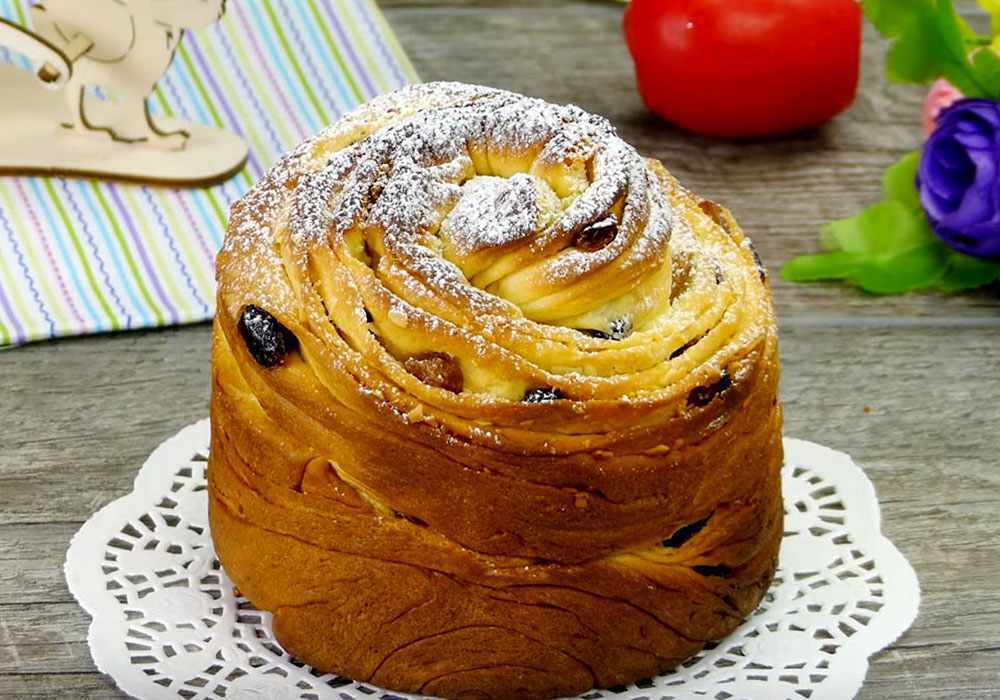
Ingredients:
For the dough:
- 300 ml milk (1.2 x 250 ml glasses)
- 20 g sugar (1 tbsp)
- 5 g dried yeast (or 15 g fresh yeast)
- 150 g flour (1 cup, 250 ml)
For the dough:
- starter
- 100 g eggs (2)
- 100 g sugar (4 heaped tbsp)
- 5 g salt (0.5 tsp)
- 500 g flour (3 x 250 ml glasses)
- 100 g butter (0.5 pack, softened) — for the dough
- 100 g butter (0.5 pack, softened) — for the layers
- 200 g raisins
Step-by-step method:
First, prepare the starter. To do this, combine the yeast with the flour and mix. If using dry yeast, mix it with the flour. If using fresh yeast, dissolve it in warm milk (no higher than 40 degrees). Add the sugar and the flour with the yeast to the slightly warm milk. Stir until smooth. Cover with a tea towel and set aside in a warm place.
To make the dough, mix the eggs with the sugar and salt, then stir. Add the yeast mixture, sift the flour through a sieve, and add the softened butter. Knead the dough and transfer it to a bowl. Cover with a tea towel and leave in a warm place for one hour.
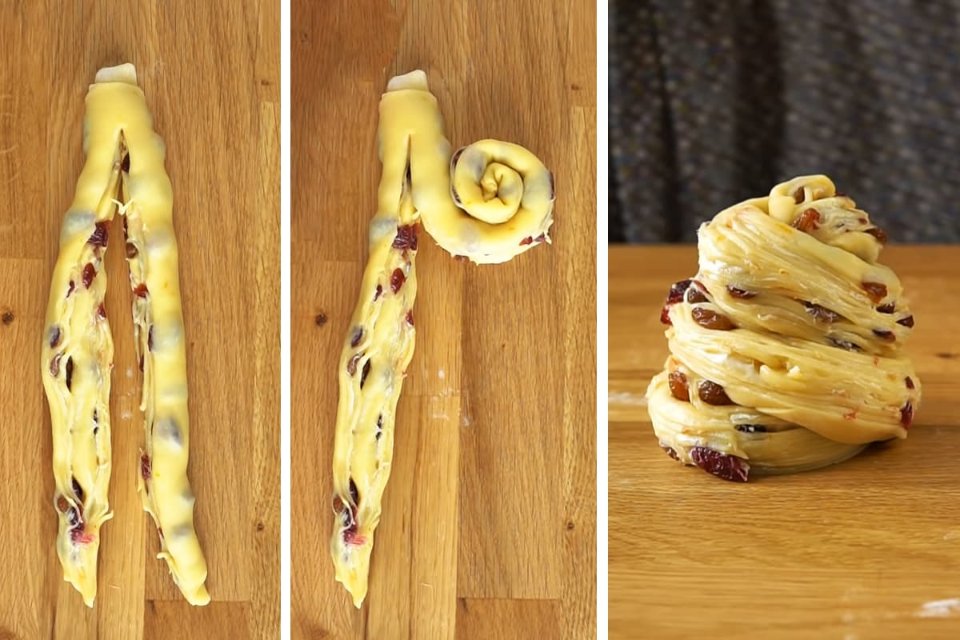
Divide the dough into six equal parts. Shape into balls and cover with cling film. Meanwhile, rinse the raisins. Roll out the dough into a rectangle, approximately 30 x 40 cm in size and 3 mm thick. Brush the surface of the dough with softened butter and sprinkle with raisins. Roll into a log, cut in half lengthways and twist into a spiral. Bake in tins at 180°C for 30–35 minutes.
Yeast-free Easter cake
You can make a Paska for Easter using yeast-free dough. It will be delicious, light and fluffy, and won’t go stale for a long time.
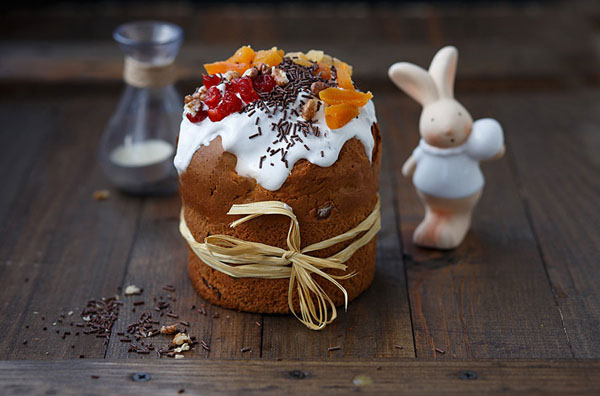
Ingredients:
- Eggs — 3
- Salt — 1/4 tsp
- Sugar — 140 g
- Vanilla sugar — 20 g
- Butter — 100 g
- Milk — 80 ml
- Zest of 1 lemon
- Flour — 300 g
- Baking powder — 10 g
- Dried fruit — 90 g
Step-by-step method:
Crack the eggs into a deep bowl, add the sugar, salt and vanilla sugar. Beat with a mixer until light and fluffy.
Add the butter and milk. Whisk. Grate the zest of one lemon.
Add the flour and baking powder, and mix. Fold the dried fruit into the batter.
Fill the moulds 3/4 full with the dough. Smooth the tops of the cakes with a spoon greased with oil.
Bake in an oven preheated to 180 degrees for 35 minutes.
Make the icing, coat the cakes and decorate to your liking.
Top 3 Easter cake icing recipes
Making white icing is quite simple. In this selection, everyone can find their own icing to make Easter cakes even more beautiful and delicious.
Classic egg white icing
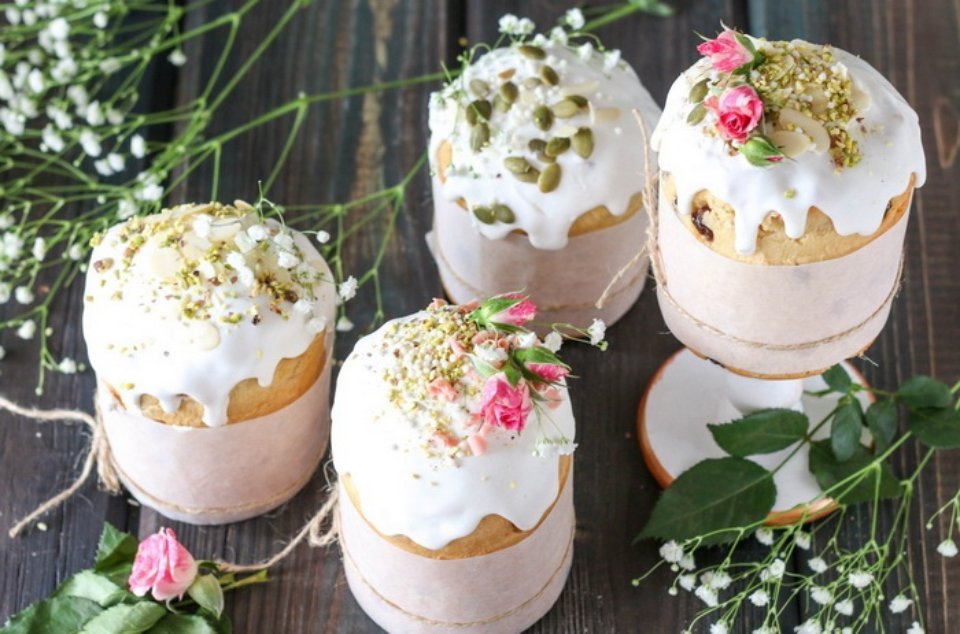
Ingredients:
- 1 egg white
- 100 g icing sugar
- 2 g citric acid or 1 tsp lemon juice
Step-by-step recipe: The egg must be cold. Separate the yolk and the egg white. Beat the egg white with a mixer, starting on a low speed, then increasing to high. While beating, gradually add the icing sugar and citric acid to the egg white. Beat until the mixture becomes smooth, glossy and uniform, which takes about 10–15 minutes. The icing must be applied to the Easter cake immediately, before it dries.
Gelatine icing
This icing adheres firmly to the cake, does not stick and does not crumble. It must be applied whilst the icing is still warm, otherwise it will set.
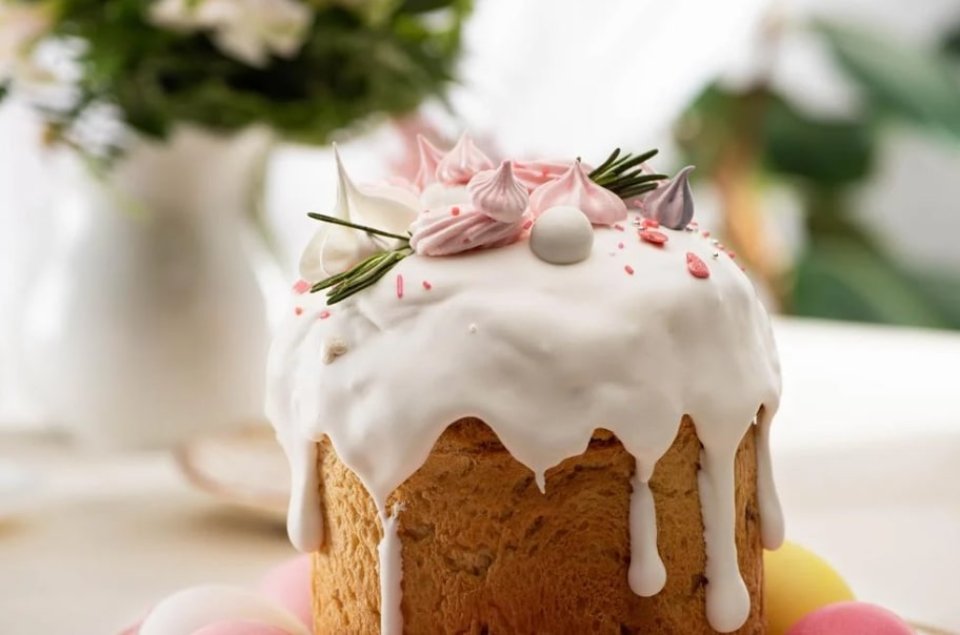
Ingredients:
Gelatine — 1 tsp or 5 g
Water — 6 tbsp
Sugar — 1 cup.
A pinch of citric acid.
Step-by-step recipe: Pour 2 tablespoons of cold water over the gelatine. Mix the remaining water with the sugar and citric acid and heat in a saucepan over a low heat until the sugar has completely dissolved. Add the swollen gelatine to the hot sugar syrup. Beat the mixture with a mixer for about 3 minutes until it forms a white foam. Allow to cool slightly and spread over the cakes.
White chocolate glaze
It tastes wonderful, sets beautifully, isn’t sticky and doesn’t crumble. Although the recipe specifies white chocolate, it can also be made successfully with dark or milk chocolate.
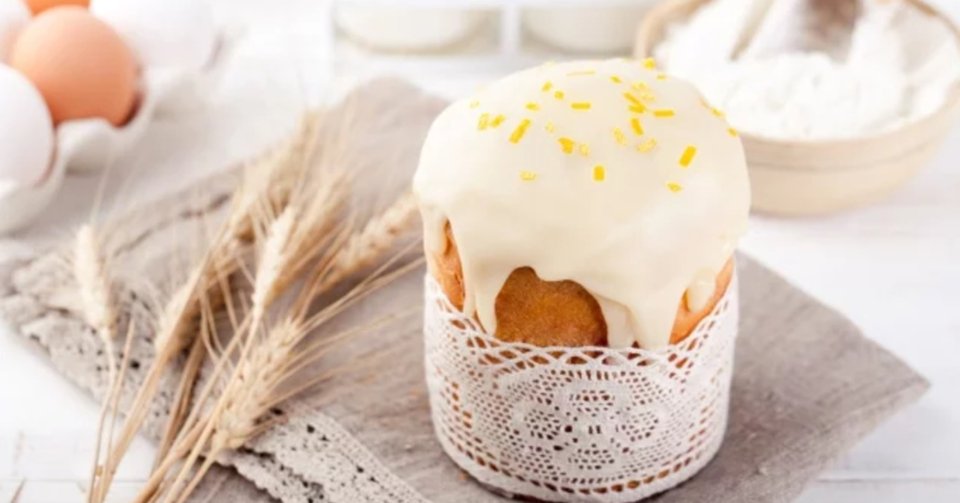
Ingredients:
White chocolate bar — 100 g
Milk — 2 tbsp
Icing sugar — 170 g
Step-by-step recipe: melt the chocolate in a bain-marie over a low heat. You can use dark chocolate. Separately, mix the milk and icing sugar and bring to the boil. Stir the boiling milk into the melted chocolate and mix well. This glaze should only be applied to cooled Easter cakes.
Important to know! Before applying the icing to the Easter cake, you must wait until it has cooled down and only then decorate it. The icing goes on more evenly on a cooled Easter cake and does not run, and on cold Easter cakes it simply sets faster.
The best days for baking Easter cakes
According to church traditions, Maundy Thursday is considered the best day for baking Easter cakes. In 2026, it falls on 9 April. On this very day, housewives tidy up the house and begin preparing festive dishes.
It is also permitted to bake Easter bread on Holy Saturday – 11 April. Many families choose this day specifically so that the bread is as fresh as possible by the time of the blessing.