Round-robin booking: it is possible to temporarily suspend staff bookings via the ‘Diya’ portal

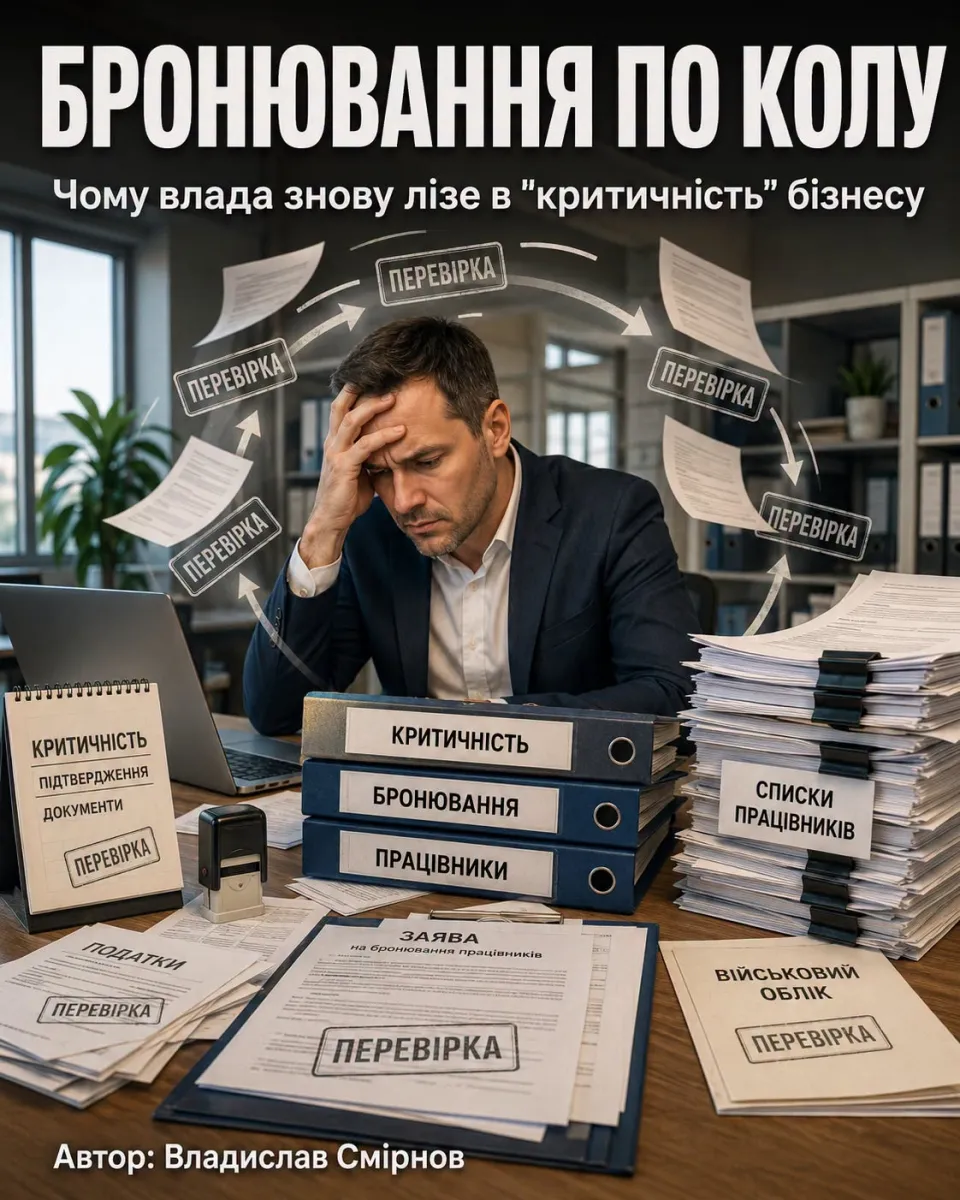
Information is circulating on social media regarding a possible temporary suspension of staff bookings via the ‘Diya’ portal. However, no regulatory document has been published that would officially confirm such a decision.
According to the information available, the decision to temporarily suspend bookings via the ‘Diya’ portal has already been taken at the level of the Supreme Commander-in-Chief’s Headquarters.
The official reason is the need for companies to carry out a mass ‘re-confirmation’ of their criticality status in line with new, stricter criteria (which we discussed earlier). It is expected that the technical block on submitting new applications will remain in place until approximately 1 September 2026 (or until 10 August for simplified procedures). In other words, the portal will simply be shut down for new bookings, forcing businesses to wait whilst officials carry out manual checks.
Now let’s imagine a normal state. It sees that the booking system is riddled with schemes, fictitious employment, bogus ‘critical enterprises’, manual decisions by regional administrations, corrupt intermediaries and the sale of ‘salvation’ from mobilisation. What should it do? It would have to eliminate the manual element, not revive it. It would have to implement a strict, public, automated algorithm: meet the criteria — you get the status; fail to meet them — you don’t; rejection — with reasons given; appeal — within a set timeframe; decision — recorded in the register; official — personally accountable; selling ‘critical’ status — a criminal offence; regional administrations and ministries — subject to audit. But the Ukrainian authorities seem to be taking a different path once again: instead of reducing the number of ‘hands’ involved in the procedure, they are attempting to place yet another ‘hand’ above it.
This ‘hand’ is called the Coordination Centre for Bookings.
The Ministry of Economy has officially announced that the Cabinet of Ministers has established the Coordination Centre as a temporary consultative and advisory body tasked with coordinating state bodies and finding solutions to problematic situations in the booking process; The statement also notes that the Centre will consider proposals from state bodies regarding the designation of enterprises as critical, and that state bodies must take its recommendations into account when making decisions. Formally, this sounds rather mild: ‘coordination’, ‘problematic situations’, ‘recommendations’, ‘advisory body’. But Ukrainian business has long known what such language really means. If a body “recommends” and others “must take into account”, then tomorrow, without this recommendation, no one will want to sign off on a critical designation. If a “problematic situation” arises, someone will very quickly appear who knows how to make it non-problematic. If a new centre is set up which ostensibly does not make any final decisions, but without which any decision becomes risky, then this is not consultation. It is a filter. And in a mobilised state, a filter is always a potential source of revenue.
“Telegraf” reports that bookings via “Diyu” may be temporarily suspended as early as the beginning of August precisely due to the creation of the new Coordination Centre, and the likely process will be: enterprise — ministry or regional administration — Coordination Centre — recommendation — decision; the publication also mentions 8 August as a possible date for the pause. RBC-Ukraine reported separately, citing a source, that bookings via “Diyu” may be put on hold due to updates to the rules governing the assignment of criticality levels. Legally speaking, we must be precise: at present, I do not see any published regulatory act that explicitly suspends bookings via ‘Diyu’ from 8 August. But politically, this is already enough to see the direction things are heading. The authorities are not simply updating the criteria. They are creating an atmosphere of uncertainty as to whether bookings will remain fast, electronic and algorithm-driven, or whether they will revert to a back-office, recommendation-based system.
And where there are bureaucracy, deadlines and fear, the tariff takes on a life of its own.
A business that would argue with the state in peacetime cannot afford to wait during wartime. Whether it imports medical equipment, transports critical cargo, repairs the energy infrastructure, supplies hospitals, provides communications, manufactures components, manages logistics, or simply pays its taxes honestly and keeps people in the formal economy, the loss of a few key employees’ leave entitlements may not merely be a staffing inconvenience, but an operational collapse. A single clinical engineer may be more important to a hospital than a dozen well-dressed officials in a department. A single logistics specialist may keep a route running that cannot be seen from an office. A single service technician may maintain equipment without which a paediatric intensive care unit would grind to a halt. But in a state run by hand, all this easily becomes a bargaining chip, because a bureaucrat can always say: prove it, explain it, clarify it, wait, report it, get approval, go through the centre, come back later.
Thus, the status of ‘criticality’ is ultimately transformed from a macroeconomic tool into a paid subscription licence for the right to breathe. Not in legal texts, but in real life. Businesses have already raised salaries to new thresholds, are already paying tax on these salaries, have already regularised their workforce, have already gone through the preliminary stages, and have already adapted their staffing structure to a mobilisation-oriented state – yet they are once again being told: ‘Stop, we’re starting again.’ Prove your compliance once more. Meet the new criteria. Wait for instructions from the centre. Keep an eye on ‘Dія’. Don’t worry, but do hurry. Everything will be transparent, but we’ll add one more manual step.
Businesses are literally being prevented from getting a foothold. They cannot properly plan their staffing, contracts, imports, production, loans, services, warehousing or logistics, because the state changes the rules for survival every few months. No sooner has a company learnt to operate within one system than it’s given another. No sooner has it met the requirements than it’s told to reconfirm. No sooner has it secured a booking than it has to check whether it will fall through. No sooner has it brought its staff onto the official payroll than it is faced with a new threshold and new risks. No sooner has it started booking via an algorithm than it must prepare for a manual booking centre. And all of this is presented as a concern for fairness.
In reality, it’s a war waged by the state against its own home front.
Because, in this model, legitimate businesses are punished for being visible. Those who pay officially are visible. Those with a staff are visible. Anyone who has registered staff is visible. Anyone who has raised wages is visible. Anyone who has made bookings via ‘Diyu’ is visible. And that is precisely why they become the easiest target for monitoring, inspection, review and re-taxation. The shadow economy is always more flexible. Undeclared employment is always less visible. Fictitious schemes always adapt more quickly. And legitimate businesses, which have placed their trust in the state, become hostages to its new deadlines.
This is what a cannibal state is all about: it devours the very sector that feeds it.
Shutting down or even chaotically suspending ‘Dii’ will not automatically provide the front line with new, combat-ready stormtroopers. It will bring about something else. It will lead to a surge in the black economy, as it becomes dangerous and expensive to operate officially. It will cause a staffing crisis in critical sectors, as workers no longer know whether they are needed by the economy or whether they will be called up tomorrow. It brings to a halt some services that are invisible from the government’s perspective, but which keep hospitals, the energy sector, imports, transport, repairs, services and local communities running. It leads to a decline in trust in the state, because the state is proving once again that following the rules does not guarantee stability; it merely makes you more controllable. It creates a new market for corruption, because every uncertainty in a country at war is monetised.
And there’s no point pretending that the authorities don’t understand this. They understand perfectly well that reservations are currently one of the most expensive administrative commodities in Ukraine. The State Bureau of Investigation has already shown that a fictitious reservation can cost thousands of dollars; now let’s imagine not just a small-scale scheme involving a few people, but a nationwide review of criticality, with a deadline of 1 September, 1.3 million reservations in the system, businesses’ fear of losing key staff, and a new Coordination Centre, whose recommendations the authorities are required to ‘take into account’. This is not merely an administrative reform. It is a goldmine for anyone operating at the intersection of state fear and private self-preservation. The State Bureau of Investigation (DBR) reported uncovering a scheme involving 4,500 dollars centred precisely on fictitious employment at a critical enterprise to secure a booking, and this example illustrates not an exception, but the market price of fear.
Therefore, the Coordination Centre is not merely a new body. It is a political symbol of the return to manual control in areas where algorithms have begun to hinder profit-making. A computer doesn’t take bribes, so the computer must be circumvented. ‘Diya’ has no connections, so ‘Diya’ must be put on hold. An automated decision cannot be intimidated, so decision-making must be returned to people. Because a person in an office can do anything: overlook something, miss a deadline, fail to understand, fail to make a recommendation, send it back for further work, ask for additional justification, refer to headquarters, headquarters to the authority, the authority to the criteria, the criteria to the decree, the decree to the war. And in this cycle, businesses either waste time or look for someone who knows how to break the cycle.
Under this logic, legitimate business is not the state’s partner in a war of attrition. It is a resource base. Geese that can be plucked through taxes, audits, salary thresholds, mobilisation risks, reservations, re-confirmations and ‘coordination’. And now these geese are no longer simply being plucked. They’re being shown a knife and told: don’t worry, it’s just an update to the criteria.
In reality, the state is shooting itself in the foot. Because every blow to legal registration is a blow to formal employment. Every manual intervention is an incentive to go underground. Every pause in ‘Dii’ is a signal: the digital state operates only as long as it doesn’t get in the way of the manual state making money. Every re-confirmation means a loss of time, a loss of patience, a loss of administrative resources, a loss of trust, a loss of investment logic, and a loss of tax revenue tomorrow. And then those very same officials will wonder why business isn’t growing, why people are going underground, why wages are being slashed, why entrepreneurs don’t want to scale up, why critical specialists are leaving, going into hiding or simply ceasing to trust the state.
A state that forces businesses to prove their right to exist every few months is not building a wartime economy. It is building a system of mobilisation-based feudalism. After 1 September, according to my estimates, around 500,000 ‘reserved’ citizens will lose their status altogether due to their businesses no longer being deemed critical; some businesses will go underground, some intermediaries will start selling ‘fast-track access’, whilst some officials will once again talk about combating abuse; no one has the right to pretend that this was not obvious. And this ‘bloody cash cow’, unlike an engineer, a doctor, a logistics specialist or a driver, is always critically important to us.
All articles in the "Opinion" section are published in full from their original sources. The editorial team may not share the authors’ views and accepts no responsibility for their statements.