Russia is adopting a strategy of attrition not only on the front line but also in the rear of Ukraine
Russia continues to step up its combined pressure on Ukraine with massive strikes on the rear, whilst the Ukrainian side is stepping up its attacks on Russian military and logistical infrastructure.
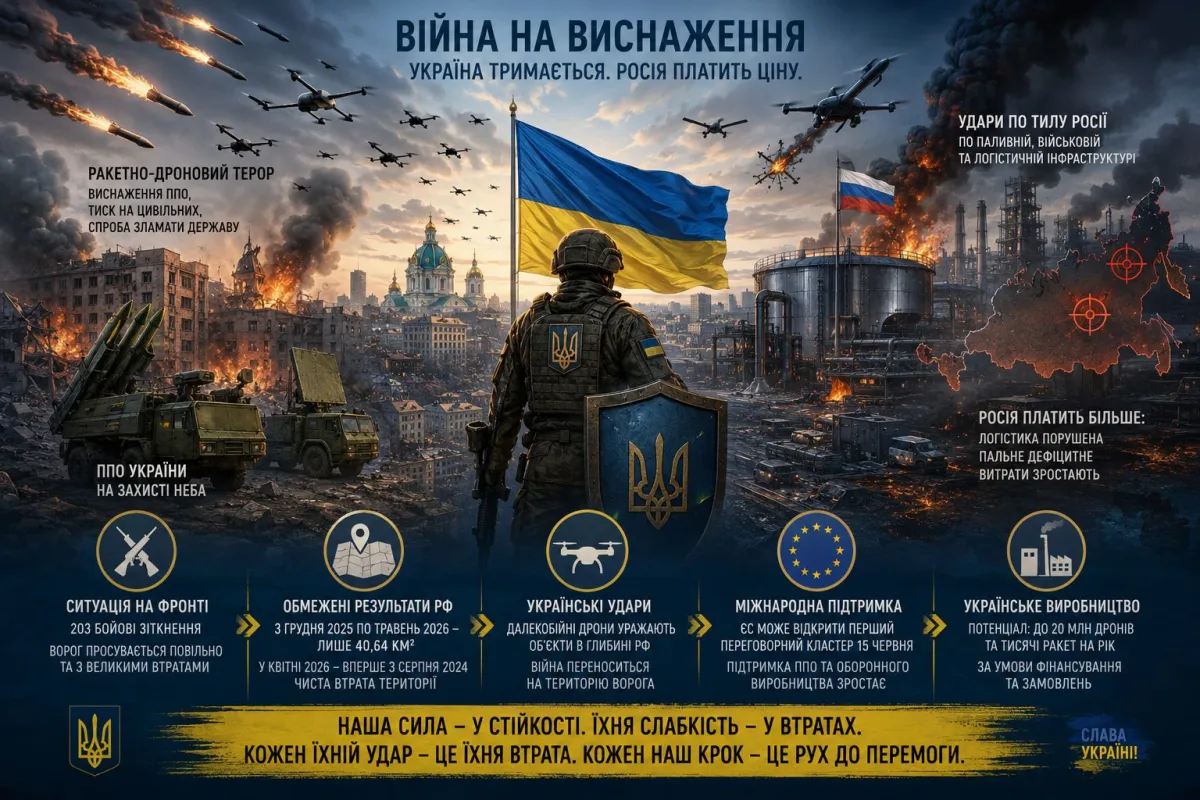
The intelligence review as of 3 June 2026 highlights several key trends: intense missile and drone pressure on Ukraine, limited results from the Russian offensive on the front line, the growing significance of Ukrainian strikes on Russian logistics and fuel infrastructure, as well as a gradual shift in the international focus towards long-term support for Ukrainian defence production.
The main event of the day was one of Russia’s largest combined strikes on Ukraine. According to Ukrainian sources, Russia deployed 73 missiles and 656 drones. Ukrainian air defences destroyed a significant proportion of the targets, but over 30 missiles reached their targets, including in civilian areas. At least 22 deaths and dozens of injuries were reported.
This strike cannot be viewed merely as an act of terror or revenge. Its logic is much broader. Russia is attempting simultaneously to wear down Ukraine’s air defence system, exert psychological pressure on the civilian population, hamper the work of the defence industry, and create a perception in the West of a ‘costly war with no quick result’. That is precisely why it is important not to give in to emotions, but to see the enemy’s strategic intent.
The situation on the front line remains difficult, but does not support the Russian narrative of an “inevitable advance”. The report notes 203 combat engagements over the past 24 hours, with intensive use of guided aerial bombs, artillery and drones. The most active sectors remain Pokrovsk, Huliaipole, Lyman, Sloviansk and Kostiantynivka.
At the same time, the Institute for the Study of War (ISW) estimates that between December 2025 and May 2026, Russian forces were able to capture or infiltrate approximately 40.64 square kilometres of territory. However, in April 2026, Russia suffered a net loss of controlled territory in the Ukrainian theatre of operations for the first time since August 2024. This does not mean that the threat has disappeared. However, it indicates that Russian offensive efforts remain extremely costly, slow and limited in their results.
Ukrainian strikes on Russian fuel, military and logistical infrastructure remain a separate important trend. Reuters reports on strikes by Ukrainian drones on an oil terminal and a military facility in the St Petersburg and Kronstadt area on 3 June. This indicates that Ukraine is gradually shifting the war into the operational and strategic depth of the Russian Federation, imposing ever-increasing costs on Moscow for the defence of its own rear.
The international context also continues to evolve. The European Union may open the first negotiation chapter on the accession of Ukraine and Moldova as early as 15 June, following a shift in Budapest’s position. This is not yet a done deal, but the very possibility of such a decision indicates the weakening of one of the main political barriers to Ukraine’s European integration.
At the same time, support for Ukraine is increasingly shifting towards investment in its own defence production. The Ukrainian Ministry of Defence states that Ukrainian industry has the potential to produce up to 20 million drones a year and thousands of missiles of various types, provided there is adequate funding and the necessary orders. This statement should be viewed precisely as an assessment of production capacity, rather than as an already achieved level of production.
At the same time, a weakness of the initial review is the excessive categorical nature of certain conclusions. Statements about a “severe fuel shortage” in Russia or “unanimous global condemnation” require a more cautious approach. It would be more accurate to speak of increased pressure on Russia’s fuel infrastructure, local logistical problems, and the intensification of negotiations regarding the further strengthening of Ukraine’s air defence. Similarly, the assertion that Russia intends to strike Ukrainian missile factories is an important signal, but it should be presented as a warning to the Ukrainian leadership, rather than as a confirmed plan of action by the enemy.
One of the main cognitive risks when assessing the situation remains the desire to see every Russian strike as a sign of desperation, and every Ukrainian strike on Russian territory as a sign of a rapid turning point in the war. The reality is far more complex. Russia still has the resources to sustain a protracted war, but its offensive effectiveness is increasingly out of step with the scale of the costs incurred. Ukraine, for its part, is successfully increasing asymmetric pressure, but continues to require systematic strengthening of its air defence and missile defence systems, the development of long-range weapons, and stable funding for the defence industry.
The strategic conclusion is quite clear: the war is gradually entering a phase of a contest of endurance between state systems. Russia is attempting to break Ukraine through combined pressure on the front lines, cities, energy infrastructure and the defence industry. Ukraine is responding with a combination of defence, technological adaptation, strikes against Russian logistics and integration into the Western defence-industrial sphere.
Therefore, the main task today is not merely to repel the latest attack. The key is to ensure that every subsequent Russian strike becomes more costly, more difficult to execute and less effective for Russia.
All articles in the "Opinion" section are published in full from their original sources. The editorial team may not share the authors’ views and accepts no responsibility for their statements.