The risks associated with the policy of simplifying the recruitment of foreign workers in Ukraine
The labour shortage in Ukraine is directly linked to domestic economic and demographic trends.
Today we are witnessing an extremely dangerous trend: any attempt to initiate a professional, rational discussion regarding the threats posed by uncontrolled migration into Ukraine – the groundwork for which is being painstakingly laid by the pro-Green, non-Ukrainian authorities – is instantly met with stigmatisation, harassment and labelling. When pro-government media networks, so-called opinion leaders or fringe groups lack economic or demographic counter-arguments, they resort to the tactic of information assassination.
This aggressive reaction is not a sign of righteousness, but rather a classic weapon of those who have absolutely nothing to say in terms of figures, macroeconomics and national security. The artificial denial of the migration issue and systematic attempts to ‘silence’ uncomfortable questions demonstrate a critical lack of genuine, statesmanlike arguments. They are trying to sell us capitulation under the guise of economic salvation.
The technology of replacement
We are being forced to accept the narrative that importing foreign labour is the only way to preserve economic potential due to a shortage of workers. But let’s be frank: today there are no objective reasons for a state policy promoting migration from Third World countries.
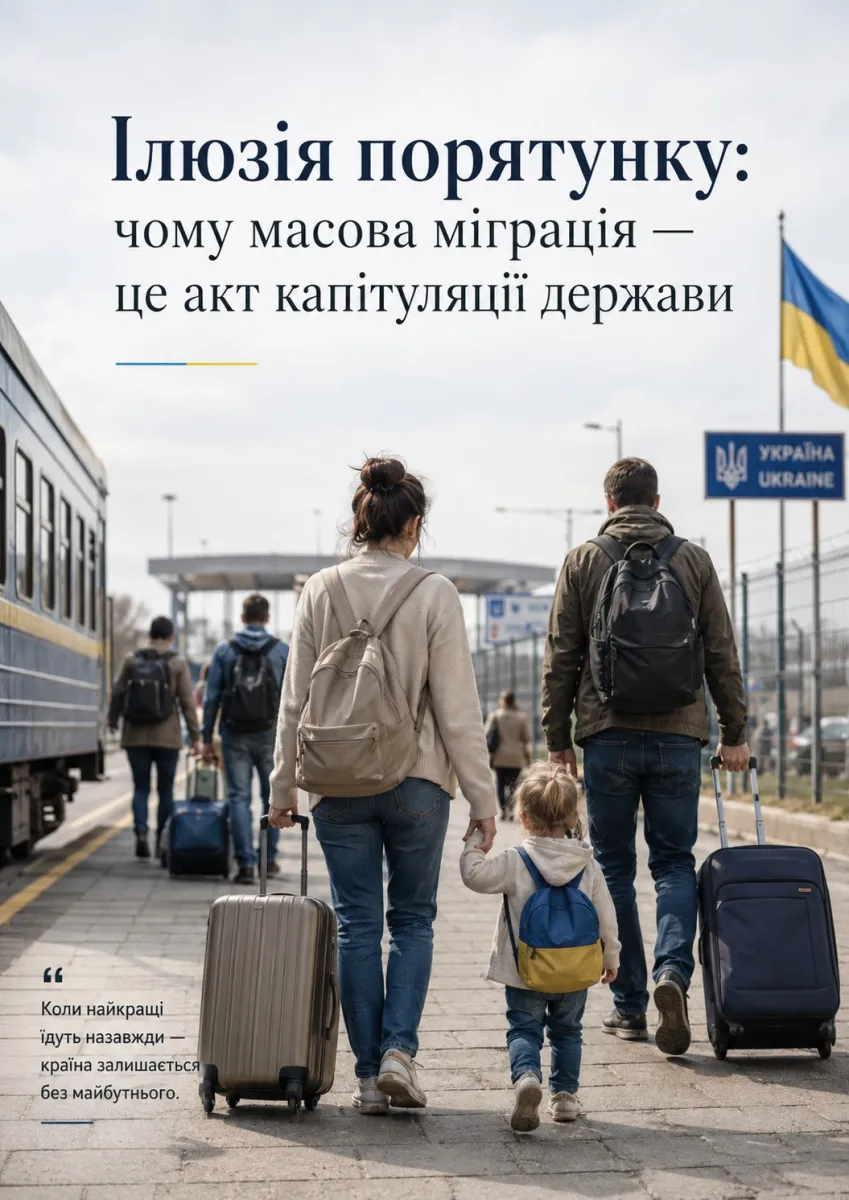
This labour shortage is not natural. It has been artificially created by a consistent, deliberate policy of driving Ukrainians out of their own country.
This process works in two stages:
Creating unbearable conditions: first, the state drives national business into a dead end. An effective tax burden on labour of 58.4% is introduced, the cost of energy and logistics skyrockets, and law enforcement agencies (the Security Service of Ukraine, etc.) switch to a regime of permanent terror against entrepreneurs. The Ukrainian middle class loses the ability to earn a living and support their families, forcing the active part of the population to emigrate en masse.
Next, to fill the vacuum created by the demographic and labour shortage, government bodies hypocritically throw up their hands: ‘We have no one to work, the economy is dying, we must bring in migrants immediately’.
This is laying the perfect groundwork for corporate feudalism. A migrant from the Third World is the ideal subject for a monopolist. They do not know the language, have no political rights, will not form an effective trade union, will not demand European working conditions, and will certainly not take to the streets to protest against corruption in government. Replacing a conscious citizen with a powerless labourer is the path to absolute control over society.
The legislative arsenal for the capitulation of Ukrainians in their own country
To understand that this is not a ‘conspiracy theory’ but a deliberate institutional policy, one need only analyse the legislative trends and draft laws that directly or indirectly undermine Ukrainian sovereignty and encourage demographic replacement:
1. The draft of the new Civil Code (No. 15150) — “The Constitution of Raiders and Looters”
This is a fundamental existential threat. The undermining of the inviolability of property rights and the introduction of provisions allowing for the easy alienation of property have catastrophic demographic consequences. A citizen whose assets and business are not protected by law loses their economic roots in their own country. This forces Ukrainians to emigrate, freeing up living and economic space for those who have no property here and are prepared to work solely for a pittance.
2. Artificial imbalance in mobilisation (Law No. 3633-IX and related acts)
The creation of a caste-like reservation system, where the state bureaucracy and grant-funded organisations receive 100% protection, whilst the real sector of the economy (engineering, manufacturing, medicine, logistics) is left bled dry. This artificially generated state-induced shortage of skilled personnel is now being exploited in the most cynical manner as the main argument for opening the borders to residents of Asian and African countries.
3. Government initiatives to abolish quotas on the employment of foreign nationals
Amendments to subordinate legislation and initiatives by the Ministry of Economy that make it as easy as possible to recruit low-skilled foreign labour. Instead of implementing retraining programmes for their own citizens and veterans, or encouraging Ukrainians to return from Europe through tax incentives, the relevant authorities are lobbying on behalf of large cartels. This amounts to outright wage dumping in the domestic market, which is effectively destroying Ukrainians’ purchasing power.
4. Risks of multiple citizenship
Although the idea is presented as a unifying force for the Ukrainian diaspora, in the absence of strict institutional safeguards, this instrument, combined with the liberalisation of the labour market, risks becoming a mechanism for legalising hundreds of thousands of economic migrants. This is a path towards the accelerated granting of political rights to them and the ability to influence elections in Ukraine.
Beneficiaries of destruction
The main lobbyists for bringing in migrants are not the mythical ‘Ukrainian economy’, but very specific quasi-monopolies: construction cartels, agricultural holdings and logistics giants. They are unwilling to invest part of their super-profits in production automation, modern technologies and increasing the wage bill. It is far easier and more profitable for them to lobby for the opening of borders to cheap labour, thereby perpetuating the country’s technological backwardness.
What would I do? A genuine sovereign policy
A genuine, sovereign state policy does not seek easy solutions at the expense of eroding its own society. It must be based on two unshakeable priorities that form the foundation of national survival:
Stimulating the domestic economy and creating conditions under which domestic micro, small and medium-sized enterprises (SMEs) will find it profitable to remain in the country, scale up and pay competitive wages to their own citizens. The economy develops through innovation, reduced tax burdens and the protection of property rights, not through the importation of unaccountable resources from abroad.
True development requires investment in our own families, a safe environment and strong national institutions. Instead, the open-door paradigm proposes that we fund the social and cultural integration of foreigners, diverting colossal resources away from safeguarding our own demographic potential.
In short: replacing one’s own population with an imported resource is by no means a way to save the economy. It is a public admission by the state of its own institutional inability to protect national business and a deliberate surrender of Ukraine’s demographic and cultural sovereignty.
Those who today most aggressively attack the voices of reason, label them ‘agents’ and promote a neoliberal agenda of replacement, are in fact not defending Ukraine. They are defending their right to continue exploiting the economy with impunity under a neo-feudal regime, bearing absolutely no responsibility for its future or that of our nation.
All articles in the "Opinion" section are published in full from their original sources. The editorial team may not share the authors’ views and accepts no responsibility for their statements.