Drone attack: what happened in Poland and what could be the consequences

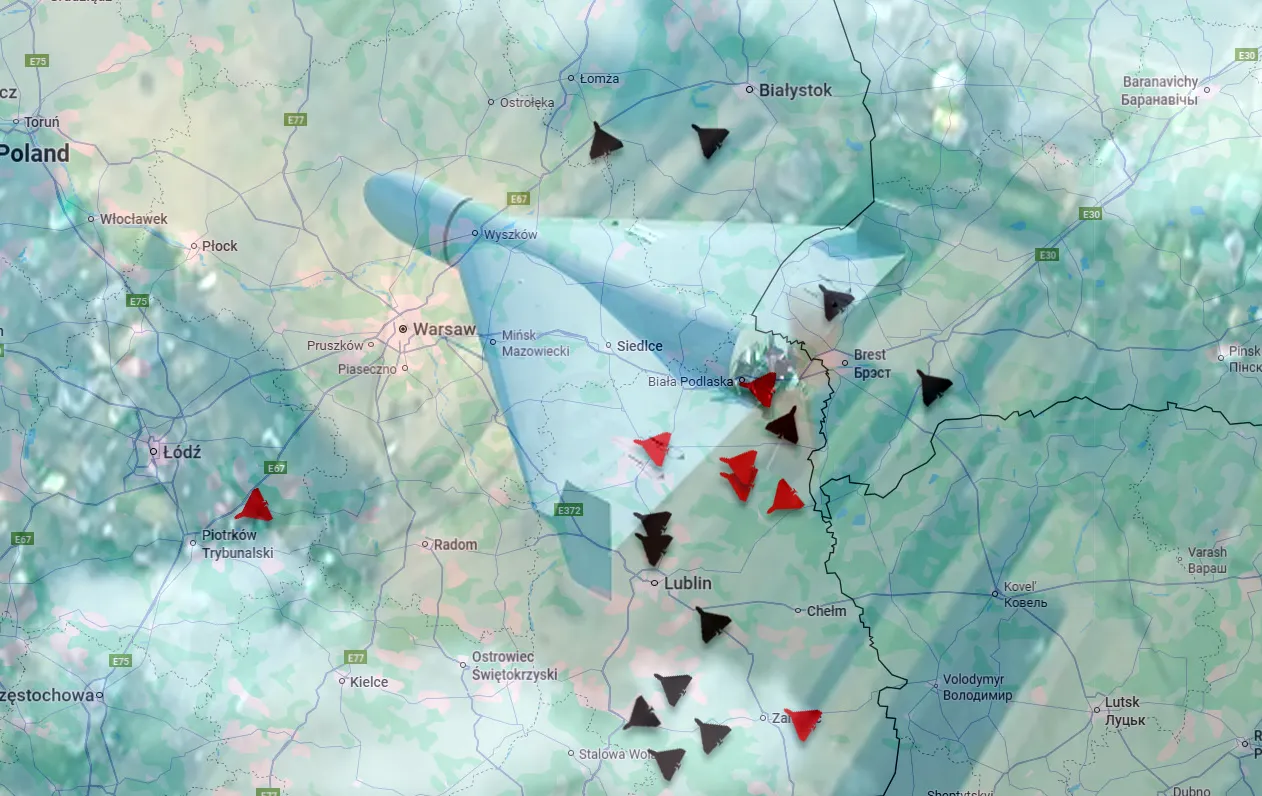
Unquestionably, the leader in yesterday's informational agenda was the news about Russian drones flying into Polish territory. Moreover, the initial information that appeared early in the morning was repeatedly supplemented and commented on at the highest level.
What was it?
On the night of September 10, during a massive Russian attack on Ukraine, Poland closed the airports "Jeshov-Yasenka", "Lublin", and two airports in Warsaw due to "unplanned military activity".
In the night (Kyiv time), Republican congressman and member of the U.S. House Armed Services Committee Joe Wilson stated: "Russia is attacking NATO ally Poland with Iranian Shahed drones less than a week after President Trump hosted President Navrotsky at the White House. This is an act of war, and we thank NATO allies for their swift response to Putin's prolonged unprovoked aggression against free and hardworking peoples".
Early in the morning, the Polish Armed Forces Operational Command officially confirmed the violation of the country's airspace and called on people to stay at home and complete military operations.
Later, Polish military officials stated that the Polish airspace was specifically violated by Russian drones and called it an act of aggression: "As a result of today's attack by the Russian Federation on Ukrainian territory, an unprecedented violation of Polish airspace by drone-type objects occurred. This is an act of aggression that poses a real threat to the safety of our citizens".
Subsequently, high-ranking Polish politicians—President, Prime Minister Donald Tusk, who convened an emergency government meeting, and Defense Minister—stated that more than a dozen Russian unmanned aerial vehicles violated the country's border. According to him, the drones that could pose a threat were shot down.
Prime Minister Tusk stated that "there is no reason to panic": "Life will continue normally. We will inform citizens about all events. There is no need to impose restrictions that would complicate citizens' daily lives".
Regarding the number of drones that entered Poland and were shot down, the figures kept changing. By 9 p.m., it was known that debris from 15 Russian drones had been found on Polish territory.
NATO Reaction
NATO does not consider the intrusion of Russian drones into Polish territory that night as an attack on an Alliance member state. This was reported by Reuters, citing a NATO source. According to the agency's interlocutor, preliminary data indicate that "the incident in Poland was a deliberate intrusion of Russian drones".
Despite this, the interlocutor added, "NATO does not consider the intrusion of Russian drones into Polish territory as an attack".
During a speech in the Sejm, Prime Minister Donald Tusk announced that the country is turning to NATO allies for consultations under Article 4 of the North Atlantic Treaty following the intrusion of Russian drones.
Article 4 of the North Atlantic Treaty provides that member states conduct joint consultations when they believe that the territorial integrity, political independence, or security of any of the parties is threatened.
As the Prime Minister added, Article 4 is just the beginning. "We expect much greater support during consultations. This is a confrontation that Russia has declared to the entire free world," he noted.
Tusk also stated that "there are currently no grounds to claim that we are at war". "But there is no doubt that this provocation is infinitely more dangerous for Poland than previous ones," he added. Tusk reported that this is the first case where drones violating Polish airspace flew directly from Belarus.
NATO Secretary General Mark Rutte said that the full assessment of the incident with Russian drones in Poland is still ongoing. He was asked directly whether there is an initial assessment of Russia's intentions—whether it was a deliberate attack, an intentional invasion, or a mistake.
"The full assessment is ongoing. But, of course, regardless of whether it was intentional or not, it is absolutely irresponsible. It is extremely dangerous. But, as I said, the full assessment continues," Rutte responded.
NATO Secretary General assessed the actions of allies in response to the Russian drone attack on Poland as a "successful" effort to ensure the defense of an Alliance member state.
Rutte reported that several allies participated in the response operation to the drone invasion, including Dutch F-16s, Polish F-16s, Italian AWACS, NATO multirole tanker aircraft, and German Patriot systems.
Despite the scale of the incident, NATO's reaction was indeed quite restrained, as reflected in Zelensky's statement: "Ukraine offered Poland the necessary assistance in countering. No one can guarantee that there won't be hundreds [of drones], if there are already dozens. Only joint European forces can provide protection. We are ready to help with technology, crew training, and intelligence. Unfortunately, at the moment, Russia has not received a firm reaction from global leaders—reactions through actions. There are more than enough declarations, but actions are still lacking".
What could be the consequences?
Regarding the consequences of the drone raid, the first thing to note is the obvious. NATO does not fully understand how to combat such attacks. It is clear that modern warfare has become drone warfare. And this is a reality that Europeans have not yet fully realized. Or if they have, they have not developed counterattack algorithms. To repel an attack of up to twenty drones, forces were involved that Ukraine can only dream of.
The drones that entered Polish territory on the night of September 10 were shot down by F-35 fighters of the Royal Netherlands Air Force in conjunction with F-16 fighters of the Polish Air Force. An Italian Gulfstream G550 CAEW AWACS aircraft and an unnamed aerial refueling aircraft were also airborne. Drone movements were monitored using Patriot radar systems.
Media also report that the cost of one Shahed UAV is approximately $10,000, and to destroy it, fighters used AIM-9X (unit cost is approximately $400,000). It becomes clear that the "cost of the issue" in responding to the threat is disproportionate to the resources spent on the attack itself. And this becomes a problem. If we imagine the number of drones arriving in Ukraine in just a month, NATO's response mode would exhaust its supplies very quickly.
Regarding the consequences of the drone attack, NATO will be forced to consider an effective system for protecting its borders, creating new units or branches of the military to respond to such threats routinely.
At the same time, the issue of economic feasibility will come to the forefront—constantly shooting down decoy drones made of foam with expensive missiles is not something NATO can afford.
But the paradox of the situation may lie in the fact that while NATO is creating an effective and accessible system for combating drones, the UAVs themselves will become more and more advanced—they will be equipped with artificial intelligence, learn to bypass air defense in real-time. And so, a new wave of high-tech arms race awaits us.
And another consequence of the night attack. Surprisingly, the main "beneficiary" of this extraordinary event could be the affected Poland. It is obvious that NATO will begin to strengthen its eastern flank, and for some time, Poland will become the primary recipient of military and financial aid.
On the evening of September 10, Polish Minister of National Defense, Vladyslav Koshyniak-Kamisz, announced that additional aid from NATO countries had been received.
"I just received information from the Swedish Minister of Defense about the urgent dispatch of further support to Poland—including air defense systems and aircraft. We are in constant contact with our allies. The Netherlands will supply multi-layered defense systems—Patriot, NASAMS, drone countermeasures—and 300 soldiers. The Czech Republic, the UK, France, Germany, Italy, Finland, and the Baltic countries—all allies are ready to provide support and make specific statements," the minister reported.
But such a situation carries certain risks for Ukraine—Europe may focus on funding its own defense rather than Ukraine's. This opinion was expressed by Ukrainian public relations expert Yaroslav Beskrestonov (Flesh).
"Europe will probably now focus on its own defense, not ours. And the money will go there. Maybe this was Russia's plan," Flesh stated.